Representative Aaron Thomas Bliss
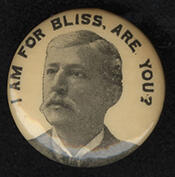
Here you will find contact information for Representative Aaron Thomas Bliss, including email address, phone number, and mailing address.
| Name | Aaron Thomas Bliss |
| Position | Representative |
| State | Michigan |
| District | 8 |
| Party | Republican |
| Status | Former Representative |
| Term Start | December 2, 1889 |
| Term End | March 3, 1891 |
| Terms Served | 1 |
| Born | May 22, 1837 |
| Gender | Male |
| Bioguide ID | B000557 |
About Representative Aaron Thomas Bliss
Aaron Thomas Bliss (May 22, 1837 – September 16, 1906) was an American politician, businessman, and Civil War veteran who served one term as a United States Representative from Michigan and later as the twenty-fifth governor of Michigan. A member of the Republican Party and a prominent resident of Saginaw, he played a significant role in the political and economic development of his region. Bliss Township in Michigan was named in his honor, reflecting his influence in the state.
Bliss was born to Lyman and Anna M. (Chaffee) Bliss in Peterboro, Madison County, New York. He attended the common schools and, as a young man, began working to finance his own education. In 1853 and 1854 he was employed as a clerk in a store in Morrisville, New York, earning $100, which he used to attend a select school in Munnsville, New York, in 1854. The following year he moved to Bouckville, also in Madison County, where he engaged in mercantile pursuits. These early experiences in commerce and self-support laid the groundwork for his later success in business and public life.
During the American Civil War, Bliss enlisted as a private in the Peterman Guards of the Tenth New York Volunteer Cavalry on October 1, 1861, and reported for duty at Elmira, New York. He advanced quickly to the rank of lieutenant, and his regiment became part of Kilpatrick’s Brigade, joining the Army of the Potomac. Bliss commanded a squadron from Washington, D.C., during the Second Battle of Bull Run and was promoted to captain. He saw extensive combat, participating in the battles of Fredericksburg, the Wilderness, Petersburg, Ground Squirrel Church, Stony Creek, South Mountain, Falls Church, and Warrenton. During General James H. Wilson’s raid near Richmond he was captured and spent approximately six months in Confederate prisons at Andersonville, Georgia; Charleston, South Carolina; Macon, Georgia; and Columbia, South Carolina. On November 29, 1864, like Hazen S. Pingree, who would later precede him as governor of Michigan, Bliss escaped from a Confederate prison. He then walked for nearly three weeks before reaching General William T. Sherman’s army at Savannah, Georgia, just two days before the city’s evacuation. He soon rejoined his own command at Petersburg, Virginia, where he remained until the end of the war.
In December 1865, Bliss moved to Saginaw, Michigan, where he entered the lumber industry, initially working in a shingle mill. Together with his brother, Lyman W. Bliss, and J. H. Jerome, he formed A. T. Bliss & Company and engaged in the manufacture of lumber and the development of timber lands along the Tobacco River. On March 31, 1868, he married Allaseba Morey Phelps of Solsville, New York, near the town of Madison. That same spring, the Bliss brothers purchased the Jerome mill at Zilwaukee, Michigan, which they operated under the name A. T. Bliss & Brother. Over time, Bliss became a leading figure in Saginaw’s financial community. In 1880 he was one of the organizers and a director of the Citizen’s National Bank, which was later reorganized as the Bank of Saginaw, and he served as president and director of the Saginaw County Savings Bank.
Bliss’s political career began at the state level. In 1882 he was elected to the Michigan Senate from Saginaw County’s 25th district. During his tenure in the Senate he was instrumental in helping to establish a soldiers’ home in Grand Rapids, reflecting his continuing concern for veterans’ welfare. He was appointed aide-de-camp on the staff of Governor Russell A. Alger in 1885, with the rank of colonel, and in 1888 he held the same position on the staff of the commander in chief of the Grand Army of the Republic. These roles strengthened his standing in Republican circles and among Civil War veterans.
In 1888, Bliss was elected as a Republican from Michigan’s 8th congressional district to the Fifty-first Congress, serving in the United States House of Representatives from March 4, 1889, to March 3, 1891. His service in Congress occurred during a significant period in American history, and he participated in the legislative process on behalf of his constituents. Among the notable bills he introduced were measures appropriating $100,000 for the construction of a federal building in Saginaw and $25,000 for an Indian school at Mount Pleasant, reflecting his attention to both local infrastructure and Native American education. He was an unsuccessful candidate for reelection in 1890 to the Fifty-second Congress, losing to Democrat Henry M. Youmans, and thus concluded one term in federal office.
After leaving Congress, Bliss returned to Saginaw and resumed his activities in the lumber business and banking, continuing to be a significant figure in the city’s commercial life. He also remained active in veterans’ affairs and in 1897 served as department commander of the Grand Army of the Republic in Michigan. His prominence in state politics and his long record of public and military service positioned him for higher office at the turn of the century.
In 1900, Bliss was elected governor of Michigan, defeating William C. Maybury, the mayor of Detroit, and he was reelected in 1902, serving as the state’s twenty-fifth governor from 1901 through 1904. During his four years in office, the Michigan Employment Institution for the Adult Blind was established in Saginaw, demonstrating his interest in social welfare and services for the disabled. His administration also oversaw the formation of a state highway department, an important step in the development of Michigan’s transportation infrastructure, and the sanctioning of railroad taxation, which addressed issues of corporate regulation and state revenue.
In his later years, Bliss was known as a patron of various civic and religious institutions. He supported the Home for the Friendless, the Young Men’s Christian Association (Y.M.C.A.), and the Methodist Church, and he was a member of the Freemasons and the Knights Templar. Bliss died less than two years after leaving the governorship, on September 16, 1906, in Milwaukee, Wisconsin, where he had gone for medical treatment. He was sixty-nine years old at the time of his death and was interred in Forest Lawn Cemetery in Saginaw, Michigan, leaving a legacy as a soldier, businessman, legislator, and governor whose name endures in the geography and institutions of Michigan.