Representative Aaron Venable Brown
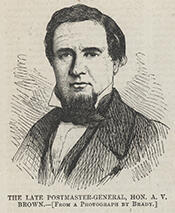
Here you will find contact information for Representative Aaron Venable Brown, including email address, phone number, and mailing address.
| Name | Aaron Venable Brown |
| Position | Representative |
| State | Tennessee |
| District | 6 |
| Party | Democratic |
| Status | Former Representative |
| Term Start | December 2, 1839 |
| Term End | March 3, 1845 |
| Terms Served | 3 |
| Born | August 15, 1795 |
| Gender | Male |
| Bioguide ID | B000899 |
About Representative Aaron Venable Brown
Aaron Venable Brown (August 15, 1795 – March 8, 1859) was an American politician who served as a Representative from Tennessee in the United States Congress from 1839 to 1845, as the 11th Governor of Tennessee from 1845 to 1847, and as United States Postmaster General from 1857 until his death in 1859. A member of the Democratic Party, he was an influential figure in Tennessee and national politics during a period of expansion, sectional tension, and war, and played a notable role in shaping the state’s “Volunteer State” reputation during the Mexican–American War.
Brown was born in Brunswick County, Virginia, one of eleven children of Aaron Brown, a Methodist minister, and his wife, Elizabeth Melton Brown. During his youth the family moved southward, and he was educated at Westrayville Academy in Nash County, North Carolina. He then attended the University of North Carolina at Chapel Hill, from which he graduated in 1814 as valedictorian of his class. After completing his formal education, Brown studied law in Nashville, Tennessee, under Judge James Trimble and was admitted to the bar in 1817. In 1818 he moved to Giles County, Tennessee, where he established a law practice and formed a partnership with James K. Polk, the future President of the United States, beginning a long political and personal association.
Brown’s political career in Tennessee began in the state legislature. He served in the Tennessee Senate from 1821 to 1825 and again from 1827 to 1829, participating in the formative years of the state’s political development. He later served two terms in the Tennessee House of Representatives from 1831 to 1835, further consolidating his standing as a Democratic leader. During these years he also developed business interests and remained active in the legal profession, building a reputation that would support his eventual rise to national office.
In 1839 Brown was elected as a Democrat to the United States House of Representatives, defeating incumbent Ebenezer J. Shields for Tennessee’s 10th Congressional District seat. He was reelected to represent the 10th District in 1841, and following redistricting in 1843 he won election to a third term from Tennessee’s 6th Congressional District, serving continuously in the House from March 4, 1839, to March 3, 1845. During his three terms in Congress he participated in the legislative process at a time of intense debate over territorial expansion and slavery, and he actively lobbied for the annexation of Texas in 1843. As a member of the House of Representatives, Brown represented the interests of his Tennessee constituents while aligning closely with the Democratic policies of expansion and states’ rights that characterized the era.
After initially intending to retire from public life at the close of his third congressional term to focus on his business affairs, Brown accepted the Democratic nomination for governor of Tennessee in 1845. The incumbent Whig governor, James C. Jones, declined to seek reelection, and the Whigs nominated U.S. Senator Ephraim H. Foster. In a closely contested race, Brown lost in East Tennessee and West Tennessee, regions that tended to favor Whig candidates, but he secured a decisive margin in the more populous Middle Tennessee. He ultimately won the governorship by approximately 1,400 votes out of about 115,000 cast and served as the state’s 11th governor from 1845 to 1847.
Brown’s gubernatorial tenure coincided with the Mexican–American War, which began during the presidency of his friend and former law partner, James K. Polk. Responding to federal calls for troops, Brown issued a statewide call for 2,800 volunteer soldiers from Tennessee. The response was overwhelming: more than 30,000 Tennesseans volunteered, far exceeding the quota and reinforcing Tennessee’s longstanding reputation as the “Volunteer State,” a designation first widely noted during the War of 1812. Although the war was initially popular, public enthusiasm waned as the conflict continued, and Brown’s support for the war effort contributed to his defeat in his 1847 reelection bid by Whig candidate Neill S. Brown, to whom he was not related. Brown was a slaveholder, and his political positions reflected the perspective of a Southern Democrat in a slaveholding state.
Following his governorship, Brown remained active in regional and national politics, particularly on issues related to slavery and sectional compromise. In 1850 he served as a delegate to the Nashville Convention, a gathering of representatives from slaveholding states convened to consider possible responses should the federal government move to restrict or abolish slavery in the territories. At the convention, Brown and his brother-in-law, General Gideon J. Pillow, coauthored a resolution urging support for the Compromise of 1850 as a means of preserving the Union and defusing sectional tensions. Although their resolution was voted down, the convention ultimately stepped back from immediate secessionist measures, at least temporarily postponing more radical action. Brown later served as a delegate to the Democratic National Convention in 1852, where Franklin Pierce and William R. King were nominated for president and vice president, and in 1854 he delivered an address to the literary societies of the University of North Carolina, reflecting his continuing engagement with public affairs and education.
Brown remained a significant figure in Democratic Party politics through the 1850s. He attended the 1856 Democratic National Convention, where he was mentioned as a possible nominee for vice president, underscoring his national prominence within the party. In 1857 President James Buchanan appointed him United States Postmaster General. In this cabinet post, which he held from 1857 until his death in 1859, Brown oversaw the nation’s postal system during a period of rapid growth, westward expansion, and increasing sectional strain, managing an essential federal service at a time when communication across an expanding republic was of growing strategic importance.
In his personal life, Brown married Sarah Burrus at an undetermined date, and the couple had six children. After her death, he married Cynthia Pillow Sanders, the sister of Gideon J. Pillow and the widow of John W. Sanders; they had one son together. Through this second marriage, Brown was connected to one of Tennessee’s prominent military and political families. His legacy in Tennessee politics extended beyond his own lifetime: his great-grandson Hill McAlister later served as Governor of Tennessee in the 1930s. Brown’s public service was further commemorated when a revenue cutter of the United States Revenue Cutter Service was named USS Aaron V. Brown in his honor.
Aaron Venable Brown died in office as Postmaster General on March 8, 1859. He was interred at Mount Olivet Cemetery in Nashville, Tennessee, a burial place for many of the state’s leading political figures. His career, spanning state and federal legislative service, the governorship, and a cabinet post, placed him at the center of many of the major political issues confronting the United States in the antebellum period.