Senator Aaron Burr
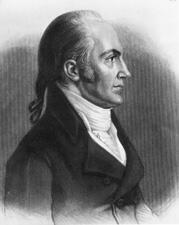
Here you will find contact information for Senator Aaron Burr, including email address, phone number, and mailing address.
| Name | Aaron Burr |
| Position | Senator |
| State | New York |
| Party | Republican |
| Status | Former Representative |
| Term Start | October 24, 1791 |
| Term End | March 3, 1797 |
| Terms Served | 1 |
| Born | February 6, 1756 |
| Gender | Male |
| Bioguide ID | B001133 |
About Senator Aaron Burr
Aaron Burr served as a Senator from New York in the United States Congress from 1791 to 1797. A member of the Republican Party, Aaron Burr contributed to the legislative process during 1 term in office.
Aaron Burr’s service in Congress occurred during a significant period in American history. As a member of the Senate, Aaron Burr participated in the democratic process and represented the interests of constituents.
Aaron Burr, Jr. (February 6, 1756 – September 14, 1836) was an American politician, businessman, and lawyer who served as the third vice president of the United States from 1801 to 1805, during Thomas Jefferson’s first presidential term. A member of the Democratic-Republican Party, he is primarily remembered for the killing of Alexander Hamilton in a duel, as well as his alleged conspiracy to take parts of the United States or the Spanish Empire to form an independent country. Burr was born to a prominent family in what was then the Province of New Jersey. After studying theology at Princeton University, he began his career as a lawyer before joining the Continental Army as an officer in the American Revolutionary War in 1775. After leaving military service in 1779, Burr practiced law in New York City, where he became a leading politician and helped form the new Jeffersonian Democratic-Republican Party. In 1791, Burr was elected to the United States Senate, where he served until 1797. He later ran in the 1800 presidential election. An Electoral College tie between Burr and Thomas Jefferson resulted in the U.S. House of Representatives voting in Jefferson’s favor, with Burr becoming Jefferson’s vice president due to receiving the second-highest share of the votes. Although Burr maintained that he supported Jefferson, the president was somewhat at odds with Burr, who was relegated to the sidelines of the administration during his vice presidency and was not selected as Jefferson’s running mate in 1804 after the ratification of the 12th Amendment to the U.S. Constitution. Burr traveled west to the American frontier, seeking new economic and political opportunities. His secretive activities led to his 1807 arrest in Alabama on charges of treason. He was brought to trial more than once for what became known as the Burr conspiracy, an alleged plot to create an independent country led by Burr, but was acquitted each time. For a short period of time, Burr left the United States to live in Europe. He returned in 1812 and resumed practicing law in New York City. He died of a stroke on September 14, 1836, at the age of 80.