Representative Aaron Harding
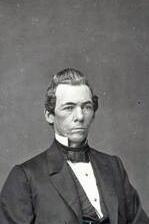
Here you will find contact information for Representative Aaron Harding, including email address, phone number, and mailing address.
| Name | Aaron Harding |
| Position | Representative |
| State | Kentucky |
| District | 4 |
| Party | Democratic |
| Status | Former Representative |
| Term Start | July 4, 1861 |
| Term End | March 3, 1867 |
| Terms Served | 3 |
| Born | February 20, 1805 |
| Gender | Male |
| Bioguide ID | H000187 |
About Representative Aaron Harding
Aaron Harding (February 20, 1805 – December 24, 1875), also known in some records as Aaron Hardin, was a nineteenth-century lawyer, state legislator, and United States Representative from Kentucky, as well as a slaveholder. He was born near Campbellsville, in what was then Green County, Kentucky (the area later becoming part of Taylor County), where he attended local rural schools. In his youth he pursued a course of self-education, becoming familiar with the classical languages and literature, an intellectual foundation that supported his later legal and political career. On October 22, 1834, he married Margaret Campbell (November 28, 1818 – February 19, 1858), the niece of Andrew Campbell, the founder of Campbellsville, thereby aligning himself with one of the region’s prominent early families.
Harding studied law in Kentucky and was admitted to the bar in 1833. He commenced the practice of law in Greensburg, the county seat of Green County, where he quickly established himself as a capable attorney. That same year, 1833, he was elected prosecuting attorney of Green County, a position that placed him at the center of local legal affairs and gave him early experience in public office. His legal practice and prosecutorial work in Greensburg helped build his reputation across the region and laid the groundwork for his subsequent entry into state and national politics.
By 1840, Harding had advanced to legislative service in the Kentucky House of Representatives. As a member of the state legislature, he participated in the political life of Kentucky during a period marked by debates over internal improvements, banking, and the evolving sectional tensions that would later culminate in the Civil War. His tenure in the Kentucky House of Representatives in 1840 further enhanced his public profile and connected him with leading figures in the state’s political establishment. Throughout these years he continued to practice law, maintaining his professional base while expanding his influence in public affairs.
Harding’s national career began with his election to the U.S. House of Representatives as a Unionist from Kentucky at the outbreak of the Civil War. He was elected to the Thirty-seventh and Thirty-eighth Congresses and served from March 4, 1861, to March 3, 1865, as a representative of the Unionist Party, which in Kentucky drew support from those who opposed secession while often maintaining conservative views on slavery and states’ rights. During these terms he served in Congress while Kentucky remained a border state loyal to the Union but deeply divided internally, and his position as a slaveholder reflected the complex loyalties and contradictions of many Unionist politicians from the border states.
In 1864 Harding was reelected as a Democrat to the Thirty-ninth Congress, continuing his service from March 4, 1865, to March 3, 1867. His shift in party designation from Unionist to Democrat was consistent with broader realignments in Kentucky politics as the Civil War ended and Reconstruction began. During the Thirty-ninth Congress, he served at a time when Congress grappled with the restoration of the former Confederate states, the status of formerly enslaved people, and the shape of postwar constitutional amendments. In 1866 he was a delegate to the Union National Convention in Philadelphia, a gathering that brought together moderate and conservative elements seeking to support President Andrew Johnson’s lenient Reconstruction policies and to oppose the more radical measures favored by many in the Republican majority in Congress.
After leaving Congress on March 3, 1867, Harding returned to private life and resumed the practice of law, this time in Danville, Kentucky, an important educational and legal center in the state. From his Danville practice he continued to be regarded as an experienced attorney and former congressman, though he no longer held major public office. His later years were spent in the legal profession and in the quieter pursuits of private life following a long career in public service that had spanned the antebellum, Civil War, and early Reconstruction eras.
Aaron Harding died in Georgetown, Kentucky, on December 24, 1875. He was interred in Georgetown Cemetery in that city. His life and career, rooted in rural Green County and extending to the halls of Congress during one of the most turbulent periods in American history, reflected the perspectives of a Kentucky Unionist slaveholder navigating the profound political and social transformations of the mid-nineteenth century.