Representative Aaron Shenk Kreider
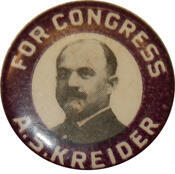
Here you will find contact information for Representative Aaron Shenk Kreider, including email address, phone number, and mailing address.
| Name | Aaron Shenk Kreider |
| Position | Representative |
| State | Pennsylvania |
| District | 18 |
| Party | Republican |
| Status | Former Representative |
| Term Start | April 7, 1913 |
| Term End | March 3, 1923 |
| Terms Served | 5 |
| Born | June 26, 1863 |
| Gender | Male |
| Bioguide ID | K000327 |
About Representative Aaron Shenk Kreider
Aaron Shenk Kreider (June 26, 1863 – May 19, 1929) was a Republican member of the U.S. House of Representatives from Pennsylvania who served five consecutive terms in Congress from 1913 to 1923. Born on a farm in South Annville Township, Lebanon County, Pennsylvania, he grew up in a rural environment that would shape his later interests in agriculture, commerce, and local development. His early life in this farming community provided firsthand experience with the economic and social concerns of small-town and agricultural constituencies that he would later represent in public office.
Kreider pursued his education locally, attending Lebanon Valley College in Annville, Pennsylvania, an institution with which he would remain closely associated throughout his life. He then undertook business studies and graduated from Allentown Business College in 1880. This combination of liberal and commercial education equipped him with the skills necessary for a career that blended entrepreneurship, manufacturing, finance, and politics, and it laid the groundwork for his later leadership roles in both industry and public service.
In 1880, shortly after completing his business education, Kreider moved to Fulton, Missouri, where he engaged in agricultural pursuits and was employed as a clerk in a store. After several years in the Midwest, he returned to Pennsylvania and entered mercantile pursuits in Campbelltown in 1884 and in Roseland in 1885. Demonstrating a strong entrepreneurial spirit, he established the town of Lawn in Lebanon County in 1886. Over the following years he expanded his business interests, engaging in agricultural pursuits as well as the grain and coal business. He moved to Palmyra, Pennsylvania, in 1893 and shortly thereafter to Annville, where he became increasingly involved in shoe manufacturing and banking, sectors in which he would gain national prominence.
Kreider’s prominence in local affairs grew alongside his business success. In Annville he served as commissioner and chairman of the Board of Commissioners from 1909 to 1912, playing a leading role in municipal governance and local administration. He was a delegate to the Republican State Convention in 1910, reflecting his rising stature within the Republican Party in Pennsylvania. In the private sector, he became a leading figure in the footwear industry, serving as president of the National Association of Shoe Manufacturers of the United States from 1913 to 1916, a position that underscored his influence in national manufacturing and trade circles and paralleled the early years of his congressional career.
Kreider was elected as a Republican to the Sixty-third Congress and to the four succeeding Congresses, serving in the U.S. House of Representatives from March 4, 1913, to March 3, 1923. His decade in Congress coincided with a significant period in American history, encompassing the Progressive Era, World War I, and the early postwar years. As a member of the House of Representatives, Aaron Shenk Kreider participated in the democratic process and represented the interests of his Pennsylvania constituents, contributing to the legislative process during his five terms in office. During the Sixty-sixth and Sixty-seventh Congresses he served as chairman of the United States House Committee on Expenditures in the Department of the Interior, where he exercised oversight over federal spending and administration in that department. A loyal member of the Republican Party, he aligned with its policies of the period while attending to the economic and infrastructural concerns of his district. He was an unsuccessful candidate for reelection in 1922, bringing his congressional service to a close in March 1923.
After leaving Congress, Kreider resumed his former manufacturing pursuits, returning to the business activities in which he had long been engaged. He also deepened his involvement with higher education, serving as president of the board of trustees of Lebanon Valley College in Annville, thereby continuing a relationship with his alma mater that stretched back to his youth. In his later years he remained a prominent figure in Annville’s civic and economic life, combining his experience in business, banking, and public affairs to support local institutions and community development.
Kreider’s personal and family life in Annville was closely associated with Hill Farm Estate, a large Federal-style mansion he built as his private home in 1919. Constructed on 26 acres less than a mile north of Lebanon Valley College on Route 934 in Annville, the residence was designed as a spacious and comfortable home, set in a quiet, scenic country setting with trees, gardens, benches, and walkways high on a hill overlooking the Annville community. The house and grounds reflected his status as a successful manufacturer, banker, and public official and became a local landmark in Lebanon County.
Aaron Shenk Kreider died in Annville, Pennsylvania, on May 19, 1929. In the decades after his death, his former home continued to play a role in the community. The mansion, known as Hill Farm Estate, was restored in 1982, when a wing was added and the property was converted into an assisted living residence offering a homelike setting for retired individuals. In 2002 an additional residence wing was added, and the home and independent-living center came to offer 46 personal-care rooms for up to 55 residents and seven independent-living Carriage House apartments. Inside the stately Federal-era mansion, a comfortable parlor and lounges, antiques, and period reproductions complemented the carefully restored architecture. The community, called Hill Farm Estate, functioned as a personal care retirement residence until 2015. In August 2024 it was bought out for $2,000,000 by entrepreneur Millard F. Wallace, extending the property’s long association with regional economic and community life that began during Kreider’s own lifetime.