Senator Aaron Augustus Sargent
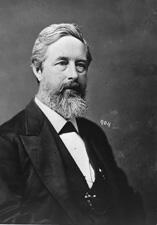
Here you will find contact information for Senator Aaron Augustus Sargent, including email address, phone number, and mailing address.
| Name | Aaron Augustus Sargent |
| Position | Senator |
| State | California |
| Party | Republican |
| Status | Former Representative |
| Term Start | July 4, 1861 |
| Term End | March 3, 1879 |
| Terms Served | 4 |
| Born | September 28, 1827 |
| Gender | Male |
| Bioguide ID | S000065 |
About Senator Aaron Augustus Sargent
Aaron Augustus Sargent (September 28, 1827 – August 14, 1887) was an American journalist, lawyer, politician, and diplomat who served in both houses of the United States Congress as a Republican from California. He is particularly noted for historically introducing in January 1878 the language that would later become the Nineteenth Amendment to the United States Constitution, granting women the right to vote. Because of his close association with railroad interests, he was sometimes called the “Senator for the Southern Pacific Railroad.”
Sargent was born in Newburyport, Massachusetts, where he attended the common schools before being apprenticed to a cabinetmaker. As a young man he worked as a printer in Philadelphia, Pennsylvania, gaining experience in the newspaper trade. In 1847 he moved to Washington, D.C., where he served as a secretary to a Congressman, an early exposure to national politics that would shape his later career. Drawn by the opportunities of the Gold Rush era, he moved to California in 1849 and settled in Nevada City in 1850.
In Nevada City, Sargent joined the staff of the Nevada Daily Journal and eventually became the owner of the newspaper, solidifying his standing in the community and in state politics. He studied law while working in journalism and was admitted to the California bar in 1854, beginning a legal practice in Nevada City. His public career advanced rapidly: he was elected district attorney for Nevada County in 1856 and that same year served in the California State Senate. In 1857 he was an unsuccessful candidate for the United States Senate, but his prominence within the emerging Republican Party in California continued to grow.
Sargent was elected as a Republican to the Thirty-seventh Congress, representing California in the U.S. House of Representatives. He later returned to the House after a gap in service, being reelected to the Forty-first and Forty-second Congresses. During his early congressional career, in 1861 he authored the first Pacific Railroad Act that was passed in Congress, a foundational measure in the federal effort to construct a transcontinental railroad. His service in Congress thus began during a critical period in American history marked by the Civil War and the nation’s westward expansion, and he contributed to the legislative process over multiple terms in office.
In 1871 Sargent was elected to the United States Senate from California and served from March 4, 1873, to March 3, 1879. As a member of the Senate, he participated in the democratic process and represented the interests of his constituents during a period of rapid industrial and territorial growth. He held significant committee assignments, serving as chairman of the Senate Committee on Mines and Mining during the Forty-fourth Congress and as chairman of the Senate Committee on Naval Affairs during the Forty-fifth Congress. His close ties to railroad interests, particularly the Southern Pacific Railroad, contributed to his reputation as the “Senator for the Southern Pacific Railroad.”
Sargent’s most enduring national legacy arose from his role in the woman suffrage movement. In January 1878 he introduced into the Senate the twenty-nine words that would later form the text of the Nineteenth Amendment to the Constitution, providing that the right to vote could not be denied on account of sex. Although the amendment did not pass in his lifetime and had to be reintroduced unsuccessfully each year for the next forty years, his action marked a critical early milestone in the federal campaign for women’s voting rights. His wife, Ellen Clark Sargent, was herself a leading voting rights advocate and a close associate of suffrage leaders such as Susan B. Anthony, and their partnership linked his legislative efforts to the broader national suffrage movement.
After leaving the Senate, Sargent returned to California in 1880 and resumed the practice of law in San Francisco, where he worked for approximately three years. He then entered diplomatic service as United States Ambassador to Germany, a post he held for about two years. His tenure ended after German authorities excluded American pork from the German Empire, a policy dispute that made his position personally distasteful and led to his departure from the post. He subsequently declined an appointment as Ambassador to Russia following the death of William H. Hunt and made an unsuccessful attempt to secure the Republican nomination for the U.S. Senate in 1885.
In his later years Sargent was also a prominent advocate of Chinese exclusion. He supported the Chinese Exclusion Act of 1882 and wrote in favor of exclusion and of renewing the act after its scheduled expiration in 1892, publishing arguments in the Overland Monthly and Out West Magazine, including articles on the Wyoming anti-Chinese riot in 1885 and 1886. The Chinese Exclusion Act was ultimately renewed in 1892 and again, indefinitely, in 1902, remaining in force until 1943, and Sargent’s writings and advocacy formed part of the broader political movement that sustained these policies.
Aaron Augustus Sargent died in San Francisco, California, on August 14, 1887. His original interment was at Laurel Hill Cemetery in San Francisco, which was closed by 1941. According to his descendants, Sargent’s ashes were later scattered over a placer mine he had owned in Nevada City, and a monument to him stands in the old Pioneer Cemetery in Nevada City, commemorating his long career as a journalist, lawyer, legislator, and diplomat.