Representative Aaron Vanderpoel
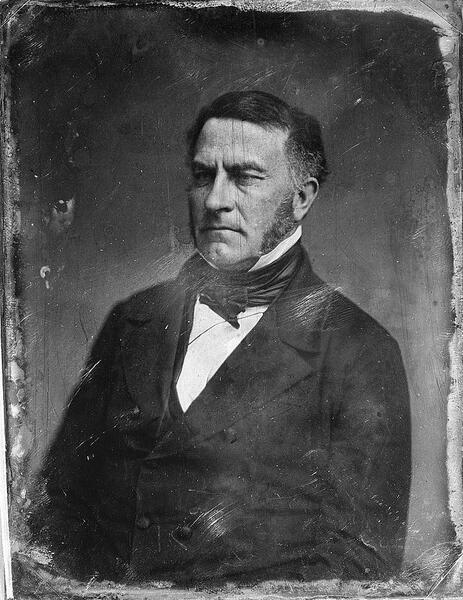
Here you will find contact information for Representative Aaron Vanderpoel, including email address, phone number, and mailing address.
| Name | Aaron Vanderpoel |
| Position | Representative |
| State | New York |
| District | 8 |
| Party | Democratic |
| Status | Former Representative |
| Term Start | December 2, 1833 |
| Term End | March 3, 1841 |
| Terms Served | 3 |
| Born | February 5, 1799 |
| Gender | Male |
| Bioguide ID | V000028 |
About Representative Aaron Vanderpoel
Aaron Vanderpoel (February 5, 1799 – July 18, 1870) was an American lawyer, jurist, and politician who served as a U.S. Representative from New York for three terms, from 1833 to 1837 and again from 1839 to 1841. A prominent Jacksonian and later Democratic figure, he was noted for his powerful speaking voice, which earned him the nickname the “Kinderhook roarer,” and he was a close friend of President Martin Van Buren.
Vanderpoel was born in Kinderhook, New York, the youngest of six children of Isaac Vanderpoel (1747–1807) and Moyca (Moyca Huyck) Vanderpoel (1758–1827). His siblings were Anne Vanderpoel (1785–1787); James Vanderpoel (1787–1843), who married Anna Doll (1782–1855) on April 7, 1808; Anne Vanderpoel (1789–1793); Elizabeth Vanderpoel (1791–1833), who married Lucas J. Van Alen on January 16, 1815; and John Vanderpoel (1796–1851), who married Sarah W. Oakley on January 14, 1823 and later became a judge of the Superior Court in Albany. Through his brother James, Vanderpoel was connected by marriage to the Van Buren family: James’s daughter, Elizabeth Vanderpoel (1814–1844), married John Van Buren (1810–1866), the second son of President Martin Van Buren. Vanderpoel and most of his siblings were educated at Kinderhook Academy and Lenox Academy, institutions that provided a classical foundation for his later legal and political career.
Vanderpoel’s family background was marked by the complex loyalties of the Revolutionary era. His maternal grandparents were Jacobus “James” Huyck of Pompaonie and Elizabeth (Van Dyck) Huyck, whose parents were Arent Van Dyck and Heyltie (Van Alen) Van Dyck. His paternal grandparents were Johannes “John” Van der Poel and Annatje Staats (née Nautje). On October 20, 1775, during the Revolutionary War, his father Isaac was commissioned adjutant of the 7th Regiment of New York Militia, raised in the militia’s Kinderhook District. Isaac was later removed from this position for disaffection to the American government, joined the British forces, and commanded a company of refugees on Staten Island. During this service he became gravely ill and, reportedly through the influence of his mother and her relative General Pieter Schuyler, was permitted to pass through American lines and return home to recover. After regaining his health, he rejoined his company on Staten Island. At the close of the war, Isaac’s estate was confiscated by the American authorities because of his allegiance to the United Kingdom, leaving him penniless. Following his marriage, he acquired a small farm in Chatham, New York, about a mile and a half from Kinderhook Lake, where he lived until his death on December 25, 1807. These family circumstances shaped the environment in which Aaron Vanderpoel grew up in the Hudson Valley.
After his early schooling, Vanderpoel pursued legal studies, first reading law with the distinguished Kinderhook lawyer Peter van Schaack. He then completed his legal training under the guidance of his elder brother, James Vanderpoel, who was an established attorney. Vanderpoel was admitted to the bar in 1820 and commenced the practice of law in Kinderhook, New York. His legal acumen and local prominence soon led him into public life. From 1826 to 1830 he served as a member of the New York State Assembly, where he aligned himself with the Jacksonian wing of the Democratic-Republican coalition that was coalescing into the Democratic Party. His legislative service in Albany helped establish his reputation as an effective advocate and orator.
Vanderpoel’s state-level experience propelled him to national office. He was elected as a Jacksonian to the Twenty-third and Twenty-fourth Congresses, serving in the U.S. House of Representatives from March 4, 1833, to March 3, 1837. During these terms he supported the policies of President Andrew Jackson and, through his personal and family connections, was closely associated with the emerging leadership of Martin Van Buren. Renowned on the House floor for the strength and resonance of his voice and his forceful style of debate, he acquired the sobriquet “Kinderhook roarer,” a reference both to his birthplace and his oratorical power. In 1836 he was an unsuccessful candidate for reelection to the Twenty-fifth Congress. Nevertheless, he returned to the House after winning election as a Democrat to the Twenty-sixth Congress, serving from March 4, 1839, to March 3, 1841. His congressional career thus encompassed three terms in an era marked by intense partisan conflict over banking, internal improvements, and executive power.
Following his retirement from Congress in 1841, Vanderpoel relocated from Kinderhook to New York City, where he continued his legal career and soon entered the judiciary. In 1842 he was appointed a judge of the Superior Court of the City of New York, a prominent trial court that handled significant commercial and civil litigation in the rapidly growing metropolis. He served on this court from 1842 to 1850, participating in the adjudication of cases arising from the city’s expanding mercantile and financial sectors. His tenure on the bench extended his public service beyond the legislative arena and reflected the broader pattern of antebellum lawyers who moved between politics and the judiciary.
In his personal life, Vanderpoel was married twice. On September 3, 1821, he married Harriet Baldwin, with whom he shared the early years of his legal and political ascent. Harriet died in April 1837, shortly after the conclusion of his first period in Congress. On April 2, 1839, he married Ellen McBride. With Ellen McBride Vanderpoel he had two children, and the family established their home in New York City during his judicial service and subsequent years. His familial ties, particularly through his brother’s marriage and his niece’s marriage to John Van Buren, reinforced his close association with President Martin Van Buren and the broader Van Buren political circle.
Aaron Vanderpoel spent his later years in New York City after leaving the bench in 1850, remaining a respected figure in legal and political circles. He died at his residence on 16th Street in New York City on July 18, 1870. His funeral service was held at St. George’s Church in Stuyvesant Square, reflecting his standing in the city’s civic and religious life. He was interred in Woodlawn Cemetery, where his burial placed him among many of the leading figures of nineteenth-century New York.