Representative Abram Stevens Hewitt
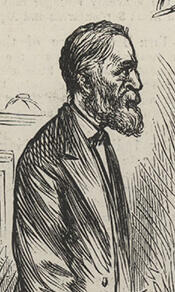
Here you will find contact information for Representative Abram Stevens Hewitt, including email address, phone number, and mailing address.
| Name | Abram Stevens Hewitt |
| Position | Representative |
| State | New York |
| District | 10 |
| Party | Democratic |
| Status | Former Representative |
| Term Start | December 6, 1875 |
| Term End | March 3, 1887 |
| Terms Served | 5 |
| Born | July 31, 1822 |
| Gender | Male |
| Bioguide ID | H000552 |
About Representative Abram Stevens Hewitt
Abram Stevens Hewitt (July 31, 1822 – January 18, 1903) was an American politician, educator, ironmaking industrialist, and lawyer who served as a Representative from New York in the United States Congress from 1875 to 1887 and as mayor of New York City from 1887 to 1888. A member of the Democratic Party, he twice represented New York’s 10th congressional district in the U.S. House of Representatives and chaired the Democratic National Committee from 1876 to 1877. He was widely regarded as a reform-minded Democrat and later became known as the “Father of the New York City Subway System” for his role in planning the financing and construction of the first line of what would develop into the New York City Subway.
Hewitt was born in Haverstraw, New York, on July 31, 1822. His mother, Ann Gurnee, was of French Huguenot descent, and his father, John Hewitt, was from Staffordshire, England, having emigrated to the United States in 1796 to work on a steam engine to power a water plant in Philadelphia. Raised in modest circumstances, Hewitt distinguished himself academically and earned a scholarship to attend Columbia College in New York City. He graduated from Columbia in 1842 and remained there as an instructor, teaching mathematics. Several years later he was admitted to the bar and became a lawyer, though his professional interests soon extended into industry and public affairs.
In 1843 and 1844, Hewitt traveled to Europe as tutor and companion to his student Edward Cooper, the son of New York industrialist and philanthropist Peter Cooper and himself a future mayor of New York City. On their return voyage to the United States, the two men were shipwrecked together, an experience that cemented a close personal bond. After this episode, Hewitt became, in his own words, “virtually a member of the Cooper family.” In 1855 he married Edward Cooper’s sister, Sarah Amelia Cooper, thus becoming Peter Cooper’s son-in-law. This family connection shaped much of his later industrial, educational, and philanthropic work.
With financial backing from Peter Cooper, Hewitt and Edward Cooper entered the iron industry. In 1845 they established an iron mill in Trenton, New Jersey, known as the Trenton Iron Company. Under their direction the company became a center of innovation in ironmaking. In 1854 the Trenton Iron Company produced the first structural wrought-iron beams in the United States and developed other advanced iron products. Hewitt’s younger brother, Charles Hewitt, served as a manager at the mill. Beyond Trenton Iron, Abram Hewitt invested in a variety of enterprises and frequently served on corporate boards. He also supervised the construction of the Cooper Union for the Advancement of Science and Art, Peter Cooper’s free educational institution in New York City, which opened in 1859. Hewitt chaired the Cooper Union board of trustees and remained closely involved with the institution until his death in 1903.
Hewitt’s reformist political outlook took shape in the context of New York’s Democratic politics in the post–Civil War era. In 1871, inspired by the reform leadership of Samuel J. Tilden, he became prominently involved in efforts to remove the corrupt “Tweed Ring,” led by William M. “Boss” Tweed, from control of Tammany Hall and to reorganize the Democratic Party in New York. His reputation as a reform Democrat and his growing prominence in business and civic life led him into electoral politics. He first won election to the U.S. House of Representatives in 1874 and served in Congress for five terms between 1875 and 1887, a significant period in American history marked by Reconstruction’s aftermath, industrial expansion, and contentious national elections.
Hewitt’s initial service in Congress began on March 4, 1875, when he took his seat as a Representative from New York’s 10th congressional district. He served two consecutive terms, from March 4, 1875, to March 3, 1879, during which he participated actively in the legislative process and represented the interests of his urban constituency. During this first stint in Congress, he was chosen to chair the Democratic National Committee in 1876, playing a central organizational role in Samuel J. Tilden’s ultimately unsuccessful presidential campaign in the disputed election of that year. After leaving Congress briefly, Hewitt returned to electoral politics in 1880, when he defeated James O’Brien—his successor in the House and a staunch opponent of Tammany Hall—for the Democratic nomination in the 10th district. He regained his old seat and served again in the U.S. House of Representatives from March 4, 1881, until his resignation on December 30, 1886. Over the course of his five terms in office, Hewitt contributed to national debates on finance, industry, and infrastructure. One of his most noted public addresses of this era was his speech at the opening of the Brooklyn Bridge in 1883, in which he celebrated the engineering achievement and the bridge’s significance for New York City.
In 1886 Hewitt was elected mayor of New York City. Running as the Democratic candidate, he defeated both the labor reform candidate Henry George and the Republican candidate Theodore Roosevelt. His campaign enjoyed the formal endorsement and organizational support of Tammany Hall, although his relationship with the Tammany leadership was often uneasy. Hewitt served as mayor from 1887 to 1888, a two-year term during which he emphasized sound financial management and municipal reform. He was known as a defender of prudent fiscal policy and was quoted as saying, “Unnecessary taxation is unjust taxation.” He supported civil service reform and resisted efforts to use city government as a vehicle for patronage. His refusal to grant Tammany Hall the level of patronage control it sought led to a rupture with Tammany boss Richard Croker, who ensured that Hewitt was not renominated for a second term. Hewitt also alienated portions of the city’s Irish American Democratic base by refusing to review the Saint Patrick’s Day parade. Nonetheless, his mayoralty is remembered for its administrative integrity and for laying important groundwork for the city’s future transit system.
Hewitt’s interest in urban infrastructure and rapid transit extended beyond his term in office. He played a key role in planning the financing and construction of the first line of what became the New York City Subway, and he was instrumental in the development and passage of the Rapid Transit Act of 1894, which authorized public funding for subway construction. For these efforts he came to be regarded as the “Father of the New York City Subway System.” His public service extended into professional and scientific organizations as well. In 1876 he was elected president of the American Institute of Mining Engineers, reflecting his prominence in the industrial and engineering communities. He later became a founder and trustee of the Carnegie Institution of Science and served as a trustee of Barnard College and of the American Museum of Natural History.
In addition to his political and educational work, Hewitt was an active investor in natural resources and transportation. He held extensive interests in West Virginia, where William Nelson Page, a noted civil engineer and industrialist, managed some of his holdings. Hewitt was also an associate of Henry Huttleston Rogers, a key figure in the Standard Oil Trust and a major developer of coal and other natural resources. Together with Rogers and Page, Hewitt invested in the Loup Creek Estate in Fayette County, West Virginia. To move bituminous coal from their mines to market, the investors organized the Deepwater Railway, initially a short line intended to connect their properties to the Chesapeake and Ohio Railway along the Kanawha River. Rate disputes with the larger railroad led to the expansion of the line across West Virginia and into Virginia, ultimately reaching a new coal pier at Sewell’s Point on Hampton Roads. The line was later renamed the Virginian Railway. In 1890 Hewitt also partnered with Edward Cooper and Hamilton McKown Twombly to form the American Sulphur Company, which entered into a 50–50 agreement with Herman Frasch and his partners to create the Union Sulphur Company, an important enterprise in the development of the modern sulphur industry.
Hewitt remained deeply engaged with higher education and philanthropy throughout his later life. Columbia University awarded him an honorary LL.D. degree in 1887, recognized his leadership by electing him president of its alumni association in 1883, and appointed him a trustee in 1901, a position he held until his death. As chairman of the Cooper Union board of trustees, he oversaw the institution’s growth as a leading center for free technical and artistic education. His philanthropic commitments extended to multiple cultural and scientific institutions, including Barnard College, the American Museum of Natural History, and the Carnegie Institution of Science, where he helped shape early policies and programs.
Abram Stevens Hewitt died at his home in New York City on January 18, 1903, and was interred at Green-Wood Cemetery in Brooklyn. According to family accounts, his last words, spoken after he removed an oxygen tube from his mouth, were, “And now, I am officially dead.” His family continued his legacy of public service, invention, and philanthropy. His daughters Amy, Eleanor, and Sarah Hewitt assembled a major decorative arts collection that was long exhibited at Cooper Union and later became the core of the Cooper-Hewitt National Design Museum. His son Peter Cooper Hewitt (1861–1921) was a successful inventor, noted for his work in electrical engineering, while another son, Edward Ringwood Hewitt (1865–1957), was an inventor, chemist, and early authority on fly-fishing who authored works including “Telling on the Trout.” Hewitt’s youngest son, Erskine Hewitt (1871–1938), became a lawyer and philanthropist in New York City; he donated the family’s Ringwood Manor estate to the State of New Jersey in 1936 and, on February 18, 1909, was named a director of the newly formed National Reserve Bank of the City of New York, becoming its chairman on March 2, 1909.
Hewitt’s memory has been preserved in numerous institutions and place names. One of Cooper Union’s academic buildings was named in his honor; although it was demolished and replaced by 41 Cooper Square in 2007, a historic twenty-foot column from the original Hewitt Building, designed by architect Stanford White, was moved to his memorial plot at Green-Wood Cemetery. A New York City fireboat, the Abram S. Hewitt, served from 1903 until 1958 and bore his name; its remains are located at the Witte Marine Scrapyard in Rossville, Staten Island. A life-sized white marble statue of Hewitt stands in the Great Hall of the Chamber of Commerce of the State of New York in Albany. The historic village of Hewitt, New Jersey, within West Milford Township and now preserved in Long Pond Ironworks State Park, includes the ruins of iron smelting furnaces once operated by Cooper and Hewitt. Ringwood Manor in Ringwood, New Jersey, the Hewitt family’s summer estate from 1857 to the 1930s, is preserved as the centerpiece of Ringwood State Park. Abram Stevens Hewitt School (P.S. 130) in the Bronx, Hewitt Hall at Barnard College, and Abram S. Hewitt State Forest along the Appalachian Trail all commemorate his contributions. In a 1993 survey of historians, political scientists, and urban experts conducted by Melvin G. Holli of the University of Illinois at Chicago, Hewitt was ranked the twenty-sixth-best American big-city mayor to have served between 1820 and 1993, underscoring his enduring reputation as a capable and reform-minded municipal leader.