Senator Absalom Willis Robertson
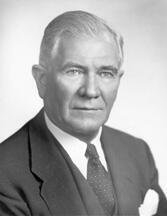
Here you will find contact information for Senator Absalom Willis Robertson, including email address, phone number, and mailing address.
| Name | Absalom Willis Robertson |
| Position | Senator |
| State | Virginia |
| Party | Democratic |
| Status | Former Representative |
| Term Start | March 9, 1933 |
| Term End | January 3, 1967 |
| Terms Served | 11 |
| Born | May 27, 1887 |
| Gender | Male |
| Bioguide ID | R000317 |
About Senator Absalom Willis Robertson
Absalom Willis Robertson (May 27, 1887 – November 1, 1971) was an American lawyer and Democratic politician from Virginia who served in public office for more than half a century, including service in both houses of the United States Congress. A member of the conservative coalition and a lukewarm ally of the Byrd Organization led by fellow U.S. Senator Harry F. Byrd, he represented Virginia in the U.S. House of Representatives from 1933 to 1946 and in the U.S. Senate from 1946 to 1966, and earlier served in the Virginia General Assembly. Over the course of his congressional career, he became a prominent opponent of federal civil rights legislation. He was also the father of televangelist and political commentator Pat Robertson.
Robertson was born on May 27, 1887, in Martinsburg, West Virginia, the son of Franklin Pierce Robertson and Josephine Ragland (née Willis). His birth in Martinsburg came just two weeks before the birth in the same community of Harry F. Byrd, with whom he would later be closely associated in Virginia politics. Robertson was raised in Virginia and pursued higher education at the University of Richmond, from which he graduated in 1907. After completing his studies, he read law and was admitted to the bar, establishing a private law practice that provided the foundation for his long public career.
Following the start of his legal practice, Robertson quickly entered politics. In 1915 he was elected as a Democrat to the Virginia State Senate from the 22nd District, representing Bedford and Rockbridge counties and the independent city of Buena Vista. He took his seat in 1916, succeeding W. T. Paxton, who had earlier replaced J. Randolph Tucker, and served until 1922. During World War I, Robertson enlisted in the United States Army; he was assigned to stateside duty, which allowed him to continue serving in his part-time legislative office. In 1922 he resigned from the State Senate. Samuel S. Lambeth Jr. was chosen in the February 1923 special session to fill the vacancy, and Robert J. Noell subsequently won election later that year to succeed him. That same year, Robertson was elected Commonwealth’s Attorney for Rockbridge County, Virginia, an elective prosecutorial office under the state constitution that could not be held concurrently with a legislative or judicial position. He served as Commonwealth’s Attorney from 1922 to 1928, further consolidating his reputation in legal and political circles.
Robertson’s federal legislative career began during the Great Depression. In 1932 he was elected as a Democrat from Virginia’s 7th congressional district to the U.S. House of Representatives, taking office on March 4, 1933, at the outset of the New Deal era. He was reelected six times to the House. In the 1934 election he won with 68.33 percent of the vote, defeating Republican J. Everett Will, Socialist Lester Ruffner, and Independent W. R. Eubank. In 1936 he was reelected with 63.87 percent of the vote over Republican Will and Socialist Ruffner. In 1938 he again secured 63.87 percent of the vote, defeating Republican Charles C. Leap. In 1940 he was reelected with 65.11 percent of the vote, defeating Republican Jacob A. Garber and Lester Ruffner, who by then was running as a Communist. In 1942 he was returned to Congress without opposition, and in 1944 he was reelected with 59.87 percent of the vote over Republican D. Wampler Earman. During his House tenure, Robertson aligned himself with the fiscally conservative, states’ rights–oriented wing of the Democratic Party that would later be known as the conservative coalition.
Robertson moved to the U.S. Senate in 1946. That year he won a special election to complete the final two years of the term of Senator Carter Glass, who had died in office. Robertson took his Senate seat the day after the election in 1946. He won the seat in his own right in 1948 and was reelected twice more, serving in the Senate until January 3, 1967. Throughout this period he was generally regarded as a typical member of the Byrd Organization, the dominant Democratic political machine in mid‑twentieth‑century Virginia, though his views occasionally diverged from those of the organization and he gradually became more independent of its leadership. In the Senate he became a key figure on financial and housing legislation and, from 1959 to 1966, served as chairman of the Committee on Banking, Housing, and Urban Affairs. Among the most enduring pieces of legislation associated with his name is the Pittman–Robertson Federal Aid in Wildlife Restoration Act, which established a formula for sharing federal excise tax revenues on firearms and ammunition with the states to finance wildlife conservation areas. That program remained in effect long after his retirement and continued as a primary funding source for state wildlife programs.
During his congressional service, which spanned from 1933 to 1967 and encompassed eleven terms in the House and Senate combined, Robertson was a prominent member of the conservative coalition and a vocal opponent of civil rights legislation and federal efforts to dismantle segregation. In 1956 he was one of nineteen senators who signed the Southern Manifesto, denouncing the U.S. Supreme Court’s decision in Brown v. Board of Education of Topeka (1954), which mandated desegregation of public schools. Asked to comment on the South’s state of mind following the desegregation order, Robertson publicly defended the doctrine of “separate but equal,” citing an 1850 decision of the Massachusetts Supreme Court and subsequent state and federal rulings that had upheld segregated schools. He argued that Southern states had made “notable progress” in meeting equality requirements over the previous decade and warned that “rapid, enforced desegregation” would destroy public education in some Southern states and generate “bitterness and racial animosities in areas where harmony heretofore prevailed.” He maintained that Southerners believed their “cherished constitutional right of every citizen to select his personal associates” was being violated by federal desegregation efforts. In the House, he endorsed the opposition of his successor in Virginia’s Seventh District, Representative Burr P. Harrison, to pending civil rights legislation, asking unanimous consent to print Harrison’s newsletter in the Congressional Record and praising Harrison’s analysis as “lucid and accurate.” Harrison’s statement condemned the proposed civil rights bill as “one of the most drastic measures ever to receive consideration by the Congress,” objecting in particular to the creation of a federal commission empowered to investigate civil rights incidents and to promote racial integration in private business.
Robertson’s resistance to civil rights measures continued into the 1960s. When President Lyndon B. Johnson sent First Lady Lady Bird Johnson on a whistle‑stop train tour of the South to build support for the Civil Rights Act of 1964 and the Voting Rights Act of 1965, Robertson was one of four Southern senators who refused to meet with her during the trip. His stance placed him increasingly at odds not only with the national Democratic Party but also with changing political currents within Virginia. By the mid‑1960s, the Twenty‑Fourth Amendment, which abolished the poll tax in federal elections, and the Voting Rights Act of 1965 had significantly expanded the electorate, particularly among Black and lower‑income voters. At the same time, some members of the Byrd Organization itself were moving away from the most hardline forms of resistance to integration. In 1966 President Johnson personally recruited Virginia State Senator William B. Spong Jr., a more liberal Democrat, to challenge Robertson in the Democratic primary for the Senate. In one of the most notable upsets in Virginia political history, Spong defeated Robertson in the primary, marking the end of Robertson’s Senate career and signaling the beginning of the decline of the Byrd Organization’s long dominance in Virginia politics. Robertson was defeated in his bid for reelection to the U.S. Senate in 1966 and left office at the expiration of his term in January 1967.
In his later years, Robertson lived in Lexington, Virginia. He remained a figure of interest in discussions of mid‑twentieth‑century Southern politics, both for his role in shaping financial and wildlife conservation policy and for his steadfast opposition to federal civil rights initiatives. He died in Lexington on November 1, 1971. Robertson was buried in Stonewall Jackson Memorial Cemetery, later renamed Oak Grove Cemetery, in Lexington. His papers are preserved at the Swem Library of the College of William and Mary, providing a documentary record of his more than five decades in public life.