Senator Adelbert Ames
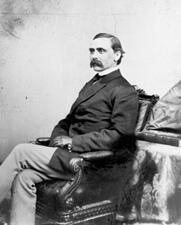
Here you will find contact information for Senator Adelbert Ames, including email address, phone number, and mailing address.
| Name | Adelbert Ames |
| Position | Senator |
| State | Mississippi |
| Party | Republican |
| Status | Former Representative |
| Term Start | January 1, 1870 |
| Term End | March 3, 1875 |
| Terms Served | 1 |
| Born | October 31, 1835 |
| Gender | Male |
| Bioguide ID | A000172 |
About Senator Adelbert Ames
Adelbert Ames (October 31, 1835–April 13, 1933) was an American sailor, soldier, businessman, and politician who served with distinction as a Union Army general during the American Civil War and later as a United States Senator from Mississippi from 1869 to 1875. A Radical Republican, he was a military governor, U.S. Senator, and civilian governor in Reconstruction-era Mississippi, and in 1898 he returned to service as a United States Army general during the Spanish–American War. He was the last Republican to serve as governor of Mississippi until the election of Kirk Fordice, who took office in January 1992, 116 years after Ames vacated the office. A staunch supporter of political equality for African Americans, his Reconstruction-era career made him one of the most controversial political figures of his generation.
Ames was born on October 31, 1835, in the town of Rockland (then known as East Thomaston), Knox County, Maine, the younger of two sons of Martha Bradbury Ames and Jesse Ames. His father was a sea captain who later purchased what became the Ames Mill in Northfield, Minnesota, later renowned as the producer of Malt-O-Meal. Growing up in a maritime family, Adelbert Ames went to sea as a young man, becoming a mate on a clipper ship and serving briefly as a merchant seaman on his father’s vessel. This early experience as a sailor preceded his decision to pursue a military career in the regular army.
On July 1, 1856, Ames entered the United States Military Academy at West Point, New York. He graduated five years later, in May 1861, ranking fifth in a class of forty-five. The outbreak of the Civil War in April 1861 accelerated the academy’s schedule, and two classes graduated that year: Ames’s class, which graduated about a month earlier than usual, and a second class originally slated for 1862, which graduated on June 24, 1861. Commissioned into the regular army at the outset of the conflict, Ames quickly distinguished himself in combat and began a rapid rise through the ranks.
During the Civil War, Ames served in the Union Army with notable gallantry. He was severely wounded while serving with Griffin’s Battery and later received the Medal of Honor for remaining on the field in command of a section of the battery, directing its fire after being badly wounded and refusing to leave until he was too weak to sit upon the caisson where his men had placed him. He rose to brigade and then division command in the Army of the Potomac. At the Battle of Gettysburg on July 1, 1863, when Brigadier General Francis C. Barlow advanced his division of the XI Corps to a forward position on what is now known as Barlow’s Knoll and was subsequently wounded and captured, Ames assumed command of the division. He led it in a difficult retreat through the streets of Gettysburg to a defensive position on Cemetery Hill. On July 2, his battered division bore the brunt of Confederate Major General Jubal A. Early’s assault on East Cemetery Hill, where Ames personally took part in hand-to-hand fighting to hold the critical ground. In recognition of his leadership, the men of the 20th Maine presented him with their battle flag as a token of esteem.
Following Gettysburg, Ames returned to brigade command and received a brevet promotion to colonel in the regular army. His command, later under Brigadier General George H. Gordon, was transferred to the Department of the South, where it saw action in South Carolina and Florida. In 1864, his division became part of the X Corps of the Army of the James under Major General Benjamin F. Butler, participating in the Bermuda Hundred Campaign and the Siege of Petersburg. That winter, the division was reassigned to the XXIV Corps and sent to North Carolina. Over the next two years Ames alternated between brigade and division command and on two occasions led his corps. He played a decisive role in the Second Battle of Fort Fisher in January 1865, commanding the 2nd Division, XXIV Corps, in the successful assault on the Confederate coastal stronghold. Accompanying his men into the fort as much of his staff fell to Confederate fire, he earned a brevet promotion to major general of volunteers and brigadier general in the regular army on March 13, 1865, for his conduct in that engagement. His wartime service also brought him into close association with Butler, whose daughter he later married, becoming the general’s son-in-law.
After the war, Ames remained in the regular army and was assigned to Reconstruction duty in the South. As a Radical Republican committed to the political rights of formerly enslaved people, he was appointed a military governor in Mississippi during the early years of Reconstruction. He entered civilian politics in that state and, as a member of the Republican Party, was elected by the Mississippi legislature to the United States Senate. He served as a Senator from Mississippi from 1869 to 1875, completing one term in office. His tenure in the Senate occurred during a significant period in American history, as Congress grappled with the terms of Reconstruction, civil rights for freedmen, and the reintegration of the former Confederate states. As a member of the Senate, Ames participated in the legislative process and represented the interests of his Mississippi constituents while aligning with the Radical Republican program of enforcing civil and political equality in the South.
In addition to his senatorial service, Ames served as civilian governor of Mississippi, becoming one of the central figures in the state’s Reconstruction politics. A staunch supporter of political equality for African Americans, he backed measures to protect Black voting rights and participation in government. His administration faced fierce opposition from white supremacist groups and conservative Democrats, and his tenure became a longstanding point of controversy in the historiography of Reconstruction. Historians of the Dunning School and other “Lost Cause” writers long depicted him as a carpetbagger and villain, while Black historians and, from the 1950s onward, neo-abolitionist scholars reassessed him more favorably as a defender of biracial democracy. After leaving office amid the collapse of Republican power in Mississippi, he pursued business interests, including involvement with his family’s milling enterprise in Northfield, Minnesota, and remained a figure of public interest, even providing an account of his role during the James–Younger gang’s attempted raid on the First National Bank of Northfield in 1876.
In 1898, during the Spanish–American War, Ames returned to active duty as a United States Army general, once again serving his country in uniform more than three decades after the Civil War. In his later years he divided his time between business, family, and public commemorations of the conflicts in which he had served. His family included several prominent figures, among them his daughter Blanche Ames Ames, an artist and suffragist. Veterans of the Spanish–American War honored his service by establishing Camp 19, General Adelbert Ames Post, of the United Spanish War Veterans in Lowell, Massachusetts. On November 1, 2009, a Medal of Honor plaque for Ames’s gravesite was dedicated at a ceremony marking the 191st birthday of Benjamin Butler at the Hildreth family cemetery, the only day of the year that cemetery is open to the public.
Ames lived to be 97 years old, dying on April 13, 1933. He was the penultimate surviving general officer of the Civil War, outlived only by Aaron Daggett, who died in 1938 at the age of 100. Because Daggett had held only a brevet rank as a brigadier general of volunteers, Ames is regarded as the last surviving Civil War general who had held his rank in the regular United States or Confederate States armies, and the last surviving general of the conflict who had begun his career in the regular U.S. Army. His long life and career, spanning from antebellum seafaring and West Point through two major American wars and the upheavals of Reconstruction, left a complex legacy in both military and political history.