Senator Alan Bible
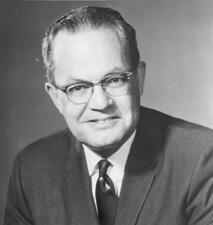
Here you will find contact information for Senator Alan Bible, including email address, phone number, and mailing address.
| Name | Alan Bible |
| Position | Senator |
| State | Nevada |
| Party | Democratic |
| Status | Former Representative |
| Term Start | January 3, 1953 |
| Term End | January 3, 1975 |
| Terms Served | 11 |
| Born | November 20, 1909 |
| Gender | Male |
| Bioguide ID | B000436 |
About Senator Alan Bible
Alan Harvey Bible (November 20, 1909 – September 12, 1988) was an American lawyer and politician who represented Nevada in the United States Senate from 1954 to 1974. A member of the Democratic Party, he served four terms in the Senate during a significant period in American history, contributing to the legislative process and representing the interests of his constituents. Before his Senate career, he served as Attorney General of Nevada from 1942 to 1950, gaining prominence in state legal and political affairs.
Bible was born in Lovelock, Nevada, to Jacob Harvey Bible and Isabel (née Welsh) Bible. His family was originally from Germany and settled in Virginia; his grandfather later moved to Ohio before the Civil War and fought with the Union Army. In Nevada, his father operated a grocery store and a cattle ranch outside Lovelock, while his mother worked as a schoolteacher. The family lived on their ranch until 1919, when a fire destroyed their home, prompting a move to Fallon, Nevada. There, Bible attended Oats Park Grammar School and Churchill County High School. As a student he was active in debating and served as president of both the freshman and senior classes, early indications of his interest in public affairs and leadership.
Bible pursued higher education at the University of Nevada in Reno, where he earned a bachelor’s degree in economics in 1930. During his undergraduate years he joined the Lambda Chi Alpha fraternity in his sophomore year and became class treasurer and assistant editor of the student newspaper, The Sagebrush, in his junior year. He went on to study law at Georgetown University Law School in Washington, D.C., receiving his law degree in 1934. While in Washington, he was given a job as an elevator operator in the United States Capitol Building by Nevada Senator Pat McCarran, an experience that brought him into close proximity with national politics and helped forge a relationship that would shape his early legal and political career.
After his admission to the Nevada bar in 1935, Bible joined Senator McCarran’s law firm in Reno. Within six months he was appointed district attorney of Storey County, a position he held for three years. During this period he became increasingly active in Democratic Party affairs, organizing a chapter of the Young Democrats and helping to select delegates to the state Democratic Committee. He also emerged as a prominent member of the political organization associated with Senator McCarran. From 1938 to 1942, Bible served as deputy Attorney General of Nevada, gaining experience in state legal matters and further solidifying his standing in Nevada politics. In 1939, he married Loucile Shields; the couple had one daughter, Debra, and three sons, Paul, William, and David.
In 1942, Bible was elected Attorney General of Nevada, defeating Republican candidate John Rolly Ross by more than 7,000 votes. As attorney general he strengthened the state’s power to regulate the gambling industry at a time when Nevada’s gaming sector was expanding, and he developed a reputation as an expert in water law, a critical issue in the arid West. He served as attorney general until 1950, when he returned to private legal practice. In 1952, he sought higher office but was narrowly defeated for the Democratic nomination for the United States Senate, losing to political newcomer Thomas B. Mechling by 475 votes, a setback that nonetheless kept him in the forefront of state Democratic politics.
Bible’s opportunity to enter the Senate came two years later. Following the death of Senator Pat McCarran in September 1954, a special election was called to fill the remainder of McCarran’s term. In November 1954, Bible was elected to the United States Senate, defeating Republican Ernest S. Brown, who had been appointed to the vacant seat by Governor Charles H. Russell, by a margin of 58 percent to 42 percent. He took his seat on December 2, 1954. Bible was subsequently reelected in 1956, 1962, and 1968, defeating Republicans Clarence Clifton Young, William B. Wright, and Edward Fike, respectively. Over the course of his four terms, he participated actively in the democratic process and helped shape federal policy during an era marked by the Cold War, the civil rights movement, and significant domestic and international change.
During his tenure in the Senate, Bible held several important committee leadership positions. He served as chairman of the Committee on the District of Columbia during the Eighty-fifth through Ninetieth Congresses, overseeing legislation affecting the governance and administration of the nation’s capital. He also chaired the Joint Committee on Washington Metropolitan Problems in the Eighty-fifth and Eighty-sixth Congresses, addressing issues related to the growth and infrastructure of the Washington metropolitan area. In addition, he was chairman of the U.S. Senate Select Committee on Small Business during the Ninety-first through Ninety-third Congresses, where he played a role in shaping policies affecting small enterprises across the country. Bible represented Nevada in the Senate until his resignation on December 17, 1974. He did not run for reelection that year; Republican Paul Laxalt defeated Democratic nominee Harry Reid in the 1974 election. Bible’s decision to resign before the end of his term enabled the governor to appoint Laxalt to fill the vacancy, giving Laxalt seniority over other senators elected in 1974.
After leaving the Senate, Bible entered the private sector and continued to be involved in public and corporate affairs. He was elected to the Board of Directors of Bally Manufacturing Corporation, reflecting his ongoing engagement with business and regulatory issues. In later years, his career and public service were documented in oral histories and archival collections, including “Alan Bible: Recollections of a Nevada Native Son: The Law, Politics, the Nevada Attorney General’s Office, and the United States Senate,” produced by the University of Nevada Oral History Program, and the Papers of Alan Bible held in the Special Collections of the University Libraries at the University of Nevada, Reno. Alan Harvey Bible died on September 12, 1988, and he is buried in Reno, Nevada, closing a life closely intertwined with the political and legal development of his home state.