Representative Albert Alexander Blakeney
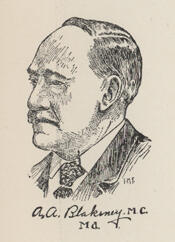
Here you will find contact information for Representative Albert Alexander Blakeney, including email address, phone number, and mailing address.
| Name | Albert Alexander Blakeney |
| Position | Representative |
| State | Maryland |
| District | 2 |
| Party | Republican |
| Status | Former Representative |
| Term Start | December 2, 1901 |
| Term End | March 3, 1923 |
| Terms Served | 2 |
| Born | September 28, 1850 |
| Gender | Male |
| Bioguide ID | B000535 |
About Representative Albert Alexander Blakeney
Albert Alexander Blakeney (September 28, 1850 – October 15, 1924) was an American industrialist and Republican politician who represented Maryland’s second congressional district in the United States House of Representatives from 1901 to 1903 and from 1921 to 1923. His congressional service, spanning two nonconsecutive terms, took place during a significant period in American history marked by the nation’s transition into the Progressive Era and the aftermath of World War I. Over the course of his public career, he participated in the legislative process and represented the interests of his Maryland constituents in the federal government.
Blakeney was born on September 28, 1850, in Riderwood, Baltimore County, Maryland, then a semi-rural community north of the city of Baltimore. Details of his early childhood and formal schooling are sparse in the historical record, but his subsequent career indicates that he entered the workforce at a relatively young age and gained practical experience in the burgeoning textile and manufacturing sector that was transforming parts of Maryland in the latter half of the nineteenth century.
Educated largely through practical engagement in industry rather than extended academic study, Blakeney learned the business of cotton manufacturing in his youth and early adulthood. He became closely associated with the production of cotton duck, a heavy, plain-woven cotton fabric widely used at the time for sails, tents, and industrial purposes. Drawing on this experience, he established large cotton-duck mills in Franklinville, Maryland, a mill village in Baltimore County. These mills contributed to the local economy and provided employment in the region, positioning Blakeney as a significant figure in the county’s industrial development before he entered public office.
Blakeney’s prominence as a manufacturer and community leader led naturally into local public service. He served as commissioner of Baltimore County, Maryland, from 1895 to 1899, a role in which he was involved in county governance, infrastructure, and administration during a period of growth and modernization in the greater Baltimore area. His tenure as county commissioner helped build his reputation as a Republican leader and provided him with administrative experience and political connections that would support his later congressional ambitions.
In 1900, Blakeney was elected as a Republican to the Fifty-seventh Congress from Maryland’s second congressional district. He served one full term in the U.S. House of Representatives from March 4, 1901, to March 3, 1903. During this first term, he took part in the legislative work of the House at a time when the federal government was grappling with issues of industrial regulation, economic expansion, and America’s emerging role on the world stage in the wake of the Spanish–American War. Although he contributed to the legislative process and represented his district’s interests, Blakeney declined to be a candidate for renomination in 1902 and thus did not seek a second consecutive term.
After leaving Congress in 1903, Blakeney returned to his business pursuits in Franklinville, resuming active management and oversight of his cotton-duck manufacturing operations. His continued involvement in industry maintained his standing in the community and kept him engaged with the economic concerns of his region. This ongoing connection to local business and civic life provided the foundation for his eventual return to national politics nearly two decades later.
Blakeney reentered congressional politics in the post–World War I era, when economic adjustment, veterans’ issues, and debates over domestic policy dominated the national agenda. In 1920, he was again elected as a Republican to represent Maryland’s second district, this time in the Sixty-seventh Congress. He served from March 4, 1921, to March 3, 1923. His second term in Congress occurred during a period of Republican ascendancy in national politics, and he once more participated in the democratic process as a member of the House of Representatives, advocating for his constituents and engaging with the legislative challenges of the early 1920s. He was an unsuccessful candidate for re-election in 1922, bringing his congressional service to a close after two nonconsecutive terms.
In his later years, following his final term in Congress, Blakeney appears to have withdrawn from public office and returned to private life in Maryland. He died in Baltimore, Maryland, on October 15, 1924, two years after his unsuccessful bid for re-election. Albert Alexander Blakeney was interred in Baltimore Cemetery, leaving behind a legacy as both an industrial entrepreneur and a public servant who bridged local and national roles during a transformative era in American political and economic history.