Senator Albert Gallatin Brown
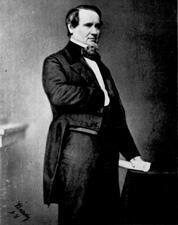
Here you will find contact information for Senator Albert Gallatin Brown, including email address, phone number, and mailing address.
| Name | Albert Gallatin Brown |
| Position | Senator |
| State | Mississippi |
| Party | Democratic |
| Status | Former Representative |
| Term Start | December 2, 1839 |
| Term End | December 31, 1861 |
| Terms Served | 6 |
| Born | May 31, 1813 |
| Gender | Male |
| Bioguide ID | B000900 |
About Senator Albert Gallatin Brown
Albert Gallatin Brown (May 31, 1813 – June 12, 1880) was an American politician who served Mississippi in multiple capacities, including three terms in the state legislature, four terms in the United States Congress, one term on the circuit bench, two terms as Governor of Mississippi from 1844 to 1848, and two terms as a United States Senator from Mississippi from 1854 until his withdrawal in 1861 at the time of secession. A member of the Democratic Party, he was also elected a senator in the Confederate Congress and became one of the most influential public men in Mississippi during the mid-nineteenth century.
Brown was born in 1813 in the Chester District of South Carolina, at the foothills of the Appalachian Mountains, to Joseph and Elizabeth (Rice) Brown, a poor family of hog farmers. The Browns were farmers originally from Charlotte County, Virginia, where Brown’s grandfather had settled after emigrating from Lincolnshire, England to Virginia in 1697 and moving to Charlotte County in the 1720s. In 1823, when Albert was ten years old, the family moved to the newly admitted state of Mississippi and settled in Copiah County, south of Jackson. The cotton frontier proved lucrative: in 1824 Joseph Brown was elected justice of the peace in Copiah County, and by 1825 he was the third-largest taxpayer in the county, owning 18 enslaved people. By 1832 he farmed a 1,600‑acre plantation and owned 23 enslaved people, establishing the economic and social setting in which Albert Gallatin Brown came of age.
Brown’s formal education in Mississippi began in 1829, when he entered Mississippi College. He soon transferred to Jefferson College, which he attended for about six months. Although his time in formal schooling was relatively brief, he developed a reputation for oratory and intellectual balance that would mark his political career. Contemporaries later described him as possessing a handsome countenance framed by a luxuriant, flowing beard and dark, curly hair, and as a man whose courage, lack of vanity, and animated, persuasive speaking style made him a commanding figure in public life.
Brown’s rise in Mississippi politics was rapid. He served three terms in the state legislature and gained prominence as an advocate of public education. He is widely regarded as a principal architect of Mississippi’s public school system and a key figure in the establishment and promotion of the University of Mississippi. His rhetorical attacks on illiteracy and his insistence on the need for educational institutions in the state were considered to have made a substantial contribution to the cause of education in Mississippi. He also served a term on the circuit bench, further broadening his experience in public service and law.
In national politics, Brown first entered the United States Congress as a Democrat and ultimately served a total of four terms. According to existing accounts, he served as a Senator from Mississippi in the United States Congress from 1839 to 1861, contributing to the legislative process during six terms in office and representing the interests of his constituents during a period of mounting sectional conflict. More precisely, he was Governor of Mississippi from 1844 to 1848 and later served as a Democratic United States Senator from Mississippi from 1854 to 1861, when he withdrew from the Senate following Mississippi’s secession from the Union. His congressional service occurred during a significant and turbulent period in American history, and as a member of the Senate he participated actively in the debates that preceded the Civil War.
Brown was a committed pro-slavery “Fire-Eater” and a strong advocate for the expansion of slavery into new territories. In 1858 he declared, “I want a foothold in Central America… because I want to plant slavery there…. I want Cuba,… Tamaulipas, Potosi, and one or two other Mexican States; and I want them all for the same reason—for the planting or spreading of slavery.” He went so far as to say, “I would spread the blessings of slavery, like the religion of our Divine Master, to the uttermost ends of the earth.” Brown was himself a slaveholder, and his pro-slavery positions drew criticism from abolitionists and formerly enslaved people. In Incidents in the Life of a Slave Girl, the escaped slave Harriet Jacobs singled him out for supporting slavery in a speech to Congress despite the fact that he “could not be ignorant of [the wrongdoings perpetrated against slaves], for they are of frequent occurrence in every Southern State.”
During the Civil War era, Brown aligned fully with the Southern nationalist cause. After leaving the United States Senate in 1861, he served as a senator in the Confederate Congress, continuing his advocacy for the Confederacy and its pro-slavery policies. His career, spanning state and national offices in both the United States and the Confederacy, led historian James Byrne Ranck to write that “the political career of Albert Gallatin Brown provides one of the most amazing chapters in Mississippi history.” To those who shared his views, Brown seemed almost charismatic; one contemporary wrote that he “possessed magical powers,” and Reuben Davis, who knew him well, later recalled in his Reminiscences on Mississippi and Mississippians that Brown “was the best-balanced man I ever knew…. In politics, he had strategy without corruption, and handled all his opponents with skill but never descended to intrigue.” Even in an epoch of bitter controversy, Davis noted, Brown’s closest friends never heard him speak ill of others.
Brown married twice. His first wife was Elizabeth Frances Thornton Taliaferro (1817–1836) of Virginia, daughter of Richard Henry Taliaferro, Sr. (1783–1830) and Frances Walker Gilmer (ca. 1784–1826). She died about five months after their marriage. Brown later married Roberta Eugenia Young (1813–1886), daughter of Brigadier General Robert Young (1768–1824) and Elizabeth Mary Conrad (1772–1810). Roberta’s older sister, Elizabeth Mary Young (1804–1859), was married to Philip Richard Fendall II (1794–1867), the District Attorney of the District of Columbia, linking Brown by marriage to prominent legal and political circles in the nation’s capital.
In his later years, Brown continued to be remembered in Mississippi as a powerful orator and a central figure in the state’s antebellum and Civil War politics, though his legacy remained inseparable from his staunch defense of slavery and secession. On June 12, 1880, he died after suffering a stroke of apoplexy at his home near Terry, Mississippi; he fell face down in a shallow pond and did not recover. His remains were interred in Greenwood Cemetery in Jackson, Mississippi. Brown County, Kansas, was later named in his honor, and his life and career have been the subject of historical study, including James Byrne Ranck’s 1974 biography, Albert Gallatin Brown: Radical Southern Nationalist. In modern culture, he appears as an important supporting character in Harry Turtledove’s 1992 alternate history novel The Guns of the South, reflecting continued interest in his role in the politics of the antebellum South and the Confederacy.