Representative Albert Paul Morano
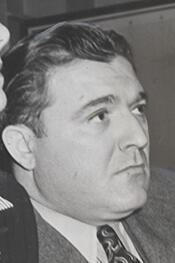
Here you will find contact information for Representative Albert Paul Morano, including email address, phone number, and mailing address.
| Name | Albert Paul Morano |
| Position | Representative |
| State | Connecticut |
| District | 4 |
| Party | Republican |
| Status | Former Representative |
| Term Start | January 3, 1951 |
| Term End | January 3, 1959 |
| Terms Served | 4 |
| Born | January 18, 1908 |
| Gender | Male |
| Bioguide ID | M000935 |
About Representative Albert Paul Morano
Albert Paul Morano (January 18, 1908 – December 16, 1987) was an American politician and member of the U.S. House of Representatives from Connecticut. A Republican, he served four consecutive terms in Congress from 1951 to 1959, representing his constituents during a significant period in mid-twentieth-century American history.
Morano was born in Paterson, New Jersey, on January 18, 1908, to Italian immigrant parents. In 1912, when he was a small child, his family moved to Greenwich, Connecticut. He attended the public schools of Greenwich, where he grew up in a community that would remain his home for the rest of his life. His early experience as the son of immigrants and a resident of a growing Connecticut town helped shape his later interest in local governance and public service.
Morano began his public career in local government in Greenwich. He served as a member of the Greenwich Board of Tax Review from 1933 to 1935, participating in the oversight of local tax assessments during the challenging years of the Great Depression. From 1935 to 1937 he was chairman of the Chickahominy Town Meeting District, a neighborhood-based governing body within Greenwich, where he gained experience in grassroots political organization and community representation. In 1939 and 1940 he worked in Washington, D.C., as secretary to U.S. Representative Albert E. Austin of Connecticut, an assignment that introduced him to the workings of the federal legislative process. Returning to Greenwich, he entered the real estate and insurance business in 1942, establishing himself in private enterprise while maintaining his political connections.
During World War II and the immediate postwar period, Morano continued to build his career in public service. From 1943 to 1947 he served as secretary to Representative Clare Boothe Luce of Connecticut, one of the most prominent Republican members of the House at the time. In this role he gained further insight into national politics, legislative procedure, and constituent relations. He subsequently held state office as unemployment benefits commissioner for Connecticut from 1947 to 1950, overseeing the administration of unemployment compensation at a time of postwar economic adjustment. He served as chairman of the unemployment commission in 1949 and 1950, giving him statewide responsibility in a key area of social and economic policy.
Morano was elected as a Republican to the Eighty-second Congress and to the three succeeding Congresses, serving in the U.S. House of Representatives from January 3, 1951, to January 3, 1959. As a member of the House of Representatives from Connecticut, he participated in the democratic process and represented the interests of his constituents during an era marked by the Korean War, the early Cold War, and the beginnings of the modern civil rights movement. During his tenure, he contributed to the legislative process across four terms in office. Notably, he voted in favor of the Civil Rights Act of 1957, the first federal civil rights legislation enacted since Reconstruction, aligning himself with efforts to strengthen voting rights and federal enforcement of civil rights protections. His service in Congress reflected both his party affiliation and his long-standing engagement with public policy at the local, state, and national levels.
In 1958 Morano was an unsuccessful candidate for reelection to the Eighty-sixth Congress, ending his eight-year tenure in the House on January 3, 1959. After leaving Congress, he remained active in public affairs. From 1963 to 1969 he served as special assistant to United States Senator Thomas J. Dodd of Connecticut, returning to Capitol Hill in a senior advisory capacity. In this position he assisted with legislative matters, constituent services, and the broader responsibilities of a U.S. senator during a decade marked by the civil rights movement, the Great Society programs, and the Vietnam War.
Morano continued to reside in Greenwich, Connecticut, in his later years, maintaining his ties to the community where he had lived since childhood and first entered public life. He died in Greenwich on December 16, 1987. He was interred in Saint Mary’s Cemetery, leaving a record of service that spanned local government, state administration, and federal office over more than five decades.