Representative Albert Lincoln Vreeland
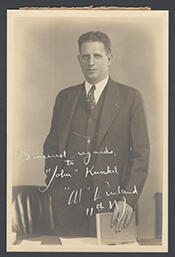
Here you will find contact information for Representative Albert Lincoln Vreeland, including email address, phone number, and mailing address.
| Name | Albert Lincoln Vreeland |
| Position | Representative |
| State | New Jersey |
| District | 11 |
| Party | Republican |
| Status | Former Representative |
| Term Start | January 3, 1939 |
| Term End | January 3, 1943 |
| Terms Served | 2 |
| Born | July 2, 1901 |
| Gender | Male |
| Bioguide ID | V000121 |
About Representative Albert Lincoln Vreeland
Albert Lincoln Vreeland (July 2, 1901 – May 3, 1975) was an American Republican Party politician who represented New Jersey’s 11th congressional district in the United States House of Representatives from 1939 to 1943. Over the course of two terms in Congress, he contributed to the legislative process during a significant period in American history, participating in the democratic process and representing the interests of his New Jersey constituents.
Details of Vreeland’s early life, including his place of birth, family background, and formative years, are not extensively documented in the available record. Born in 1901, he came of age in the early twentieth century, a time marked by rapid industrialization, social change, and the aftermath of the Progressive Era. These broader national developments formed the backdrop to his youth and likely influenced his later engagement in public affairs and Republican Party politics.
Information about Vreeland’s formal education is similarly limited in surviving summaries. While specific institutions and degrees are not recorded in the present sources, his subsequent election to federal office suggests that he attained the level of education and professional experience typical of congressional candidates of his era, preparing him for the responsibilities of legislative service and public representation.
Before entering Congress, Vreeland became active in the Republican Party, aligning himself with its principles during the interwar period. His political development occurred against the context of the Great Depression and the New Deal, when debates over the role of the federal government, economic recovery, and social welfare dominated public life. Within this environment, he emerged as a Republican standard-bearer in New Jersey, building the political support necessary to seek national office.
Vreeland was elected as a Republican to the United States House of Representatives from New Jersey’s 11th congressional district and served from 1939 to 1943. His tenure covered the Seventy-sixth and Seventy-seventh Congresses, years that spanned the final phase of the Great Depression and the nation’s entry into World War II following the attack on Pearl Harbor in December 1941. As a member of the House of Representatives, he participated in the democratic process, contributed to the legislative work of Congress, and represented the interests and concerns of his district’s constituents during a time of profound domestic and international challenge.
During his two terms in office, Vreeland took part in deliberations on issues central to that era, including national defense, wartime mobilization, and the continuing effects of economic hardship on American communities. Serving as a Republican in a period dominated by Democratic administrations and New Deal policies, he was part of the loyal opposition that scrutinized executive initiatives and helped shape the contours of congressional debate. His service coincided with major legislative decisions that prepared the United States for global conflict and reoriented the federal government’s role in economic and social life.
Vreeland left Congress in 1943, at the conclusion of his second term. The available record does not provide extensive detail about his subsequent professional activities, but like many former members, he would have carried forward his experience in national policymaking into later endeavors in public, private, or civic life. He remained part of the generation of legislators whose careers were defined by the crises of depression and world war.
Albert Lincoln Vreeland died on May 3, 1975. His congressional service from 1939 to 1943 placed him among the lawmakers who guided the United States through the closing years of the Great Depression and the opening years of World War II, and he is remembered in the historical record as a Republican representative of New Jersey’s 11th congressional district who contributed to the legislative process during a pivotal era in American history.