Representative Albert Russell Wynn
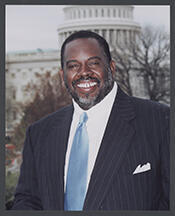
Here you will find contact information for Representative Albert Russell Wynn, including email address, phone number, and mailing address.
| Name | Albert Russell Wynn |
| Position | Representative |
| State | Maryland |
| District | 4 |
| Party | Democratic |
| Status | Former Representative |
| Term Start | January 5, 1993 |
| Term End | May 31, 2008 |
| Terms Served | 8 |
| Born | September 10, 1951 |
| Gender | Male |
| Bioguide ID | W000784 |
About Representative Albert Russell Wynn
Albert Russell Wynn (born September 10, 1951) is an American lobbyist and former politician who served as a member of the United States House of Representatives, representing Maryland’s 4th Congressional District from January 3, 1993, to May 31, 2008. A member of the Democratic Party, he served eight consecutive terms in Congress during a significant period in American political history, contributing to the legislative process and representing the interests of his constituents in a predominantly Democratic, majority-Black district.
Wynn was born in Montgomery County, Pennsylvania, on September 10, 1951. He pursued higher education at the University of Pittsburgh, where he completed his undergraduate studies and was initiated into the Beta Epsilon chapter of the Kappa Alpha Psi fraternity. He later attended Howard University and went on to earn a law degree from Georgetown University Law Center in Washington, D.C. His academic training in law and public policy laid the foundation for a career that would span local, state, and national public service.
Soon after completing his education, Wynn began his professional career in public service in Maryland. He became director of the Prince George’s County Consumer Protection Commission, where he worked on issues affecting consumers in one of the state’s largest and most diverse counties. In 1982, he founded his own law firm, combining legal practice with growing involvement in local politics. Wynn entered the Maryland General Assembly in the early 1980s, serving first in the Maryland House of Delegates from 1983 to 1987 and then in the Maryland State Senate from 1987 to 1993. Over that decade in the state legislature, he built a reputation as an advocate for consumer protection, minority business development, and economic issues, experience that would inform his later work in Congress.
In 1992, Wynn sought election to the U.S. House of Representatives from Maryland’s 4th Congressional District. Following the 1990 Census, the district had been reconfigured as a Black-majority district, and the incumbent, three-term Democrat Tom McMillen, had been drawn out of the district. Wynn entered a crowded seven-way Democratic primary and won the nomination by approximately 1,300 votes, a victory that effectively assured his election in the heavily Democratic district. In the November 1992 general election, he won with about 75 percent of the vote. He was subsequently reelected seven times, never dropping below 75 percent of the vote in general elections, and served continuously from 1993 until his resignation in 2008.
During his congressional tenure, Wynn served on the influential House Committee on Energy and Commerce, where he chaired the Subcommittee on the Environment and Hazardous Materials. He placed a high priority on economic and small business issues and, during the 105th Congress, sponsored legislation that was enacted to improve federal contracting opportunities for small and minority-owned businesses. For his efforts on behalf of small businesses, he twice received the Small Business Administration Administrator’s Leadership Award. Wynn also served on the Congressional Black Caucus, including its Political Action Committee and its Minority Business Task Force, reflecting his ongoing focus on economic empowerment and minority enterprise. On major national issues, he sometimes broke with a majority of his caucus; notably, during the 107th Congress, he was one of only four of the 36 Congressional Black Caucus members to vote on October 10, 2002, for the joint resolution authorizing the Iraq War. He also supported the Bush Administration’s energy bill promoted by Vice President Dick Cheney, as well as legislation such as the repeal of the estate tax and the Bankruptcy Reform Act of 2005, positions that later drew criticism from progressive activists and some constituents.
Wynn’s political career was not without controversy and personal challenges. His 2000 reelection race drew national attention when his estranged wife, Jessie Wynn, served as campaign manager for his Republican opponent, John B. Kimble. In radio advertisements for Kimble’s campaign, she charged that “Albert Wynn does not respect black women. He left me for the white woman,” an episode that attracted considerable media coverage but did not prevent his reelection. Wynn also became a visible voice in the national debate over immigration. He issued statements supporting the integration of undocumented immigrants into American society, provided that strong border security provisions were included. In April 2006, he spoke at the Washington, D.C., Immigration Rally, condemning H.R. 4437 and other bills that aimed to deport all illegal immigrants, and stated on his official website, “Now that they are in this country, we owe them respect and fair treatment.”
In 2006, Wynn faced a serious primary challenge from community activist Donna Edwards, who had previously clerked for him in the 1980s when he served in the Maryland legislature and who was then the executive director of the Arca Foundation. Edwards criticized Wynn for his votes in favor of the Iraq War authorization, the repeal of the estate tax, the Bankruptcy Reform Act of 2005, and the Bush Administration’s energy bill, arguing that he was too conservative and too closely aligned with Republicans. Although Wynn was initially heavily favored, Edwards gained momentum, and two weeks before the primary The Washington Post endorsed her candidacy. In the September 12, 2006 Democratic primary, Wynn ultimately defeated Edwards with 49.7 percent of the vote to her 46.4 percent, a margin of 2,725 votes out of more than 82,000 cast, while a third candidate, George McDermott, received 3.9 percent. The final tally was delayed for nearly two weeks due to widespread problems with new electronic voting machines in Montgomery and Prince George’s counties.
Edwards sought a rematch in the 2008 Democratic primary. This time, she secured the backing of influential progressive and “netroots” organizations, including MoveOn.org, Daily Kos, and OpenLeft, as well as support from many local community groups. In the February 12, 2008 primary, Edwards decisively defeated Wynn, winning approximately 60 percent of the vote to his 36 percent. On February 13, 2008, following his loss in the primary, Wynn announced that he would resign his seat, and on March 27, 2008, he formally stated that his resignation from Congress would be effective in June. He left office on May 31, 2008. Edwards was subsequently elected in a special election to complete the remainder of his term and went on to defeat Republican Peter James, an anti-war candidate, in the November 2008 general election.
After leaving Congress, Wynn transitioned to a career in lobbying and government relations. He became a partner at Dickstein Shapiro, a large Washington, D.C.–based law and lobbying firm whose clients have included companies and organizations in the tobacco, entertainment, energy, and software industries, as well as the Teamsters union. Because House ethics rules prohibit former members from lobbying current members of Congress for one year after leaving office, Wynn’s early resignation in May 2008 allowed him to begin lobbying Congress in June 2009 rather than in January 2010. In his post-congressional career, he has continued to work at the intersection of law, public policy, and business, drawing on his long experience in local, state, and federal government.