Representative Alexander Hamilton Bailey
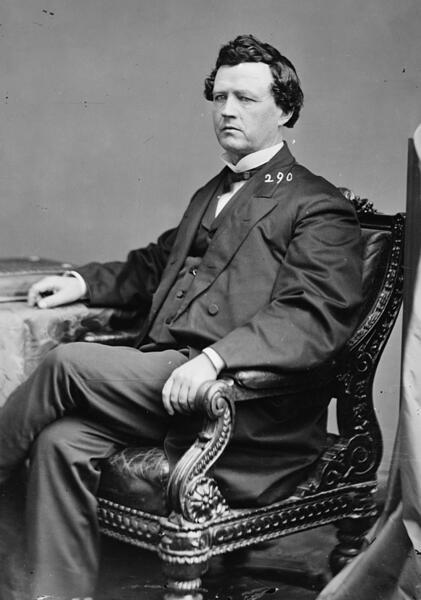
Here you will find contact information for Representative Alexander Hamilton Bailey, including email address, phone number, and mailing address.
| Name | Alexander Hamilton Bailey |
| Position | Representative |
| State | New York |
| District | 21 |
| Party | Republican |
| Status | Former Representative |
| Term Start | March 4, 1867 |
| Term End | March 3, 1871 |
| Terms Served | 2 |
| Born | August 14, 1817 |
| Gender | Male |
| Bioguide ID | B000034 |
About Representative Alexander Hamilton Bailey
Alexander Hamilton Bailey (August 14, 1817 – April 20, 1874) was an American lawyer, judge, and Republican politician who served as a United States Representative from New York from 1867 to 1871. Over the course of his career he held a series of local, county, and state offices before entering Congress during the Reconstruction era, and later returned to the judiciary as a county judge.
Bailey was born in Minisink, Orange County, New York, on August 14, 1817. Little is recorded about his early family life, but he pursued higher education at a time when relatively few Americans attended college. He enrolled at the College of New Jersey, now Princeton University, and graduated in 1837. While at Princeton he studied law, preparing for a professional career in the legal field.
After completing his studies, Bailey was admitted to the bar and commenced the practice of law. He first established himself in Greene County, New York, where he quickly entered public service. From 1840 to 1842 he served as examiner in chancery of Greene County, a position that involved responsibilities in equity jurisprudence under New York’s then-existing chancery system. He also served as a Justice of the Peace in Catskill for four years, gaining experience in local judicial and administrative matters. In 1849 he was elected to the New York State Assembly as a representative of Greene County, marking his entry into state-level legislative service. He subsequently served as Judge of the Greene County Court from 1851 to 1855, further solidifying his reputation in the legal community.
In 1856 Bailey moved to Rome, in Oneida County, New York, where he continued the practice of law and became active in the political life of his new community. Aligning with the emerging Republican Party, he was elected to the New York State Senate, serving from 1862 to 1865. During his tenure in the Senate he sat in the 85th, 86th, 87th, and 88th New York State Legislatures, participating in state governance during the Civil War years and helping to shape legislation in a period of national conflict and transformation.
Bailey’s congressional service began during Reconstruction. Elected as a Republican to the United States House of Representatives for the Fortieth Congress to fill the vacancy caused by the resignation of Roscoe Conkling, he took his seat on November 30, 1867. He was re-elected to the Forty-first Congress and served continuously until March 3, 1871, thus completing two terms in office. As a member of the House of Representatives from New York, Alexander Hamilton Bailey represented the interests of his constituents and contributed to the legislative process at a time of significant national change following the Civil War. During his tenure he served as chairman of the Committee on Expenditures in the Department of State, overseeing and reviewing the financial administration of that department. A member of the Republican Party throughout his congressional career, he participated in the broader debates over Reconstruction policy and federal governance that characterized the era.
Bailey chose not to be a candidate for renomination in 1870 and left Congress at the close of the Forty-first Congress in March 1871. That same year he returned to judicial service when he was elected judge of the Oneida County Court. He remained on the bench in Oneida County from 1871 until his death, continuing his long association with the law and public service at the local level.
Alexander Hamilton Bailey died in Rome, Oneida County, New York, on April 20, 1874. He was interred in Rome Cemetery in Rome, New York. His career, spanning local judicial roles, state legislative service, and two terms in the United States House of Representatives, reflected a sustained commitment to law and public office in New York during the mid-nineteenth century.