Representative Alexander Hamilton Coffroth
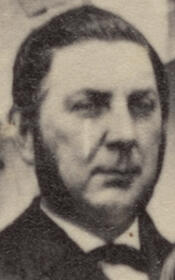
Here you will find contact information for Representative Alexander Hamilton Coffroth, including email address, phone number, and mailing address.
| Name | Alexander Hamilton Coffroth |
| Position | Representative |
| State | Pennsylvania |
| District | 17 |
| Party | Democratic |
| Status | Former Representative |
| Term Start | December 7, 1863 |
| Term End | March 3, 1881 |
| Terms Served | 3 |
| Born | May 18, 1828 |
| Gender | Male |
| Bioguide ID | C000593 |
About Representative Alexander Hamilton Coffroth
Alexander Hamilton Coffroth (May 18, 1828 – September 2, 1906) was a Democratic member of the U.S. House of Representatives from Pennsylvania who served as a Representative in the United States Congress during the mid-19th century. A member of the Democratic Party, he contributed to the legislative process during three terms in office, with his service in Congress occurring during a significant period in American history, including the Civil War and Reconstruction. During Coffroth’s tenure as its Representative, Pennsylvania’s 16th district included Adams County, which encompasses Gettysburg, the site in 1863 of the Battle of Gettysburg and President Abraham Lincoln’s Gettysburg Address.
Coffroth was born in Somerset, Pennsylvania, where he spent his early life. He attended the local public schools and Somerset Academy, receiving the education typical of a well-schooled young man in a small Pennsylvania community of the era. He had at least two brothers, John B. Coffroth and C.A.B. Coffroth, and the family was rooted in Somerset County. Before entering the legal profession, he became involved in journalism and party politics at the local level, experiences that helped shape his later public career.
In his early adulthood, Coffroth produced a Democratic newspaper in Somerset for five years, establishing himself as a committed partisan voice and gaining prominence within the Democratic Party. He then pursued legal studies under the tutelage of the Honorable Jeremiah S. Black, a distinguished Pennsylvania jurist and statesman. Coffroth was admitted to the bar in February 1851 at Somerset and commenced the practice of law there. His growing reputation in both law and politics led to his selection as a delegate to several Democratic state conventions, and he further advanced his political standing by serving as a delegate to the Democratic National Conventions of 1860, which met first in Charleston, South Carolina, and later in Baltimore, Maryland, during the fractious presidential contest that preceded the Civil War.
Coffroth was elected as a Democrat to the Thirty-eighth Congress, representing Pennsylvania in the U.S. House of Representatives beginning in 1863. As a member of the House of Representatives, he participated in the democratic process and represented the interests of his constituents during a time of national crisis. During this term, he notably supported the passage of the Thirteenth Amendment to the Constitution, which abolished slavery in the United States, joining a minority of Democrats, including Archibald McAllister, who broke with much of their party to vote in favor of the measure. His support for the amendment placed him on the side of a landmark constitutional change at the close of the Civil War.
Coffroth claimed reelection to the Thirty-ninth Congress and was seated on February 19, 1866. He served until July 18, 1866, when he was succeeded by William H. Koontz, who successfully contested the election before the House. The disputed election and his eventual unseating underscored the intense partisan struggles of the Reconstruction era. Despite this setback, Coffroth remained active in Democratic politics. He served as an assessor of internal revenue in 1867, a federal administrative post created in the wake of the Civil War to help manage and collect new federal taxes, and he continued his engagement in national party affairs as a delegate to the 1872 Democratic National Convention.
Coffroth returned to Congress when he was again elected as a Democrat to the Forty-sixth Congress. During this later period of service, he held a leadership role as chairman of the United States House Committee on Invalid Pensions, where he oversaw legislation concerning pensions for disabled veterans and their dependents, a matter of continuing importance in the decades following the Civil War. He was not a candidate for renomination in 1880, and his congressional service concluded that year. Over the course of his three terms in office, he participated in the legislative work of the House and represented his Pennsylvania district during a transformative period in the nation’s history.
After leaving Congress, Coffroth resumed the practice of law in Somerset, returning to the profession in which he had first established his public reputation. He remained a respected figure in his community and among Democratic circles in Pennsylvania. In addition to his legal and political legacy, Coffroth held a unique place in American historical memory as the last surviving pallbearer who had served at the funeral of President Abraham Lincoln, linking his personal biography to one of the most solemn events in the nation’s past.
Alexander Hamilton Coffroth died at a sanitarium in Markleton, Pennsylvania, on September 2, 1906. He was interred in Union Cemetery in Somerset, Pennsylvania, near the community where he had been born, educated, and spent much of his professional life. His career, spanning journalism, law, party politics, and congressional service, reflected the turbulent political landscape of the Civil War and Reconstruction eras and left a lasting imprint on the history of his district and state.