Representative Alfred Milnes
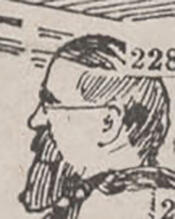
Here you will find contact information for Representative Alfred Milnes, including email address, phone number, and mailing address.
| Name | Alfred Milnes |
| Position | Representative |
| State | Michigan |
| District | 3 |
| Party | Republican |
| Status | Former Representative |
| Term Start | December 2, 1895 |
| Term End | March 3, 1897 |
| Terms Served | 1 |
| Born | May 28, 1844 |
| Gender | Male |
| Bioguide ID | M000783 |
About Representative Alfred Milnes
Alfred Milnes (May 28, 1844 – January 15, 1916) was a British-born American politician and businessman who rose from immigrant and Civil War soldier to serve as a Republican Representative from Michigan in the United States Congress from 1895 to 1897. He was born in Bradford, Yorkshire, England, to Henry and Mary Ann (née Amyss) Milnes. His parents joined the Church of Jesus Christ of Latter-day Saints and, in 1854, left England with their family, sailing from Liverpool on a sixty-day voyage to New Orleans. From there they traveled by boat to St. Louis and then to Kansas City, Missouri, where Henry Milnes purchased a wagon and led the family overland to Salt Lake City, Utah Territory, via Fort Kearny, Fort Laramie, and Fort Bridger, arriving on September 25, 1854. Two years after their arrival, Mary Ann Milnes died, and Henry moved the family to Springville, Utah. Disenchanted with the Mormon community, Henry sold his property at a great loss in May 1859 and moved the family eastward, spending the winter of 1859–1860 in Newton, Iowa. In 1861, after traveling the entire distance by oxen-drawn wagon, the family settled in Coldwater, Branch County, Michigan, where Henry opened a small store and became a successful merchant.
Milnes’s formal education was intermittent, reflecting the demands of frontier and immigrant life. He attended common schools in Salt Lake City and later in Newton, Iowa. When the family arrived in Coldwater, he was seventeen years old. There he continued his education in the local schools during the winter months while working during the summers as his circumstances allowed. This pattern of alternating work and schooling helped prepare him for a career in commerce and public life, grounding him in both practical business experience and the civic culture of his adopted community in Michigan.
With the outbreak of the American Civil War, Milnes enlisted as a private in Company C, Seventeenth Regiment, Michigan Volunteer Infantry, on June 30, 1862. The regiment mustered at Detroit and departed the state on August 27, 1862, proceeding directly to Washington, D.C. Milnes saw early and intense combat; on September 14, 1862, he fought in the Battle of South Mountain in Maryland, and three days later at the Battle of Antietam, where the regiment lost about half its men. The Seventeenth Michigan subsequently took part in the Battle of Fredericksburg and was later joined to the 9th Army Corps under General Ambrose Burnside. The regiment participated in the pursuit of Confederate General John Hunt Morgan to end Morgan’s Raid, then served as rearguard against Confederate General Joseph E. Johnston during the Siege of Vicksburg, and moved on to Jackson, Mississippi. It later operated in Kentucky and east Tennessee, seeing action at the Battle of Campbell’s Station and the Siege of Knoxville. Transferred to Annapolis, Maryland, the regiment was attached to the Army of the Potomac and suffered heavy losses in the Battle of the Wilderness, where only 35 of the original 225 men remained. The regiment was then discontinued as a separate military unit, and the survivors, including Milnes, were assigned to the headquarters of General Orlando B. Willcox, where they performed guard duty until the end of the war.
After the Civil War, Milnes returned to Coldwater at the age of twenty-one and entered civilian life in his father’s mercantile business as a clerk. On January 6, 1868, he married Lucina E. Hull, the younger child of Cyrus and Eunice (Allen) Hull, who owned a farm in nearby Quincy, Michigan. Alfred and Lucina Milnes had three children: Alfred Cyrus, Maude L., and Mabel F. In 1871, Milnes formed a mercantile partnership in Coldwater under the name “Milnes & Vanderhoof,” which prospered for about a decade. After ten years, he sold his interest in the partnership and established his own business, further solidifying his position in the commercial life of Branch County and providing a foundation for his subsequent political career.
Milnes’s entry into public office began at the local level. He served as a member of the board of aldermen of Coldwater in 1876 and 1877, gaining experience in municipal governance. He was elected mayor of Coldwater and served in that capacity in 1885 and 1886, during which time he became a prominent figure in local Republican politics. Building on his municipal service, he was elected to the Michigan Senate, representing the 7th district from 1888 to 1892. In 1894, he was elected the 28th lieutenant governor of Michigan and served under Governor John T. Rich. He held that office until his resignation on June 1, 1895, a step that preceded his move to the national legislature.
Milnes was chosen in a special election in April 1895 as a Republican from Michigan’s 3rd congressional district to the Fifty-fourth Congress, filling the vacancy caused by the resignation of Representative Julius C. Burrows. He took his seat in the U.S. House of Representatives on December 2, 1895, and served until March 3, 1897. During his single term in Congress, Milnes participated in the legislative process at a time of significant economic and political change in the United States, representing the interests of his Michigan constituents within the Republican Party. His service in Congress occurred during a consequential period in American history, and as a member of the House of Representatives he contributed to the democratic process and the national debate on issues of the day. He was an unsuccessful candidate for re-election in 1896 to the Fifty-fifth Congress, bringing his congressional career to a close after one term in office.
Following his departure from Congress, Milnes continued in public service and business. In 1898 he was appointed postmaster of Coldwater, a federal position he held until 1902. He later served as a delegate to the Michigan constitutional convention of 1907–1908, participating in the revision of the state’s fundamental law. Alongside these public roles, Milnes engaged in the real estate and insurance business in Coldwater, maintaining an active presence in the economic life of the community where he had lived since youth. He remained a respected local figure, known for his long record of military, civic, and political service.
Alfred Milnes died in Coldwater, Michigan, on January 15, 1916. He was interred in Oak Grove Cemetery in Coldwater. His life traced a path from English immigrant and western pioneer child to Civil War veteran, successful merchant, municipal leader, state legislator, lieutenant governor, and member of the United States House of Representatives, reflecting both the mobility and the civic opportunities of nineteenth-century American society.