Representative Alfred Edward Santangelo
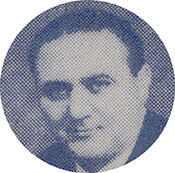
Here you will find contact information for Representative Alfred Edward Santangelo, including email address, phone number, and mailing address.
| Name | Alfred Edward Santangelo |
| Position | Representative |
| State | New York |
| District | 18 |
| Party | Democratic |
| Status | Former Representative |
| Term Start | January 3, 1957 |
| Term End | January 3, 1963 |
| Terms Served | 3 |
| Born | June 4, 1912 |
| Gender | Male |
| Bioguide ID | S000057 |
About Representative Alfred Edward Santangelo
Alfred Edward Santangelo (June 4, 1912 – March 30, 1978) was an American lawyer and Democratic politician from New York who served three terms as a United States Representative from 1957 to 1963. Over the course of a career that spanned state and national office, he contributed to the legislative process during a significant period in mid‑twentieth‑century American history, representing the interests of his New York constituents in both the New York State Senate and the U.S. House of Representatives.
Santangelo was born on June 4, 1912, in New York City. He was educated in the city’s public schools and graduated from Curtis High School on Staten Island. He went on to attend the City College of New York, where he became a member of the Alpha Phi Delta fraternity in 1935. Pursuing a legal career, he enrolled at Columbia Law School, from which he graduated in 1938, and was subsequently admitted to the bar, beginning the practice of law in New York.
Building on his legal background, Santangelo entered public life in the post–World War II era. He was first elected to the New York State Senate as a Democrat from the 22nd District, serving from 1947 to 1950. During this initial period in the State Senate he sat in the 166th and 167th New York State Legislatures, participating in the development of state policy in the early years of the postwar economic expansion. In 1950 he sought re‑election but was defeated by Republican William J. Bianchi, temporarily interrupting his legislative service.
Santangelo returned to the New York State Senate in the following decade. He again represented the 22nd District from 1953 to 1956, sitting in the 169th and 170th New York State Legislatures. His renewed tenure in Albany coincided with a period of rapid growth and change in New York City and its surrounding communities, and it helped establish his reputation as a Democratic legislator and prepared the way for his subsequent election to national office.
In 1956 Santangelo was elected as a Democrat to the 85th United States Congress and took his seat in the House of Representatives on January 3, 1957. He was re‑elected to the 86th and 87th Congresses, serving continuously from January 3, 1957, to January 3, 1963. As a member of the House during a pivotal era marked by the Eisenhower and Kennedy administrations, the early stages of the civil rights movement, and the intensification of Cold War tensions, Alfred Edward Santangelo participated in the democratic process at the federal level and contributed to the legislative work of Congress on behalf of his New York constituents. His three terms in office encompassed debates over domestic policy, economic growth, and national security that defined the late 1950s and early 1960s.
Following the 1960 Census, congressional redistricting in New York altered the political landscape in which Santangelo had been elected. Running for re‑election in November 1962 in the newly drawn 24th congressional district, he was defeated by Republican Paul A. Fino, bringing his service in the U.S. House of Representatives to a close on January 3, 1963. After leaving Congress, he returned to private life and to the practice of law, remaining identified with the Democratic Party and with the public service he had rendered at both the state and federal levels.
Alfred Edward Santangelo died on March 30, 1978, in Orlando, Florida. He was interred in Calvary Cemetery and Mausoleum in Woodside, Queens County, New York, returning in death to the city where he had been born, educated, and had built his career in law and politics.