Senator Algernon Sidney Paddock
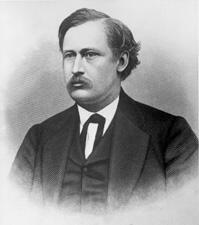
Here you will find contact information for Senator Algernon Sidney Paddock, including email address, phone number, and mailing address.
| Name | Algernon Sidney Paddock |
| Position | Senator |
| State | Nebraska |
| Party | Republican |
| Status | Former Representative |
| Term Start | December 6, 1875 |
| Term End | March 3, 1893 |
| Terms Served | 2 |
| Born | November 9, 1830 |
| Gender | Male |
| Bioguide ID | P000010 |
About Senator Algernon Sidney Paddock
Algernon Sidney Paddock (November 9, 1830 – October 17, 1897) was an American politician who served as secretary of Nebraska Territory and as a Republican United States Senator from Nebraska after statehood. He represented Nebraska in the U.S. Senate during two nonconsecutive terms between 1875 and 1893, contributing to the legislative process during a significant period in American history and participating actively in the democratic governance of his state and the nation.
Paddock was born in Glens Falls, Warren County, New York, where his father, Ira Paddock, was a prominent lawyer. He spent his youth in upstate New York and was educated at Glens Falls Academy and Union College. As a young man he taught school and studied law, reflecting an early engagement with both education and the legal profession. After college he spent about three months visiting a brother in Detroit, Michigan, but soon returned to New York, where he continued his legal studies and prepared for a professional career.
In 1857 Paddock left New York and settled in Omaha, in the Nebraska Territory, where he began to establish himself in public life and agricultural pursuits, starting a family and a farm practice. He became an active member of the Republican Party, with which he would be identified for the rest of his life. From 1858 to 1859 he helped edit the newspaper Nebraska Republican, using journalism to advance Republican principles. In 1859 he successfully ran for a seat in the Nebraska Territory House of Representatives and attended a territorial convention that same year. As his political profile grew, he served as a delegate to the Republican National Convention in 1860 and campaigned heavily for Abraham Lincoln in both Nebraska and New York. His extended family also had public reform connections; the noted anti-polygamy activist Cornelia Paddock was the wife of his cousin, Alonzo Paddock.
In 1861 President Abraham Lincoln appointed Paddock secretary of the Nebraska Territory, a position he held until Nebraska achieved statehood in 1867. During this period he also served as acting governor in 1861, assuming executive responsibilities in the territorial administration. When Nebraska became a state, Paddock sought election to both the United States House of Representatives and the United States Senate but was unsuccessful in those campaigns. President Andrew Johnson subsequently offered him the governorship of Wyoming Territory, an appointment Paddock declined. Remaining in Nebraska, he continued to be active in Republican politics and in the development of the region.
Paddock married Emma Mack in 1869, and the couple had several children. In 1872 he moved from Omaha to Beatrice, Nebraska, where he expanded his interests in agriculture and industry by starting a farm and a factory. His political career advanced further when, in 1875, he was elected to the United States Senate from Nebraska. He served his first term from 1875 to 1881, during which he was chairman of the Senate Committee on Agriculture from 1877 to 1878. As a member of the Senate, Paddock represented the interests of his Nebraska constituents and participated in national legislative debates during the post–Civil War and Reconstruction era. He was defeated for re-election in 1880, temporarily interrupting his congressional service.
In 1882 Paddock was appointed to a federal commission tasked with organizing elections in Utah Territory. He served on this commission until 1886 and used the position to support efforts to discourage and restrict the practice of polygamy in the territory, aligning with broader federal policies of the period. His work on the Utah commission kept him engaged in national issues even while he was out of the Senate, and it reinforced his reputation as a committed Republican and federal official.
Paddock returned to the U.S. Senate when he was again elected from Nebraska in 1886, beginning his second term on March 4, 1887. He served this six-year term until March 3, 1893. During this period he chaired two Senate committees and continued to be involved in agricultural and regulatory issues. In 1891 he introduced an important, though ultimately unsuccessful, bill to regulate certain aspects of food production for safety reasons, anticipating later federal food safety legislation. His advocacy in this area foreshadowed more extensive national laws on food and drug regulation that were enacted after his death. Throughout his years in Congress, from 1875 to 1893, Paddock participated in the legislative process during a transformative era in American economic and political development.
After retiring from the Senate in 1893, Paddock returned to Beatrice, Nebraska, where he engaged in the brokerage business and remained a respected figure in state affairs. He died in Beatrice on October 17, 1897. Following his death, he was interred at Prospect Hill Cemetery in North Omaha. His legacy in Nebraska is reflected in the naming of Paddock, in Holt County, Nebraska, in his honor, and in the preservation of his papers at the Nebraska State Historical Society, documenting the career of a prominent Republican leader of the territorial and early statehood periods.