Representative Allan Langdon McDermott
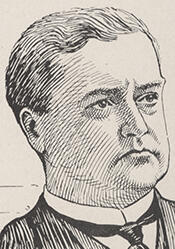
Here you will find contact information for Representative Allan Langdon McDermott, including email address, phone number, and mailing address.
| Name | Allan Langdon McDermott |
| Position | Representative |
| State | New Jersey |
| District | 10 |
| Party | Democratic |
| Status | Former Representative |
| Term Start | December 4, 1899 |
| Term End | March 3, 1907 |
| Terms Served | 4 |
| Born | March 30, 1854 |
| Gender | Male |
| Bioguide ID | M000403 |
About Representative Allan Langdon McDermott
Allan Langdon McDermott (March 30, 1854 – October 26, 1908) was an American Democratic Party politician who served as a Representative from New Jersey in the United States Congress from 1899 to 1907. He represented New Jersey’s 7th congressional district from 1900 to 1903 and the 10th district from 1903 to 1907, contributing to the legislative process during four terms in office. His congressional service occurred during a significant period in American history at the turn of the twentieth century, when he participated in the democratic process and represented the interests of his New Jersey constituents.
McDermott was born in South Boston, Massachusetts, on March 30, 1854, to a family of Scottish origin. He attended local public schools in Boston and was trained as a printer, a trade that led him into the world of journalism. For several years he worked as a newspaper reporter, gaining experience in public affairs and political life. Seeking a career in law, he moved to New Jersey and began legal studies under Leon Abbett, a prominent New Jersey lawyer and future governor. He subsequently enrolled in the law department of the University of the City of New York (now New York University School of Law), from which he graduated before being admitted to the bar in November 1877. After his admission, he commenced the practice of law in Jersey City, New Jersey.
McDermott’s early legal and public career developed rapidly in Jersey City. From 1879 to 1883 he served as corporation attorney for Jersey City, advising the municipal government on legal matters. He entered elective office as a member of the New Jersey General Assembly in 1880 and 1881, where he began to build his reputation within the Democratic Party. In 1883 he was appointed a district court judge, a position he held until 1886. During the same period, from 1883 to 1886, he served as president of the Jersey City Board of Finance and Taxation, overseeing important aspects of the city’s fiscal and tax administration. His expertise in taxation led to his appointment as a member of the New Jersey State Board of Taxation from 1884 to 1886, further solidifying his standing as an authority on state and local finance.
In addition to his legal and judicial responsibilities, McDermott became a key figure in New Jersey Democratic politics. He served as chairman of the New Jersey State Democratic Committee from 1885 to 1895, playing a central role in organizing the party and directing its statewide campaigns over a decade marked by shifting national political alignments. In 1894 he was appointed to the commission to revise the constitution of New Jersey, participating in efforts to modernize the state’s fundamental law. His prominence within the party led to his selection as the Democratic legislative caucus candidate for United States Senator in both 1895 and 1902, though he was not elected. He also served as a delegate at large to the Democratic National Convention in 1896, taking part in the national deliberations of his party during a pivotal presidential election year. McDermott continued his state-level legislative career as a member of the New Jersey Senate in 1899 and 1900.
McDermott entered the United States House of Representatives at the close of the nineteenth century. He was elected as a Democrat to the Fifty-sixth Congress to fill the vacancy caused by the death of Representative William D. Daly. He took his seat on December 3, 1900, and was subsequently reelected to the Fifty-seventh, Fifty-eighth, and Fifty-ninth Congresses. During this period he represented New Jersey’s 7th congressional district from 1900 to 1903 and, following redistricting, the 10th district from 1903 to 1907. Over the course of his four terms, he participated in debates and legislation during a transformative era that included issues of industrial regulation, urban growth, and America’s emerging role on the world stage. He chose not to be a candidate for renomination in 1906, bringing his congressional service to a close on March 3, 1907.
In his personal life, McDermott was married to Margaret O’Neill. The couple had two children: a son, Walter, and a daughter, Aline McDermott, who became known as an actress. After leaving Congress, McDermott returned to private life in New Jersey, remaining a respected figure in legal and political circles in Jersey City.
Allan Langdon McDermott died in Jersey City on October 26, 1908. He was interred in Hoboken Cemetery in North Bergen, New Jersey. His career spanned journalism, law, municipal and state office, party leadership, and service in the United States House of Representatives, reflecting a long engagement with public life in New Jersey and the nation.