Representative Allen Ralph Bushnell
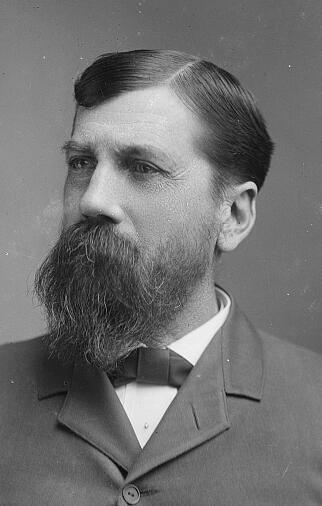
Here you will find contact information for Representative Allen Ralph Bushnell, including email address, phone number, and mailing address.
| Name | Allen Ralph Bushnell |
| Position | Representative |
| State | Wisconsin |
| District | 3 |
| Party | Democratic |
| Status | Former Representative |
| Term Start | December 7, 1891 |
| Term End | March 3, 1893 |
| Terms Served | 1 |
| Born | July 18, 1833 |
| Gender | Male |
| Bioguide ID | B001170 |
About Representative Allen Ralph Bushnell
Allen Ralph Bushnell (July 18, 1833 – March 29, 1909) was an American attorney, politician, and Democratic member of Congress from the U.S. state of Wisconsin. He served as a Representative from Wisconsin in the United States Congress from 1891 to 1893, completing one term in the House of Representatives. Over the course of his public life, he was the first mayor of Lancaster, Wisconsin, represented that area in the Wisconsin State Assembly in the 1872 session, served as United States Attorney for the Western District of Wisconsin, and was a Union Army officer in the American Civil War with the famous Iron Brigade of the Army of the Potomac.
Bushnell was born in Hartford, Trumbull County, Ohio, on July 18, 1833, the son of Dr. George W. Bushnell and Sarah (Bates) Bushnell. He attended the public schools of Hartford and pursued higher education at Oberlin College and Hiram College in Ohio. After his collegiate studies, he turned to the law, moving west to Grant County, Wisconsin, in 1854. There he read law in the office of attorney Stephen O. Paine in Platteville, supporting himself in part by teaching school. In December 1857 he was admitted to the Wisconsin bar at Lancaster, Wisconsin, and soon afterward established his own legal practice in Platteville, which he maintained for the next four years.
Bushnell entered public office in 1860 when he was elected district attorney of Grant County, assuming the position in January 1861. His tenure was short-lived, as the outbreak of the American Civil War prompted him to resign after only a few months in order to volunteer for military service in the Union Army. Responding to President Abraham Lincoln’s call for 75,000 volunteers, he enrolled as a private in a local militia unit known as the Platteville Guards, which subsequently became Company C of the 7th Wisconsin Infantry Regiment. When the regiment mustered into federal service, Bushnell was commissioned first lieutenant of Company C.
Serving in the eastern theater of the war, Bushnell and the 7th Wisconsin Infantry were organized into a brigade under General Rufus King alongside the 2nd Wisconsin, 6th Wisconsin, and 19th Indiana regiments. This formation soon gained renown as the Iron Brigade of the Army of the Potomac. Bushnell rose to the rank of captain of Company C and saw action in major engagements, including the Second Battle of Bull Run and the Battle of Fredericksburg. His military career was cut short in 1863 when he received an honorable discharge due to medical disability. Following his discharge, he returned to Ohio and spent about a year under the care of his father before resuming his professional life.
In 1864 Bushnell returned to Wisconsin and resumed the practice of law, relocating his practice from Platteville to Lancaster. Shortly after his return, his successor as Grant County district attorney, Joseph Trotter Mills, resigned after being elected to the Wisconsin circuit court. Governor James T. Lewis appointed Bushnell to fill the remainder of Mills’s term as district attorney, which expired in January 1865. Initially active in the Republican Party of Wisconsin, Bushnell reentered elective politics in 1871 and was elected to the Wisconsin State Assembly from Grant County’s 2nd Assembly district, defeating James Wilson Seaton. He served in the 1872 legislative session and sat on the Assembly Committee on the Judiciary and the Joint Committee on Charitable and Penal Institutions. When Lancaster was incorporated as a city in 1878, Bushnell was elected its first mayor, further solidifying his local prominence.
Bushnell’s party allegiance shifted over time. Disillusioned with postwar spending and what he regarded as the excesses of the Republican political machine, he endorsed and campaigned for Democrat Samuel J. Tilden in the 1876 presidential election. Thereafter he became aligned with the Democratic Party. When Democrat Grover Cleveland assumed the presidency in 1885, Bushnell was appointed United States Attorney for the Western District of Wisconsin. He held that federal prosecutorial post until 1890, when a successor was appointed by Republican President Benjamin Harrison. Later that year, Bushnell became the Democratic nominee for the United States House of Representatives in Wisconsin’s 3rd congressional district and, in the wave election of 1890, unseated incumbent Republican Robert M. La Follette.
As a member of the House of Representatives, Bushnell participated in the democratic process and represented the interests of his constituents during a significant period in American history. He moved his residence to Madison, Wisconsin, in 1891, prior to being sworn in to the Fifty-second Congress in March of that year. During his single term in Congress, from 1891 to 1893, he became a proponent of silver-backed currency, reflecting contemporary debates over monetary policy. His most enduring legislative contribution was his support for a proposed constitutional amendment providing for the direct election of United States senators. The measure passed the House of Representatives but failed in the Senate; the principle it embodied would not be fully realized until the ratification of the Seventeenth Amendment to the United States Constitution roughly two decades later. The congressional redistricting of 1891 placed Bushnell in the same district as fellow Democratic incumbent Charles Barwig. In the ensuing intraparty contest, the Democratic Party chose to renominate Barwig for the 1892 election, and Bushnell left office at the expiration of his term in March 1893.
After his congressional service, Bushnell resumed the practice of law in Madison. He also entered the business field, serving as counsel and treasurer for the Wisconsin Life Insurance Company. Remaining engaged in public affairs, he made one final bid for elective office in 1906, running for a seat on the Wisconsin Supreme Court. In a four-way race, he was defeated by attorney William H. Timlin. Bushnell continued to reside in Madison and remained a respected figure in Wisconsin’s legal and political circles.
In his personal life, Bushnell married Laura F. Burr, with whom he had three children; only one daughter survived infancy. Laura Burr Bushnell died in 1873. In 1875 he married Mary P. Sherman, a cousin of his first wife. With Mary Sherman he had at least three more children, though only one son, Alfred, survived childhood. In early 1909, while attending his sister’s funeral in Platteville, Bushnell contracted pneumonia. He died at his home in Madison on March 29, 1909. His remains were interred at Hillside Cemetery in Lancaster, Wisconsin, closing the life of a lawyer, soldier, and public servant whose career spanned local, state, and national office.