Representative Allen Daniel Candler
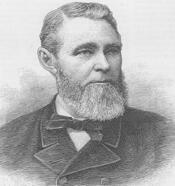
Here you will find contact information for Representative Allen Daniel Candler, including email address, phone number, and mailing address.
| Name | Allen Daniel Candler |
| Position | Representative |
| State | Georgia |
| District | 9 |
| Party | Democratic |
| Status | Former Representative |
| Term Start | December 3, 1883 |
| Term End | March 3, 1891 |
| Terms Served | 4 |
| Born | November 4, 1834 |
| Gender | Male |
| Bioguide ID | C000109 |
About Representative Allen Daniel Candler
Allen Daniel Candler (November 4, 1834 – October 26, 1910) was a Georgia state legislator, U.S. Representative, and the 56th Governor of Georgia. He was born in Auraria, a mountainous mining community in Lumpkin County, Georgia, the eldest of twelve children of Daniel Gill Candler and Nancy Caroline Matthews. Raised in rural north Georgia, he attended local country schools before enrolling at Mercer University in Macon, Georgia. He graduated from Mercer in 1859, after which he briefly studied law and worked as a schoolteacher, laying the foundation for a public career that would span municipal, state, and federal office.
With the outbreak of the Civil War, Candler entered Confederate service. In May 1862 he enlisted as a private in the 34th Georgia Volunteer Infantry and was immediately elected first lieutenant by the men of his company. He saw action in some of the war’s most intense campaigns, including the battles of Vicksburg, Missionary Ridge, Resaca, Kennesaw Mountain, Atlanta, and Jonesboro. Over the course of the conflict he rose to the rank of colonel and, by war’s end, was serving under General Joseph E. Johnston in the Army of Tennessee in North Carolina. Candler was wounded at Kennesaw Mountain and lost an eye at Jonesboro. Reflecting on his survival and losses after the war, he remarked that he considered himself comparatively fortunate, counting himself “quite wealthy” with “one wife, and baby, one eye, and one silver dollar.”
After the Civil War, Candler settled first in Jonesboro, Georgia, and later in Gainesville, Georgia. He turned to farming and business pursuits and soon became active in Democratic politics during the turbulent Reconstruction era. As one of many conservative Democrats seeking to restore their party’s control over state government from the Republican administration backed by occupying federal troops, he emerged as a local leader. In 1872 he was elected mayor of Gainesville. The following year, in 1873, he entered the Georgia House of Representatives, where he served until 1878. That year he was elected to the Georgia Senate, serving a two-year term. During this period he was also involved in manufacturing enterprises and served as president of a railroad, combining commercial leadership with his growing influence in state politics.
Candler advanced to national office in the early 1880s. In 1882 he was elected as a Democrat to the 48th Congress and served as a Representative from Georgia in the United States House of Representatives from March 4, 1883, to March 3, 1891, a span of four consecutive terms. His service in Congress occurred during a significant period in American history marked by post-Reconstruction realignment and industrial expansion. As a member of the House of Representatives, he participated in the legislative process and represented the interests of his Georgia constituents. During his third term he served as chairman of the Committee on Education, giving him a role in shaping federal policy in that area. In 1886 he drew controversy at home when he introduced legislation to allocate federal pension funds “for the relief of the First Georgia State Troops,” a Union-aligned regiment organized in 1864 by James G. Brown. The proposal provoked angry protests from many north Georgia Confederates, who derisively referred to the unit as “first Georgia hogback Yankey fellers.” Candler declined to run for re-election in 1890 and left Congress at the close of his fourth term in 1891.
Returning to state politics, Candler was elected Secretary of State of Georgia in 1894. He held that office until 1898, when he resigned to seek the governorship. Campaigning as the “one-eyed ploughboy from Pigeon Roost,” a reference to both his war injury and rural background, he won the 1898 gubernatorial election with approximately 70 percent of the vote, defeating Populist candidate J. R. Hogan. He was re-elected to a second two-year term in 1900, defeating another Populist challenger, George W. Trayler. As governor, Candler was known as a conservative administrator. He supported pensions for Confederate widows but otherwise pursued reductions in state taxes and government expenditures. He also advocated the establishment of a whites-only Democratic primary on the theory that the Democratic Party was a private organization and thus not bound by the Fifteenth Amendment’s guarantee of voting rights regardless of race. In a one-party system in which Democrats dominated all levels of government from the end of Reconstruction in 1871 until the late twentieth century, this policy effectively excluded Black citizens from meaningful participation in Georgia’s electoral process.
Candler’s tenure as governor coincided with some of the most violent episodes of lynching in Georgia’s history. While he publicly condemned mob violence and urged the courts to conduct speedier trials in an effort to forestall lynchings, he simultaneously attributed such violence to what he characterized as Black criminality and white resentment of African Americans’ demands for equal treatment. In the events surrounding the notorious 1899 lynching of Sam Hose, Candler criticized what he called the “better class” of Black citizens for not assisting authorities in Hose’s apprehension. His statements, widely reported in the Atlanta press alongside editorials that inflamed public sentiment, reflected and reinforced the racial attitudes and practices that underpinned segregation and extrajudicial violence in the state at the turn of the century.
After leaving the governor’s office, Candler continued in public service as Georgia’s first compiler of records. In that capacity he devoted himself to the collection, organization, and publication of the state’s historical documents, particularly those from the colonial, Revolutionary, and Confederate periods. His work resulted in nearly thirty volumes of edited state records, a contribution that significantly shaped the preservation of Georgia’s documentary heritage. In recognition of his efforts and his long career in public life, Candler County, Georgia, created in 1914, was named in his honor.
Allen Daniel Candler died on October 26, 1910, in Atlanta, Georgia. He was buried in Alta Vista Cemetery in Gainesville, the community that had been central to his postwar life and political rise.