Representative Alton Lennon
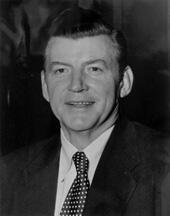
Here you will find contact information for Representative Alton Lennon, including email address, phone number, and mailing address.
| Name | Alton Lennon |
| Position | Representative |
| State | North Carolina |
| District | 7 |
| Party | Democratic |
| Status | Former Representative |
| Term Start | July 10, 1953 |
| Term End | January 3, 1973 |
| Terms Served | 9 |
| Born | August 17, 1906 |
| Gender | Male |
| Bioguide ID | L000240 |
About Representative Alton Lennon
Alton Asa Lennon (August 17, 1906 – December 28, 1986) was an American Democratic politician who represented North Carolina in both the United States Senate and the United States House of Representatives. Over the course of nine terms in Congress, he contributed to the legislative process during a significant period in American history, and he is one of very few former senators in modern times to have subsequently served in the House. A member of the Democratic Party, he first entered national office through an interim appointment to the Senate in the 1950s and later represented the Cape Fear region in the House of Representatives from 1957 to 1973.
Lennon was born in Wilmington, New Hanover County, North Carolina, on August 17, 1906, the son of Rosser Yates Lennon and Minnie (High) Lennon. He attended the public schools of Wilmington before enrolling at Wake Forest College, from which he graduated in 1929. That same year he was admitted to the bar and began the practice of law in Wilmington. On October 12, 1933, he married Karine Welch, and Wilmington remained his lifelong home and the base of his professional and political activities.
Lennon’s early public career was rooted in local and state service. From 1934 to 1942 he served as judge of the New Hanover County Recorder’s Court, gaining experience in the administration of justice at the county level. After returning to private law practice, he was elected to the North Carolina State Senate in 1947 and served there until 1951. His work in the state legislature helped establish his reputation within the Democratic Party and prepared him for subsequent federal office.
Lennon entered national politics when he was appointed as a Democrat to the United States Senate on July 10, 1953, to fill the vacancy caused by the death of Senator Willis Smith. He served in the Senate from July 10, 1953, to November 28, 1954. Seeking to continue in that office, he was an unsuccessful candidate for the Democratic nomination in 1954 to fill the vacancy in his own right. After leaving the Senate, he resumed the practice of law in Wilmington, but he remained active in public affairs and within the Democratic Party.
In 1956 Lennon was elected as a Democrat to the 85th Congress and took his seat in the U.S. House of Representatives on January 3, 1957. He was reelected to the seven succeeding Congresses, serving continuously from January 3, 1957, to January 3, 1973, and representing the Cape Fear region of North Carolina. Over these nine terms in Congress—counting both his Senate and House service—he participated in the democratic process and represented the interests of his constituents during a period marked by the civil rights movement, the Cold War, and the Vietnam War. His long tenure made him a familiar figure in North Carolina politics and in the House Democratic caucus.
Lennon’s congressional record was characterized by consistent opposition to major federal civil rights and certain social legislation, despite the fact that roughly half of the residents of his district were African American or Native American. He voted against the Civil Rights Act of 1957, the Civil Rights Act of 1960, the Civil Rights Act of 1964, and the Civil Rights Act of 1968. He also opposed the 24th Amendment to the U.S. Constitution, which abolished the poll tax in federal elections, and the Voting Rights Act of 1965. In 1966 he was the only Southerner to vote against citing seven Ku Klux Klan leaders for contempt of Congress, stating, “I never heard it said that Klansmen were subversive or affiliated with any foreign government to overthrow the United States.” During the mid-1960s he also took hawkish positions on foreign policy and domestic dissent, urging in 1966 that North Vietnamese ports be bombed and calling in 1967 for the Department of Justice to prosecute black activist Stokely Carmichael for statements against the military draft.
Lennon declined to seek reelection to the House in 1972, bringing his congressional service to a close on January 3, 1973. In his later years he remained a prominent figure in North Carolina public life. Although a lifelong Democrat, he supported conservative Republican Senator Jesse Helms’s bid for reelection in 1978, reflecting his own conservative orientation on many national issues. In recognition of his long public service and his association with his hometown, the Federal Building and Courthouse in Wilmington was named in his honor in 1976.
Alton Asa Lennon continued to reside in Wilmington, North Carolina, after leaving Congress and lived there until his death on December 28, 1986. His career spanned local judicial service, the North Carolina State Senate, an appointed term in the United States Senate, and eight consecutive terms in the United States House of Representatives, marking more than three decades of involvement in state and national politics.