Representative Alvin Paul Kitchin
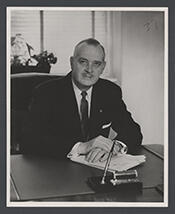
Here you will find contact information for Representative Alvin Paul Kitchin, including email address, phone number, and mailing address.
| Name | Alvin Paul Kitchin |
| Position | Representative |
| State | North Carolina |
| District | 8 |
| Party | Democratic |
| Status | Former Representative |
| Term Start | January 3, 1957 |
| Term End | January 3, 1963 |
| Terms Served | 3 |
| Born | September 13, 1908 |
| Gender | Male |
| Bioguide ID | K000249 |
About Representative Alvin Paul Kitchin
Alvin Paul Kitchin (September 13, 1908 – October 22, 1983) was a Democratic member of the United States House of Representatives from North Carolina who served three consecutive terms in Congress from 1957 to 1963. He was born in Scotland Neck, Halifax County, North Carolina, on September 13, 1908, into a family deeply involved in state and national politics. He was the grandson of former congressman William H. Kitchin and the nephew of congressman Claude Kitchin and North Carolina Governor William Walton Kitchin. At the time of his birth, his father, A. Paul Kitchin Sr., was serving as a member of the North Carolina House of Representatives, further embedding him in a tradition of public service from an early age.
Kitchin was educated in the public schools of North Carolina and attended Oak Ridge Military Academy from 1923 to 1925. He went on to study law at Wake Forest College Law School, from which he graduated in 1930. That same year he was admitted to the bar and commenced the practice of law in his hometown of Scotland Neck. His early legal career in private practice provided him with a foundation in the law and in the concerns of local citizens that would later inform his work as a federal official and legislator.
In 1933, Kitchin entered federal service with the Federal Bureau of Investigation, marking a significant shift from local legal practice to national law enforcement. Over the course of his FBI career, he rose to serve as special agent in charge of several major field offices, including those in Newark, New Jersey; New Orleans, Louisiana; and Dallas, Texas. His work in these posts placed him at the center of federal investigative activity in diverse regions of the country during a period that spanned the Great Depression, World War II, and the early postwar years. He retired from the FBI in August 1945 and returned to North Carolina, settling in Wadesboro, the hometown of his wife. There he resumed the practice of law, establishing himself as a prominent attorney and community figure in Anson County.
Kitchin’s entry into congressional politics came in the mid-1950s, during a period of intense regional and national debate over civil rights and federal authority. In 1956, he was elected as a Democrat to the 85th Congress after the local Democratic organization turned against incumbent Representative Charles B. Deane, who had refused to sign the Southern Manifesto, a document opposing the Supreme Court’s desegregation rulings. Kitchin was selected and supported by party leaders in part because of his strong backing of the Southern Manifesto, reflecting the prevailing segregationist sentiment among many white voters and political leaders in his district at that time.
Alvin Paul Kitchin took his seat in the U.S. House of Representatives on January 3, 1957, representing a North Carolina district during a significant period in American history marked by the early civil rights movement, the Cold War, and the Eisenhower and Kennedy administrations. As a member of the House of Representatives, he participated in the legislative process and represented the interests of his constituents, contributing to debates and votes on domestic and foreign policy issues that came before the 85th, 86th, and 87th Congresses. He was re-elected to the 86th Congress, serving from January 3, 1959, to January 3, 1961, and again to the 87th Congress, serving until January 3, 1963, thus completing three full terms in office.
Kitchin’s congressional career came to an end following redistricting prior to the 1962 elections. The redrawing of district lines placed him in a more competitive political environment alongside Republican Representative Charles R. Jonas. Running for re-election in the newly configured 8th District, Kitchin faced Jonas in the general election and was defeated, bringing his six-year tenure in the House to a close. His loss reflected both the changing political landscape of North Carolina and the growing strength of the Republican Party in parts of the South during the early 1960s.
After leaving Congress in 1963, Kitchin returned to Wadesboro and resumed the full-time practice of law. He remained a resident of Wadesboro, continuing his legal work and maintaining his involvement in local affairs. Alvin Paul Kitchin lived there until his death on October 22, 1983. He was interred at East View Cemetery in Wadesboro, North Carolina, closing a life that had spanned local law practice, federal investigative service, and three terms in the United States Congress.