Representative Ambrose Williams Clark
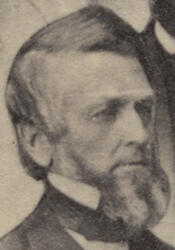
Here you will find contact information for Representative Ambrose Williams Clark, including email address, phone number, and mailing address.
| Name | Ambrose Williams Clark |
| Position | Representative |
| State | New York |
| District | 20 |
| Party | Republican |
| Status | Former Representative |
| Term Start | July 4, 1861 |
| Term End | March 3, 1865 |
| Terms Served | 2 |
| Born | February 19, 1810 |
| Gender | Male |
| Bioguide ID | C000420 |
About Representative Ambrose Williams Clark
Ambrose Williams Clark (February 19, 1810 – October 13, 1887) was a U.S. Representative from New York who served in the United States Congress from 1861 to 1865. A member of the Republican Party, he represented his constituents in the House of Representatives during the critical years of the American Civil War and contributed to the legislative process over two consecutive terms in office.
Clark was born near Cooperstown, New York, on February 19, 1810. He attended the public schools and was trained as a printer, a trade that led him into the newspaper business at an early age. His work in printing and publishing provided him with both a livelihood and a platform for political advocacy in upstate New York during a period of rapid political realignment and sectional tension in the United States.
Building on his training as a printer, Clark became an influential newspaper publisher and an advocate of Whig Party politics. He was publisher of the Otsego Journal from 1831 to 1836, using the paper to support Whig positions and candidates. In 1836 he moved to Lewis County, where he published the Northern Journal until 1844. He then settled in Watertown, New York, where from 1844 to 1860 he published the Northern New York Journal. Through these newspapers, Clark played a prominent role in shaping public opinion in central and northern New York, particularly on issues of economic development and national policy.
With the collapse of the Whig Party in the 1850s, Clark became an early adherent of the newly formed Republican Party. He formally aligned with the Republicans when the party was founded in the mid-1850s, reflecting his opposition to the expansion of slavery and his support for many of the economic policies that the new party advanced. His prominence as a publisher and party advocate led to local public office. In 1859 and 1860 he served as the town supervisor of Watertown and, by virtue of that office, as a member of the Jefferson County Board of Supervisors, gaining administrative and legislative experience at the local level.
Clark was elected as a Republican to the Thirty-seventh and Thirty-eighth Congresses, serving from March 4, 1861, to March 4, 1865. His entire congressional tenure coincided with the Civil War, a significant period in American history in which Congress grappled with questions of Union preservation, military mobilization, finance, and emancipation. As a member of the House of Representatives, Ambrose Williams Clark participated in the democratic process and represented the interests of his New York constituents while supporting the broader Republican war effort and national legislative program. During these two terms he contributed to the work of Congress as it sought to sustain the Union and redefine the federal government’s role during wartime.
After leaving Congress in 1865, Clark continued his public service in the diplomatic corps. He was appointed by President Abraham Lincoln as United States consul at Valparaíso, Chile, and served in that capacity from 1865 to 1869. While stationed in Valparaíso, he was responsible for protecting American commercial and maritime interests in one of the principal ports on the Pacific coast of South America. In 1869 he also acted as chargé d’affaires in Chile in the absence of the U.S. Minister, temporarily assuming the chief diplomatic responsibilities of the legation and representing the United States government in its relations with the Chilean authorities.
In his later years Clark resided in Watertown, New York, where he remained a respected figure owing to his long career in journalism, local government, national politics, and diplomacy. His family connections also linked him to other public figures; his daughter Paulina Sabina Clark was the wife of George A. Bagley, who would himself serve as a U.S. Representative from New York. Ambrose Williams Clark died in Watertown on October 13, 1887. He was interred in Brookside Cemetery in Watertown, closing a life that spanned the early republic, the Civil War era, and the nation’s postwar expansion.