Representative Ambrose Arnold Ranney
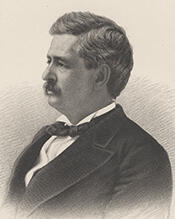
Here you will find contact information for Representative Ambrose Arnold Ranney, including email address, phone number, and mailing address.
| Name | Ambrose Arnold Ranney |
| Position | Representative |
| State | Massachusetts |
| District | 3 |
| Party | Republican |
| Status | Former Representative |
| Term Start | December 5, 1881 |
| Term End | March 3, 1887 |
| Terms Served | 3 |
| Born | April 17, 1821 |
| Gender | Male |
| Bioguide ID | R000058 |
About Representative Ambrose Arnold Ranney
Ambrose Arnold Ranney (April 17, 1821 – March 5, 1899) was a Republican Representative from Massachusetts who served three consecutive terms in the United States House of Representatives from 1881 to 1887. His congressional career took place during a significant period in American history, as the nation continued to adjust to the post–Civil War era and the rapid economic and social changes of the late nineteenth century. Over the course of his public life, he combined a substantial legal career with repeated service in state and national office, and he was noted for his support of women’s suffrage.
Ranney was born in Townshend, Vermont, on April 17, 1821, the son of Waitstill R. Ranney and Phebe (Atwood) Ranney. Raised in rural Vermont, he pursued a classical education that prepared him for advanced study. He attended Dartmouth College in Hanover, New Hampshire, from which he graduated before turning to the study of law. His early life in New England, in a region strongly influenced by reform movements and a tradition of civic engagement, helped shape the outlook he later brought to his legal and political work.
After completing his studies at Dartmouth, Ranney read law in Woodstock, Vermont, in 1844, following the then-common practice of legal apprenticeship rather than formal law school training. He subsequently relocated to Massachusetts, where he was admitted to the bar in 1848. That same year he commenced the practice of law in Boston, building a professional reputation in one of the nation’s leading commercial and legal centers. His growing experience in municipal and corporate matters led to increasing responsibilities in public legal service.
Ranney’s legal expertise brought him into Boston city government, where he served as corporation counsel from 1855 to 1857. In this capacity he acted as the chief legal officer for the city, advising municipal authorities and representing Boston in legal matters at a time of urban expansion and infrastructural development. His work as corporation counsel enhanced his visibility in Massachusetts politics and laid the groundwork for his subsequent legislative career.
Ranney entered elective office as a member of the Massachusetts House of Representatives, serving in that body in 1857, 1863, and 1864. His terms in the state legislature coincided with the tumultuous years surrounding the Civil War, when Massachusetts played a prominent role in national debates over slavery, union, and reconstruction. As a Republican legislator, he participated in the state-level democratic process and contributed to the formulation of laws and policies during a period of intense political and social change.
Building on his state legislative experience, Ranney was elected as a Republican to the United States House of Representatives, where he served in the Forty-seventh, Forty-eighth, and Forty-ninth Congresses from 1881 to 1887. Representing a Massachusetts district, he took part in the national legislative process during the Gilded Age, addressing issues related to economic development, civil rights, and governance in a rapidly industrializing country. Among his notable positions was his support for women’s suffrage, aligning him with reformers who sought to expand democratic participation. He represented the interests of his constituents in Massachusetts while contributing to broader national debates in the House of Representatives.
Ranney’s congressional service ended when he was an unsuccessful candidate for reelection in 1886 to the Fiftieth Congress. After leaving Congress in 1887, he resumed the practice of law in Boston, returning to the profession in which he had long been established. He continued his legal work during his later years, remaining part of the city’s professional and civic life until his death.
Ambrose Arnold Ranney died in Boston, Massachusetts, on March 5, 1899. He was buried at Forest Hills Cemetery in Boston, a resting place for many of the city’s prominent citizens. His career, spanning local, state, and national service, reflected the pathways by which nineteenth-century lawyers shaped public policy and participated in the evolving democratic institutions of the United States.