Senator Ambrose Hundley Sevier
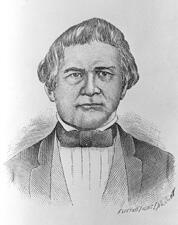
Here you will find contact information for Senator Ambrose Hundley Sevier, including email address, phone number, and mailing address.
| Name | Ambrose Hundley Sevier |
| Position | Senator |
| State | Arkansas |
| Party | Democratic |
| Status | Former Representative |
| Term Start | February 23, 1828 |
| Term End | March 15, 1848 |
| Terms Served | 8 |
| Born | November 4, 1801 |
| Gender | Male |
| Bioguide ID | S000256 |
About Senator Ambrose Hundley Sevier
Ambrose Hundley Sevier (November 4, 1801 – December 31, 1848) was an American attorney, planter, and Democratic politician from Arkansas who became one of the most influential figures in the territory’s transition to statehood and in its early representation in the United States Congress. A central member of the powerful Conway-Johnson political alliance—often called “The Family”—that dominated Arkansas politics in the antebellum period, he was elected by the state legislature as a United States Senator and also served as Speaker of the Arkansas Territorial House of Representatives. Over the course of his long legislative career, he contributed to the democratic process and represented the interests of his constituents during a significant period in American history.
Sevier was born near Greeneville, in Greene County, Tennessee, on November 4, 1801. In 1820 he moved west to Missouri, reflecting the broader migration patterns of Americans pushing into the trans-Mississippi frontier. The following year, in 1821, he settled in Little Rock in the Arkansas Territory, which was then in the early stages of its political and institutional development. There he entered public service as clerk of the Territorial House of Representatives. While working in the territorial legislature, he studied law and was admitted to the bar in 1823, beginning a legal career that complemented his growing prominence in territorial politics.
Sevier’s family and marital connections further anchored him in Arkansas’s emerging political elite. He married Juliette Johnson, the daughter of Benjamin Johnson, who had gone to Arkansas as the first territorial judge and who, in 1836, became the first federal district judge when Arkansas was admitted as a state. Juliette’s brother, Robert Ward Johnson, later became an influential Arkansas politician and United States Senator. Ambrose and Juliette Sevier had several children, and through blood and marriage Sevier was linked to a network of Democratic leaders including his first cousins Representative Henry Wharton Conway, Governor James Sevier Conway, and Governor Elias Nelson Conway; his brother-in-law Senator Robert Ward Johnson; and his son-in-law Governor Thomas James Churchill. This extended political kinship group, known collectively as “The Family,” exercised substantial control over Arkansas’s territorial and early state governments.
Sevier’s formal political career began in the Arkansas Territorial House of Representatives, to which he was elected in 1823. He served in that body until 1827 and was chosen as Speaker in 1827, demonstrating his rapid rise in territorial politics. Following the death of his cousin Henry Wharton Conway, who was killed in a duel, Sevier was elected as a Jacksonian Delegate to the Twentieth Congress to fill the resulting vacancy. He took his seat in 1828 and was reelected as territorial delegate to three successive Congresses, serving continuously from 1828 to 1836. In this role he had no vote on the House floor but played a crucial part in advocating for Arkansas’s interests and pressing for its admission to the Union. His leadership during this period earned him recognition as the “Father of Arkansas Statehood.”
When Arkansas was admitted to the Union in 1836, Sevier’s prominence was rewarded with election by the state legislature as one of the new state’s first United States Senators. He is recorded as having served as a Senator from Arkansas in the United States Congress from 1828 to 1848, encompassing his years as territorial delegate and then as senator, and he was a member of the Democratic Party throughout this period. In the Senate, he was first elected in 1836 and subsequently reelected in 1837 and 1843, reflecting sustained legislative and political support at home. During the Twenty-ninth Congress he was, by courtesy, allowed to occupy the chair as President pro tempore of the Senate for a day, though he was not formally elected to that post. Over his Senate career he served as chairman of the Committee on Indian Affairs and as a member of the Committee on Foreign Relations, positions that placed him at the center of federal policymaking on issues critical to the expanding nation, including relations with Native American nations and the conduct of foreign affairs. He resigned his Senate seat in 1848, concluding two decades of continuous service in the national legislature.
In the final year of his life, Sevier continued to play a significant role in national affairs. In 1848 he was appointed a commissioner to help negotiate the Treaty of Guadalupe Hidalgo, which brought the Mexican–American War to an end and transferred vast territories to the United States. Later that year, in December 1848, President James K. Polk appointed him to head what would later become the International Boundary and Water Commission, charged with overseeing the new boundary between the United States and Mexico. Sevier, however, died before the Senate could act on his nomination, and he never assumed that post.
Ambrose Hundley Sevier died on December 31, 1848, on his plantation in Pulaski County, Arkansas, shortly after completing his work related to the treaty negotiations that reshaped the map of North America. He was buried in historic Mount Holly Cemetery in Little Rock, where the State of Arkansas later erected a monument in his honor. Sevier County, Arkansas, was named for him, further commemorating his legacy. Remembered as the “Father of Arkansas Statehood” and as a leading figure in the Conway-Johnson “Family” of Democratic politicians, Sevier left a lasting imprint on the political development of Arkansas and on the broader history of the United States during a formative era.