Representative Americus Vespucius Rice
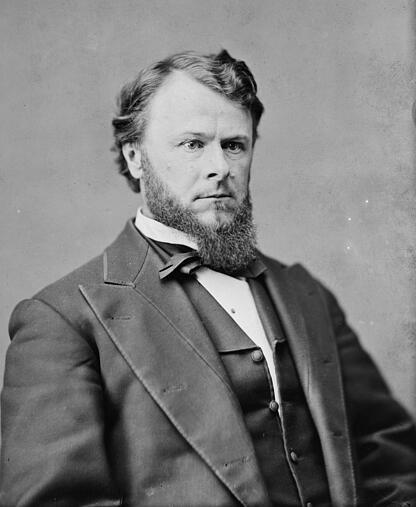
Here you will find contact information for Representative Americus Vespucius Rice, including email address, phone number, and mailing address.
| Name | Americus Vespucius Rice |
| Position | Representative |
| State | Ohio |
| District | 5 |
| Party | Democratic |
| Status | Former Representative |
| Term Start | December 6, 1875 |
| Term End | March 3, 1879 |
| Terms Served | 2 |
| Born | November 18, 1835 |
| Gender | Male |
| Bioguide ID | R000194 |
About Representative Americus Vespucius Rice
Americus Vespucius Rice (November 18, 1835 – April 4, 1904) was a nineteenth-century politician, banker, businessman, and Union Army officer from Ohio who served two consecutive terms as a Democratic Representative in the United States House of Representatives from 1875 to 1879. He was born in Perrysville, Ashland County, Ohio, on November 18, 1835, to Clark Hammond Rice and Catherine (Mowers) Rice. A direct descendant of Edmund Rice, an English immigrant to the Massachusetts Bay Colony, his lineage ran through Clark Hammond Rice (1804–1870), Ebenezer Rice (1773–1821), Samuel Rice (1752–1828), Gershom Rice (1703–?), Ephraim Rice (1665–1732), and Thomas Rice (1626–1681) to Edmund Rice (1594–1663). He pursued classical studies in his youth, attended Antioch College in Yellow Springs, Ohio, and later graduated from Union College in Schenectady, New York. He also undertook the study of law, although his professional career ultimately centered on military service, politics, and banking rather than legal practice.
At the outbreak of the American Civil War, Rice entered the Union Army and quickly assumed positions of responsibility. He was first commissioned as a captain in the 21st Ohio Volunteer Infantry Regiment on April 27, 1861, serving with that unit until it was mustered out of service on August 12, 1861. Shortly thereafter, on September 2, 1861, he was commissioned as a captain in the 57th Ohio Infantry. His leadership and service led to rapid advancement: he was promoted to lieutenant colonel on February 8, 1862, and became colonel of the 57th Ohio Infantry on May 24, 1863. During the Atlanta Campaign, while commanding the regiment at the Battle of Kennesaw Mountain, he was severely wounded, resulting in the amputation of his right leg, a sacrifice that would shape both his later public service and his interest in veterans’ welfare.
In recognition of his wartime service, Rice received a brevet promotion at the close of the conflict. On May 31, 1865, he was appointed a brigadier general of volunteers, and on January 13, 1866, President Andrew Johnson formally nominated him for appointment as a brigadier general of volunteers with rank from that date of May 31, 1865. The United States Senate confirmed this appointment on February 23, 1866. Rice was mustered out of volunteer service on January 15, 1866, concluding a distinguished military career that had taken him from captain to brigade command. After the war, he became a member of the Ohio Commandery of the Military Order of the Loyal Legion of the United States, a prestigious military society composed of Union officers and their descendants, reflecting his continued association with the community of former Union officers.
Following his return to civilian life, Rice turned to banking and business in Ohio. He became manager of a private banking house in Ottawa, Putnam County, Ohio, where he established himself as a prominent local financier. His growing involvement in public affairs led to his selection as a delegate to the Democratic National Convention in 1872, signaling his emergence as an influential figure within the Democratic Party in Ohio. Building on his wartime reputation and business standing, he successfully sought national office two years later.
Rice was elected as a Democrat to the United States House of Representatives in 1874 and served in the Forty-fourth and Forty-fifth Congresses from March 4, 1875, to March 3, 1879, representing Ohio. His service in Congress occurred during a significant period in American history, in the decade following the Civil War and during the later years of Reconstruction. As a member of the House of Representatives, he participated in the legislative process and represented the interests of his Ohio constituents. During his two terms, he served as chairman of the Committee on Invalid Pensions from 1877 to 1879, a role in which his own experience as a wounded veteran and amputee informed his work on legislation affecting disabled soldiers and their families. He did not seek renomination in 1878 and thus concluded his congressional service at the end of his second term in 1879.
After leaving Congress, Rice resumed and expanded his activities in banking and business. He became president of A. V. Rice & Company, a banking concern in Ottawa, Ohio, and served as a director in various business enterprises, further solidifying his status as a leading businessman in his region. His expertise and reputation led to his appointment as a pension agent for Ohio in 1893, and he served in that capacity from 1894 to 1898, administering federal pension payments to veterans and their dependents. This appointment continued the pattern of his public life, which consistently linked his Civil War service to advocacy and administration on behalf of former soldiers.
In the closing years of his life, Rice relocated to the nation’s capital. He moved to Washington, D.C., in 1899, where he engaged in banking and other business enterprises and entered federal service once again, this time in a civilian capacity. He was appointed a purchasing agent for the United States Census Bureau, a position in which he oversaw procurement activities in support of the Bureau’s operations. He served in that role until his death in Washington, D.C., on April 4, 1904. Americus Vespucius Rice was interred with military honors in Arlington National Cemetery in Arlington, Virginia, reflecting both his distinguished Civil War record and his long career in public service as a soldier, banker, and member of Congress.