Representative Amo Houghton
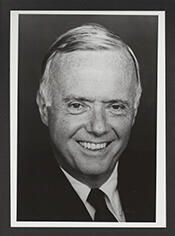
Here you will find contact information for Representative Amo Houghton, including email address, phone number, and mailing address.
| Name | Amo Houghton |
| Position | Representative |
| State | New York |
| District | 29 |
| Party | Republican |
| Status | Former Representative |
| Term Start | January 6, 1987 |
| Term End | January 3, 2005 |
| Terms Served | 9 |
| Born | August 7, 1926 |
| Gender | Male |
| Bioguide ID | H000814 |
About Representative Amo Houghton
Amory Houghton Jr. (August 7, 1926 – March 4, 2020) was an American Republican politician, businessman, and philanthropist from the state of New York who served as a Representative from New York in the United States Congress from 1987 to 2005. A member of one of upstate New York’s most prominent business and political families, the Houghtons, he was the son of Amory Houghton and Laura DeKay Richardson and the grandson of Alanson B. Houghton, who had served both in Congress and as U.S. ambassador to Germany and the United Kingdom. Born in Corning, Steuben County, New York, he grew up in a community closely tied to his family’s glass manufacturing enterprise, Corning Glass Works, later Corning Incorporated.
Houghton was educated at St. Paul’s School in Concord, New Hampshire, where he was a member of the class of 1945. His association with the school continued long after his graduation, and he later served as a member of its board of trustees. In 1944, while still of high-school age, he enlisted in the United States Marine Corps during World War II. He was assigned to the heavy cruiser USS Macon (CA-132) and to the U.S. Naval Base at Guantánamo Bay, Cuba, where he took part with his unit in activities associated with the Battle of the Caribbean. He attained the rank of private first class before being discharged from the Marine Corps in 1946.
Following his military service, Houghton attended Harvard University, where he received a Bachelor of Arts degree in 1950. He continued his studies at Harvard Business School, earning a Master of Business Administration degree in 1952. His education in liberal arts and business administration prepared him for a long career in corporate leadership and later in public service. A committed Episcopalian, he attended Christ Episcopal Church in Corning, New York, where he taught Sunday School throughout the 1950s, and he served as a trustee of the Episcopal Theological School in Cambridge, Massachusetts, which later merged into the Episcopal Divinity School.
Houghton spent the bulk of his business career with his family’s company, Corning Glass Works (now Corning Incorporated), founded in 1851 by his great-great-grandfather, Amory Houghton (1812–1882). He joined Corning in 1951 and held a series of operational and managerial posts, including accountant, process engineer, manufacturing foreman, and sales manager. He joined the company’s board of directors in 1955, became a vice president in 1957, and was appointed president in 1961. From 1964 to 1983, he served as Corning’s chairman and chief executive officer, overseeing significant expansion and diversification of the company’s product lines and global reach. In addition to his leadership at Corning, Houghton held directorships at several major corporations, including IBM, First National City Bank (later Citigroup), Procter & Gamble, Genentech, and B. F. Goodrich, making him an influential figure in American corporate governance.
In 1986, Houghton was elected to the United States House of Representatives as a Republican, beginning his congressional service on January 3, 1987. He represented an upstate New York district for nine consecutive terms, serving until January 3, 2005. During his tenure in Congress, he served on the House Committee on Ways and Means and the Committee on International Relations, positions that gave him influence over tax policy, trade, and foreign affairs. Houghton’s service in Congress occurred during a significant period in American history, spanning the end of the Cold War, the Persian Gulf War, the Clinton administration, and the early years of the George W. Bush administration. Throughout this period, he participated in the legislative process and represented the interests of his constituents, becoming one of upstate New York’s best-known and most respected members of Congress and routinely winning reelection with more than 65 percent of the vote. He was reportedly among the wealthiest members of the House, with an estimated fortune of $475 million.
Houghton developed a reputation as a moderate Republican and a leading voice for civility in politics. He founded the Republican Main Street Partnership to encourage a more centrist, pragmatic approach within the party and to foster bipartisan cooperation on public issues. While he generally supported his party on budgetary and fiscal matters, he frequently crossed party lines on issues such as environmental protection, civil rights, and funding for the arts and education. He was one of the most vocal pro‑choice Republicans in Congress and at times clashed with the increasingly Southern and socially conservative orientation of the Republican Party. Because of his moderate stance and personal demeanor, he was often called upon to act as a broker between Democratic and Republican members on contentious issues.
Houghton’s independent voting record was evident on several high-profile legislative decisions. In 1998, he was one of only four House Republicans to vote against all articles of impeachment against President Bill Clinton. In 2001, he was one of three Republicans to oppose the permanent repeal of the federal estate tax. On October 10, 2002, he was among six House Republicans who voted against the resolution authorizing the invasion of Iraq. In 2003, he was one of only three Republicans to vote against an initial version of the Jobs and Growth Tax Relief Reconciliation Act, the second major tax-cut package of the Bush administration, although he ultimately supported the final version of the bill after changes were made. A member of the Republican Party throughout his career, he nonetheless became increasingly identified with efforts to temper partisanship and promote institutional reform, later joining the ReFormers Caucus of Issue One, a bipartisan group of former elected officials advocating for political and campaign finance reforms.
On April 7, 2004, Houghton announced that he would not seek a tenth term in Congress. His final term concluded on January 3, 2005, and he was succeeded by fellow Republican John R. “Randy” Kuhl. In retirement, Houghton remained engaged in public affairs and continued to speak out on issues of governance and political culture. In 2016 and 2018, he publicly criticized the presidency of Donald Trump and stated that he would support efforts to remove Trump from office, reflecting his longstanding concern about civility, institutional norms, and the direction of his party.
In his personal life, Houghton married Ruth Frances West of Waccabuc, New York, in 1950. The couple had four children: Amory, Robert, Sarah, and Quincy. After their divorce in 1988, he married Priscilla B. Dewey (1924–2012) in 1989. Known to family and friends as “Amos,” he balanced his corporate and political responsibilities with extensive civic, religious, and philanthropic involvement in Corning and beyond. Corning Incorporated announced on March 5, 2020, that Houghton had died the previous day, March 4, 2020, closing a life that spanned military service in World War II, leadership of a major American corporation, and nearly two decades of service in the United States House of Representatives.