Representative Ander Crenshaw
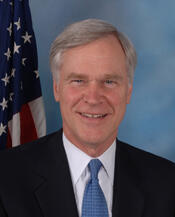
Here you will find contact information for Representative Ander Crenshaw, including email address, phone number, and mailing address.
| Name | Ander Crenshaw |
| Position | Representative |
| State | Florida |
| District | 4 |
| Party | Republican |
| Status | Former Representative |
| Term Start | January 3, 2001 |
| Term End | January 3, 2017 |
| Terms Served | 8 |
| Born | September 1, 1944 |
| Gender | Male |
| Bioguide ID | C001045 |
About Representative Ander Crenshaw
Alexander Mann “Ander” Crenshaw (born September 1, 1944) is an American banker, attorney, and Republican politician who represented Florida’s 4th congressional district in the United States House of Representatives from January 3, 2001, to January 3, 2017. Over eight terms in Congress, he contributed to the legislative process during a significant period in American history, participating in the democratic process and representing the interests of his North Florida constituents. Before his congressional career, he was a prominent figure in Florida state politics and the financial sector.
Crenshaw was born in Jacksonville, Florida, where he was raised and developed early ties to the community he would later represent in Congress. He attended the University of Georgia, earning a Bachelor of Arts degree in 1966. Following his undergraduate studies, he returned to Florida to pursue a legal education, receiving his Juris Doctor from the University of Florida. Trained as an attorney, he combined his legal background with an interest in public affairs, which laid the groundwork for his subsequent roles in both politics and finance.
After completing his education, Crenshaw entered the private sector as an investment banker. His work in banking and finance provided him with experience in economic and fiscal matters that would later inform his legislative priorities. At the same time, he began building a political career in Florida, aligning with the Republican Party at a time when it was gaining strength in a state long dominated by Democrats.
Crenshaw’s formal political career began in the Florida House of Representatives, where he served from 1972 through 1978. During this period, he established himself as a rising Republican figure in state politics. In 1978, he sought statewide office, winning the Republican primary for Florida Secretary of State. He was defeated in the general election by Democrat George Firestone, an early indication of the challenges Republicans still faced in statewide contests at that time. Undeterred, Crenshaw continued to pursue higher office. In 1980, he ran in the Republican primary for the United States Senate from Florida, finishing third in a multi-candidate field. He garnered approximately 12.56 percent of the vote—roughly 13 percent—behind Paula Hawkins, who won the primary and subsequently the general election, and former U.S. Representative Louis Frey Jr.
After several years out of elected office, Crenshaw returned to public service in 1986 by winning a special election to the Florida Senate. He served in the Florida State Senate from 1986 to 1994, becoming a central figure in the state’s emerging Republican leadership. In November 1992, he was elected president of the Florida Senate, becoming the first Republican to hold that position in 118 years. Because the Senate was evenly split between Republicans and Democrats, he agreed to serve only one year as a compromise, rather than the customary two-year term. In 1994, he sought to extend his influence to the executive branch by running for the Republican nomination for governor of Florida. In a crowded primary field, he finished fourth with about 12 percent of the vote (12.1 percent), behind State Treasurer Tom Gallagher and Secretary of State Jim Smith, and losing to Jeb Bush, who won the nomination with a plurality of 46 percent. Although he won several counties, the defeat marked the end of his state-level electoral campaigns.
Crenshaw returned to electoral politics on the federal level in 2000. When Representative Tillie Fowler retired from Florida’s 4th congressional district to honor a self-imposed four-term limit, Crenshaw sought and won the Republican nomination for the seat. The district at that time included just over half of Jacksonville as well as most of its suburbs and was historically one of the most Republican districts in Florida. It had been continuously represented by only three individuals since its creation in 1943, when it was designated the 2nd District (1943–1967), then the 3rd District (1967–1993), and finally the 4th District from 1993 onward. Crenshaw easily won the general election in November 2000 and took office on January 3, 2001. He was reelected repeatedly, often facing little or no serious opposition. He ran unopposed in 2002 and 2004 and faced no major-party opposition in 2010 or 2012. In one of his later campaigns, he was challenged by Independent Troy Stanley, with Gary L. Koniz and Deborah “Deb” Katz Pueschel qualifying as write-in candidates, but the district’s strong Republican orientation ensured his continued tenure.
During his sixteen years in the U.S. House of Representatives, Crenshaw largely maintained a low public profile while steadily accruing influence through committee work and party leadership. He served on the powerful House Committee on Appropriations, where he worked on federal spending and budgetary matters. Within Appropriations, he served on the Subcommittee on Defense; the Subcommittee on State, Foreign Operations, and Related Programs; and the Subcommittee on Financial Services and General Government, which he chaired. He also served on the Subcommittee on the Legislative Branch and was chair of that subcommittee during the 112th Congress. By the end of his tenure, he had risen within the Republican leadership to serve as a Deputy Majority Whip, helping to marshal votes and shape the party’s legislative agenda.
Crenshaw’s congressional activity extended beyond formal committee assignments to participation in a range of caucuses that reflected his policy interests and the concerns of his district. He co-chaired the Crohn’s and Colitis Caucus, the Effective Foreign Assistance Caucus, the International Conservation Caucus, and the Nepal Caucus, and was a member of the Sportsmen’s Caucus, the Tea Party Caucus, and the Congressional Cement Caucus. His voting record and public positions occasionally placed him at the intersection of competing Republican constituencies. On September 29, 2008, he was one of only three Florida Republicans to vote for the Emergency Economic Stabilization Act of 2008, which created the Troubled Asset Relief Program (TARP) in response to the financial crisis. Despite supporting the bailout legislation, he later issued a press release applauding the organizers and participants of the April 15, 2009, First Coast Tax Day Tea Party in Jacksonville, one of many Tea Party protests that criticized federal bailouts and government spending. On July 2, 2014, he introduced the Financial Services and General Government Appropriations Act, 2015 (H.R. 5016; 113th Congress), an appropriations bill for fiscal year 2015 that provided funding for the Department of the Treasury, the federal courts, the Executive Office of the President, and the government of the District of Columbia.
On April 13, 2016, Crenshaw announced that he would retire from Congress and not seek re-election, thereby concluding his congressional service at the end of his eighth term on January 3, 2017. After leaving office, he returned to private life, drawing on his background as an attorney, banker, and legislator. As of the latest available information, he remains a notable figure in Florida’s modern political history, recognized for his role in the Republican ascendancy in the state legislature and for his long tenure representing the Jacksonville area in the U.S. House of Representatives.