Representative Andrew Gregg Curtin
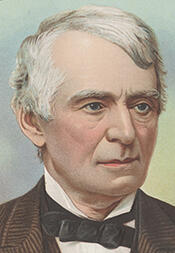
Here you will find contact information for Representative Andrew Gregg Curtin, including email address, phone number, and mailing address.
| Name | Andrew Gregg Curtin |
| Position | Representative |
| State | Pennsylvania |
| District | 20 |
| Party | Democratic |
| Status | Former Representative |
| Term Start | December 5, 1881 |
| Term End | March 3, 1887 |
| Terms Served | 3 |
| Born | April 22, 1817 |
| Gender | Male |
| Bioguide ID | C001004 |
About Representative Andrew Gregg Curtin
Andrew Gregg Curtin (April 22, 1815 – October 7, 1894) was an American lawyer, Civil War–era governor, diplomat, and legislator whose public career spanned more than five decades. He was born in Bellefonte, Centre County, Pennsylvania, where sources differ on his birth year—some citing April 22, 1817—but his gravestone records April 22, 1815. He was the son of Roland Curtin Sr., a wealthy Irish-born iron manufacturer from County Clare who co‑founded Eagle Ironworks at Curtin Village in 1810 with Miles Boggs, and Jane (née Gregg) Curtin, daughter of U.S. Senator Andrew Gregg. Curtin’s family was deeply rooted in Pennsylvania’s political and military history: he was the great‑grandson of James Potter, vice president of Pennsylvania, and the grandson of Andrew Gregg, a prominent Pennsylvania politician. His extended family included several notable Union officers in the Civil War, among them his cousin David McMurtrie Gregg and his nephew John I. Gregg, both Union generals, and his cousin Colonel John I. Curtin.
Curtin received his early education at Bellefonte Academy before pursuing higher studies at Dickinson College in Carlisle, Pennsylvania, and subsequently at the Dickinson School of Law. After completing his legal training, he was admitted to the bar and began practicing law in Pennsylvania. His legal career provided the foundation for his entry into public life, and he first emerged on the political scene during the 1840 presidential election, when he campaigned actively for Whig candidate William Henry Harrison. This early partisan work aligned him with the Whig Party’s economic and national development agenda and introduced him to statewide political networks that would later prove decisive in his rise to higher office.
Curtin’s first significant public appointment came in 1855, when Pennsylvania Governor James Pollock named him Superintendent of Public Schools, a position from which he helped shape the state’s educational policy. As the Whig Party collapsed in the 1850s, Curtin joined the newly formed Republican Party and quickly became one of its leading figures in Pennsylvania. He successfully ran for governor in 1860 and was inaugurated as the 15th governor of Pennsylvania on January 15, 1861, just as the nation stood on the brink of civil war. At the same time, he played an important role in helping Abraham Lincoln secure the Republican nomination for president in 1860, thereby tying his own political fortunes closely to those of the incoming administration.
As governor during the American Civil War, Curtin was a staunch supporter of President Lincoln and committed Pennsylvania’s full resources to the Union cause. He organized the Pennsylvania Reserves into combat units and oversaw the establishment of the first major Union training camp for militia, Camp Curtin, which opened near Harrisburg on April 18, 1861; more than 300,000 men were drilled there over the next four years. Curtin became a trusted friend and confidant of Lincoln, visiting the White House frequently to discuss the progress of the war. To coordinate the efforts of Union state executives, he convened the Loyal War Governors’ Conference in Altoona, Pennsylvania, on September 24–25, 1862, one of his most significant contributions to the broader Union war effort. He also created the Pennsylvania State Agency in Washington, D.C., and another branch in Nashville, Tennessee, to support wounded soldiers, and he founded a state‑funded Orphan’s School system to educate and care for the children of soldiers who had died in service to the Union. During his governorship, from 1858 to 1860, he also served as president of the Tyrone and Clearfield Railroad, reflecting his engagement with the state’s transportation and economic development.
Curtin played a central role in the Gettysburg Campaign and its aftermath. Working with Major General Darius N. Couch and Major Granville O. Haller, he helped organize the defense of Pennsylvania and delay General Robert E. Lee’s Army of Northern Virginia, preventing it from crossing the Susquehanna River. He had earlier recommended fellow Pennsylvanian George G. Meade for promotion to brigadier general and command of one of the Pennsylvania Reserve brigades in 1861; Meade would go on to defeat Lee at the Battle of Gettysburg in July 1863. After the battle, Curtin was the driving force behind the establishment of the Soldiers’ National Cemetery at Gettysburg. Through his agent David Wills, he persuaded President Lincoln to attend the cemetery’s dedication. Curtin sat on the platform with Lincoln on November 19, 1863, when the president delivered the Gettysburg Address. The immense strain of wartime leadership took a toll on Curtin’s health, and he suffered a severe breakdown during his first term; Secretary of State Eli Slifer often managed state affairs during Curtin’s periods of incapacity. Lincoln offered him a diplomatic post abroad, but Curtin declined and instead successfully sought reelection as governor in 1863. In recognition of his wartime service, he was later elected a 3rd Class Companion of the Military Order of the Loyal Legion of the United States.
Following the Civil War, Curtin’s political trajectory shifted. He sought but failed to secure the Republican nomination for the United States Senate from Pennsylvania, losing to Simon Cameron. President Ulysses S. Grant subsequently appointed him U.S. Minister (Ambassador) to Russia, a post in which Curtin represented American interests abroad in the Reconstruction era. Over time, Curtin’s political allegiance moved away from the Republican Party, and he eventually joined the Democratic Party. As a Democrat, he continued his public service at the national level and was elected to the United States House of Representatives from Pennsylvania, serving as a Representative from 1881 to 1887. During these three consecutive terms in Congress, he participated in the legislative process and represented the interests of his Pennsylvania constituents, contributing to national debates in a period marked by industrial expansion, postwar adjustment, and evolving party alignments. His congressional service thus capped a long career that had begun in the Whig ranks, passed through Republican wartime leadership, and concluded under the Democratic banner.
In his personal life, Curtin married Katharine Irvine Wilson (1821–1903) on May 30, 1844. She was the daughter of Dr. William Irvine Wilson and Mary (née Potter) Wilson. The couple had five children: Mary Curtin (1845–1927), who married George Fairlamb Harris; Martha Irvin Curtin (1848–1935), who married Captain Kidder Randolph Breese; Myron Stanley Curtin (1854–1857), who died in childhood; Katherine Irvine Wilson Curtin (1859–1930), who married Moses Dewitt Burnet; and Bessie Elliott Curtin (1865–1866), who also died young. Curtin spent his final years in his native Bellefonte, Pennsylvania, where he remained a respected elder statesman and a symbol of the state’s pivotal role in the Union victory. He died there on October 7, 1894, and was buried in Union Cemetery in Bellefonte. His legacy as Pennsylvania’s Civil War governor and later congressman was commemorated during World War II with the naming of the Liberty ship SS Andrew G. Curtin in his honor, and his life has been the subject of numerous biographical and historical studies, including entries in the Biographical Directory of the United States Congress and institutional histories such as Bucknell University’s biography of Andrew Gregg Curtin.