Representative Andrew Jackson May
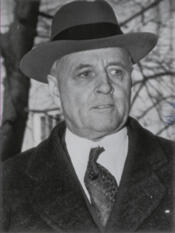
Here you will find contact information for Representative Andrew Jackson May, including email address, phone number, and mailing address.
| Name | Andrew Jackson May |
| Position | Representative |
| State | Kentucky |
| District | 7 |
| Party | Democratic |
| Status | Former Representative |
| Term Start | December 7, 1931 |
| Term End | January 3, 1947 |
| Terms Served | 8 |
| Born | June 24, 1875 |
| Gender | Male |
| Bioguide ID | M000272 |
About Representative Andrew Jackson May
Andrew Jackson May (June 24, 1875 – September 6, 1959) was a Kentucky attorney, influential New Deal-era politician, and Democratic member of the United States House of Representatives from Kentucky who served eight consecutive terms in Congress from 1931 to 1947. A prominent figure in national defense legislation, he served as chairman of the House Committee on Military Affairs during World War II and was widely regarded as a chief architect of the Peacetime Selective Service Act. His long public career, however, was later overshadowed by his implication in the leak of classified naval information during the war and an unrelated federal conviction for bribery.
May was born on Beaver Creek, near Prestonsburg in Floyd County, Kentucky, on June 24, 1875. He grew up in the mountainous eastern region of the state, an area that would remain the base of his political support throughout his life. On June 25, 1898, he and his twin brother, William H. May, graduated from Southern Normal University Law School in Huntingdon, Tennessee (an institution later associated with Union University in Jackson, Tennessee). Admitted to the bar in 1898, he commenced the practice of law in Prestonsburg. The brothers formed the law firm of May & May, which became a well-known practice in the region and continued until William H. May’s death on February 20, 1921.
In addition to his private practice, May quickly assumed public legal responsibilities. He served as county attorney of Floyd County, Kentucky, from 1901 to 1909, gaining experience in local governance and building a reputation as an able lawyer. He was later appointed special judge of the circuit court of Johnson and Martin Counties in 1925 and 1926. During these years, May was also active in Democratic Party politics and engaged in agricultural pursuits, coal mining, and banking, reflecting the economic mix of eastern Kentucky in the early twentieth century. His involvement in these enterprises broadened his connections in both business and political circles and helped lay the groundwork for his later congressional career.
May first sought national office in 1928, when he ran for Congress in a heavily Republican district against incumbent Representative Katherine Langley. He was defeated in that initial attempt, but he ran again two years later. In the 1930 election he successfully unseated Langley, winning a seat in the U.S. House of Representatives as a Democrat. He was elected to the Seventy-second Congress and to seven succeeding Congresses, serving from March 4, 1931, to January 3, 1947. As a member of the House of Representatives during a significant period in American history, he participated actively in the legislative process and represented the interests of his Kentucky constituents throughout the New Deal and World War II eras. A consistent supporter of President Franklin D. Roosevelt’s administration, May became known as an influential New Deal Democrat.
During his congressional service, May played a central role in major domestic and defense legislation. He helped push through the Social Security Act and the Servicemen’s Readjustment Act of 1944, commonly known as the GI Bill of Rights, both of which became cornerstone programs of the New Deal and postwar policy. He was especially noted for his work on military preparedness. In 1940, he was credited as the chief architect of the Peacetime Selective Service Act, which established the first peacetime draft in American history and provided critical manpower for the nation’s armed forces. This act significantly enhanced U.S. readiness when Japanese forces attacked Pearl Harbor in December 1941. Colleagues recognized his influence; Representative John W. McCormack wrote to him that, as chairman of the House Committee on Military Affairs before Pearl Harbor and during the war, May had led the fight for legislation “necessary to defend and preserve our country,” and that history would justifiably place him “as one of the foremost Americans of this generation.”
As chairman of the powerful Committee on Military Affairs during the Seventy-sixth through Seventy-ninth Congresses, May occupied a key position in shaping wartime policy. He was regarded as neither an isolationist nor a warmonger, but he spoke frequently about the war in Europe and the threat posed by Adolf Hitler. He warned that the decision on whether the United States would go to war might not rest with the President, Congress, or the American people, but would instead be determined by “the impersonation of hatred Adolph Hitler, who decided it also for Poland, France, Belgium, and Holland.” During World War II, May also became involved with New York businessmen Murray and Henry Garsson, who sought lucrative munitions contracts from the U.S. government, a relationship that would later contribute to his legal troubles.
May’s wartime record was marred by what became known as the “May Incident,” involving the release of highly confidential military information. U.S. submarines in the Pacific had been waging a successful undersea campaign against Japanese shipping, often surviving depth-charge attacks because Japanese charges were set to explode at too shallow a depth. After returning from a war zone inspection trip, May held a press conference in June 1943 at which he publicly revealed that American submarines had a high survival rate because Japanese depth charges were not set deep enough. Press associations carried the story widely, and newspapers across the country, including one in Honolulu, published the account. Following this disclosure, Japanese anti-submarine forces reportedly adjusted their tactics. Vice Admiral Charles A. Lockwood, commander of the U.S. submarine fleet in the Pacific, later estimated that May’s security breach may have cost the United States as many as 10 submarines and 800 crewmen, remarking that May “would be pleased to know that the Japs set them deeper now.” A report from the U.S. Navy’s Pacific Submarine Fleet concluded that Japanese forces never fully discovered the maximum test depth of U.S. fleet submarines and made no specific finding that they altered their depth-charge settings because of May’s remarks. Nonetheless, the incident became a lasting blemish on his record, even as contemporaries such as Admiral Richard E. Byrd wrote to commend May’s “superb job” on Army legislation and his cooperation with the Navy.
In the immediate postwar period, May’s connections with the Garsson brothers came under intense scrutiny. In 1946, Senator James Mead began investigations into war profiteering, and the Garssons’ munitions operations were among the enterprises examined. The Garssons, who had no prior experience in arms manufacturing, had obtained substantial government contracts during the war. Evidence emerged that May had frequently telephoned Army ordnance and other government officials on their behalf to secure war contracts, obtain draft deferments, and arrange other favors, interventions so frequent that one ordnance official referred to them as “blitz calls.” May had also organized the Cumberland Lumber Company to build crates for shipping the Garssons’ munitions. Federal prosecutors contended that the money he received through this company was not legitimate business income but compensation for using his influence as chairman of the Military Affairs Committee. Public perception was further shaped by testimony about excessive profits in the Garssons’ business and allegations that one of their plants produced 4.2-inch mortar shells with defective fuzes, causing premature detonations and the deaths of 38 American soldiers.
Amid mounting criticism and news reports of irregularities in his conduct, May was an unsuccessful candidate for reelection in 1946 to the Eightieth Congress, ending his sixteen-year tenure in the House. His legal troubles quickly escalated. On July 3, 1947, after less than two hours of deliberation, a federal jury convicted him on charges of accepting bribes to use his position as chairman of the House Military Affairs Committee to secure munitions contracts during World War II. Murray and Henry Garsson were also convicted and sentenced to prison. May appealed his conviction through the federal courts, but the United States Supreme Court declined to hear his case. At the age of 74, he began serving his sentence and ultimately spent nine months in prison. Despite his incarceration, he continued to retain some influence within Democratic Party circles, and in 1952 President Harry S. Truman granted him a full presidential pardon. Although the pardon restored his civil rights, May was unable to revive his once-prominent political career.
Following his release and pardon, May returned to Prestonsburg, Kentucky, where he resumed the practice of law and remained active in local affairs. He lived quietly in his later years, removed from the national spotlight that had defined his congressional service. Andrew Jackson May died in Prestonsburg on September 6, 1959, and was buried in Mayo Cemetery. His legacy remained complex: he was honored in his home state for his long service and wartime leadership, and in 1962 Kentucky Governor Bert T. Combs dedicated the May Lodge at Jenny Wiley State Resort Park in Prestonsburg in his memory, even as his name also appeared in later compilations of American federal politicians convicted of crimes and federal political scandals.