Representative Andrew Stevenson
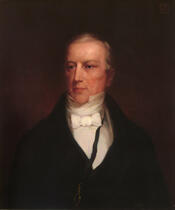
Here you will find contact information for Representative Andrew Stevenson, including email address, phone number, and mailing address.
| Name | Andrew Stevenson |
| Position | Representative |
| State | Virginia |
| District | 11 |
| Party | Jackson |
| Status | Former Representative |
| Term Start | December 3, 1821 |
| Term End | March 3, 1835 |
| Terms Served | 7 |
| Born | January 21, 1784 |
| Gender | Male |
| Bioguide ID | S000891 |
About Representative Andrew Stevenson
Andrew Stevenson (January 21, 1784 – January 25, 1857) was an American politician, lawyer, and diplomat who served as a Representative from Virginia in the United States Congress from 1821 to 1835 and later as Speaker of the U.S. House of Representatives and Minister to the United Kingdom. He was born in Culpeper County, Virginia, on January 21, 1784, the son of James Stevenson (1739–1809) and Frances Arnette (née Littlepage) Stevenson (1750–1808). Raised in Virginia’s planter and professional class, he received a private education appropriate to his social standing before pursuing formal higher education.
Stevenson attended the College of William & Mary, where he studied law, and was admitted to the Virginia bar in 1809. He established a legal practice in Richmond, Virginia, which became the base of his early professional and political life. Richmond voters elected him to the Virginia House of Delegates, where he served in the part‑time legislature from 1809 to 1816 and again from 1818 to 1821, representing the city. During the War of 1812, his colleagues in the House of Delegates chose him as Speaker, a position he held from 1812 to 1815. He twice sought election to the United States House of Representatives, in 1814 and 1816, but was unsuccessful in those early attempts.
In 1820, Stevenson won election to the Seventeenth U.S. Congress as a Democratic-Republican, beginning his long tenure in the national legislature. He entered Congress at a time of growing factionalism within the Democratic-Republican Party. During the contentious 1824 presidential election, he aligned first with the William H. Crawford faction in the Eighteenth Congress and then, as party divisions hardened, identified with the Jacksonians for the remainder of his congressional career. A member of the Jackson Party, he represented Virginia in the U.S. House of Representatives from 1821 to 1835, serving seven consecutive terms and contributing to the legislative process during a significant period in American history. On December 3, 1827, the opening day of the Twentieth Congress, the House elected him Speaker. He was reelected Speaker three times, in 1829, 1831, and 1833, and held the post until his resignation on June 2, 1834. As Speaker, he played a central role in organizing the House, including committee assignments and chairmanships, and was regarded as a key legislative ally of President Andrew Jackson.
Stevenson’s congressional service intersected closely with the politics of the Jackson administration. In June 1834, he resigned from Congress to accept President Jackson’s appointment as Minister to the United Kingdom. The U.S. Senate, however, initially denied his confirmation by a vote of 23 to 22. Jackson’s opponents argued that Jackson had offered Stevenson the diplomatic post in 1833 and that Stevenson, as Speaker, had organized the House in accordance with Jackson’s preferences, particularly in committee structure and leadership, which Anti-Jacksonians characterized as an improper quid pro quo and an intrusion of executive influence into legislative prerogatives. After the Senate’s rejection, Stevenson returned to Virginia, resumed his legal practice, and remained active in party affairs, presiding over the 1835 Democratic National Convention. In February 1836, Jackson renominated him as Minister to the United Kingdom; this time the Senate confirmed him by a vote of 26 to 19. Stevenson served as U.S. ambassador in London from 1836 to 1841, spanning the end of Jackson’s presidency and much of Martin Van Buren’s administration.
His tenure in Britain was marked by controversy related to slavery, an issue of growing international and domestic tension. Stevenson was a slaveowner, and some segments of British public opinion and abolitionist activists resented his appointment. The Irish statesman Daniel O’Connell was reported to have denounced Stevenson publicly as a “slave breeder,” a charge considered even more serious than slaveholding. Outraged, Stevenson challenged O’Connell to a duel, but O’Connell, who had a lifelong aversion to dueling, refused and suggested he had been misquoted. The dispute became a public scandal, and repeated references to slave breeding caused Stevenson considerable embarrassment. Many observers believed that, if O’Connell’s accusations were false, Stevenson would have been better served by ignoring them rather than engaging in a public quarrel that drew further attention to the issue.
After returning from his diplomatic post in 1841, Stevenson resumed life in Virginia and continued to be active in Democratic Party politics. In 1845, he was elected to the board of visitors of the University of Virginia, reflecting his prominence in state affairs and interest in public education. In 1846, he purchased the Blenheim estate in Albemarle County, Virginia, where he established a large plantation worked by enslaved laborers. The 1820 federal census had recorded him as owning eight enslaved people in Richmond, and the 1830 census likewise showed him as a slaveholder in that city. By the 1850 U.S. Federal Census, the last taken during his lifetime, Stevenson owned 63 enslaved people in Albemarle County. He presided over the 1848 Democratic National Convention, underscoring his continued influence within the national party. From 1856 to 1857, he served briefly as rector of the University of Virginia, the governing board’s presiding officer, shortly before his death.
Stevenson married three times. In 1809, he wed Mary Page White, a granddaughter of Carter Braxton, a signer of the Declaration of Independence. She died in 1812 during childbirth, leaving one son, John White Stevenson (1812–1886), who would follow his father into law and politics. John White Stevenson became a Congressman and later served as Governor of Kentucky after the American Civil War and as a U.S. Senator. During his father’s lifetime, John married Sibella Winston (1823–1904) in 1843; they had five children—Sally C. (Stevenson) Colston, Mary W. (Stevenson) Colston, Judith W. (Stevenson) Winslow, Samuel W. Stevenson, and John W. Stevenson. In 1816, Andrew Stevenson married his second wife, Sarah “Sally” Coles (1789–1848), a cousin of Dolley Madison and sister of Edward Coles, the antislavery Governor of Illinois; she died in 1848. In 1849, he married his third and final wife, Mary Schaff.
Andrew Stevenson spent his final years at Blenheim in Albemarle County, overseeing his plantation and remaining engaged in educational and political circles until declining health curtailed his activities. He died at his Blenheim estate on January 25, 1857. Stevenson was buried at Enniscorthy Cemetery in Keene, Virginia. His manor house at Blenheim survived into the modern era and was listed on the National Register of Historic Places in 1976, a physical reminder of his long and often controversial career in Virginia and national public life.