Representative Andy Levin
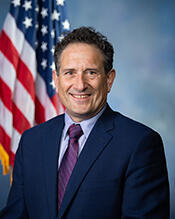
Here you will find contact information for Representative Andy Levin, including email address, phone number, and mailing address.
| Name | Andy Levin |
| Position | Representative |
| State | Michigan |
| District | 9 |
| Party | Democratic |
| Status | Former Representative |
| Term Start | January 3, 2019 |
| Term End | January 3, 2023 |
| Terms Served | 2 |
| Born | August 10, 1960 |
| Gender | Male |
| Bioguide ID | L000592 |
About Representative Andy Levin
Andrew Saul Levin (born August 10, 1960) is an American attorney and politician who served as the U.S. Representative from Michigan’s 9th congressional district from January 3, 2019, to January 3, 2023. A member of the Democratic Party, he was elected to the House in 2018, succeeding his retiring father, Representative Sander Levin, and served two terms in Congress. His tenure in the House occurred during a significant period in American history, and he participated actively in the legislative process while representing the interests of his constituents. Levin is part of a prominent Michigan political family and is the nephew of Carl Levin, who served as a United States senator from Michigan from 1979 to 2015.
Levin was born on August 10, 1960, to Sander Levin and Vicki Schlafer. He grew up in a politically engaged household in Huntington Woods, Michigan, where his father was elected to the United States House of Representatives in 1982 and went on to serve until 2019. Raised alongside his two sisters, Jennifer and Madeleine, and his brother, Matthew, Levin was exposed early to public service and political life. He is Jewish and later became known as a synagogue leader, a role that reflected both his religious identity and his engagement with communal affairs.
Levin pursued an extensive education before entering public life. He graduated from Williams College with a bachelor’s degree, then went on to earn a master’s degree in Asian languages and culture from the University of Michigan. He subsequently received a Juris Doctor from Harvard Law School. This combination of liberal arts, area studies, and legal training provided the foundation for his later work as an attorney, labor organizer, and policymaker, particularly in the areas of labor, workforce development, and international affairs.
Before his election to Congress, Levin built a career focused on labor relations, workforce policy, and clean energy. In 1994, he served as a staff attorney for the U.S. Commission on the Future of Worker-Management Relations, where he worked on issues at the intersection of labor and management. He then worked as a trade union organizer and director, deepening his involvement in the labor movement. In 2006, he ran as a Democrat for the 13th district seat in the Michigan State Senate, narrowly losing to Republican John Pappageorge by 0.6 percent of the vote. Following that campaign, Levin directed Voice@Work, a program aimed at expanding trade union membership and strengthening workers’ rights.
Levin entered state government in 2007, when Governor Jennifer Granholm appointed him deputy director of the Michigan Department of Energy, Labor, and Economic Growth (DELEG). In that capacity, he oversaw the “No Worker Left Behind” program, which provided job training and retraining opportunities to unemployed and underemployed workers during a period of economic transition in Michigan. In 2009, Granholm named him chief workforce officer, and in 2010 he became acting director of DELEG, serving in that role until the end of her administration in 2011. After leaving state government, Levin turned to the private sector in clean energy, founding the firm Levin Energy Partners LLC and serving as president of Lean & Green Michigan, an initiative focused on promoting energy efficiency and clean energy investment.
Levin ran to succeed his father in the U.S. House of Representatives from Michigan’s 9th congressional district in 2018. In the Democratic primary, he defeated former State Representative Ellen Lipton and attorney Martin Brook, winning 52.5 percent of the vote. In the general election, he prevailed over Republican businesswoman Candius Stearns, securing his first term in Congress. He ran for a second term in 2020 and was reelected, defeating Republican Charles Langworthy and several minor candidates with 57.8 percent of the vote. During his time in the House of Representatives, from 2019 to 2023, Levin contributed to the legislative process and participated in the democratic governance of the country while representing his Michigan constituents.
In Congress, Levin’s committee assignments reflected his longstanding interests in labor, education, and foreign affairs. He served on the Committee on Education and Labor, where he was vice chair, and on its Subcommittee on Health, Employment, Labor, and Pensions and Subcommittee on Higher Education and Workforce Investment. He also served on the Committee on Foreign Affairs, including the Subcommittee on Asia, the Pacific and Nonproliferation and the Subcommittee on the Western Hemisphere, Civilian Security and Trade. Ideologically aligned with the progressive wing of the Democratic Party, he was a deputy whip of the Congressional Progressive Caucus and a member of the Medicare for All Caucus and the House Pro-Choice Caucus. Levin was an advocate for workers’ rights and supported workplace measures and potential unionization of congressional staff. In November 2020, The New York Times reported that he was rumored to be under consideration as a possible candidate for Secretary of Labor in the incoming Biden administration, though Boston Mayor Marty Walsh was ultimately appointed to the post in 2021.
Levin’s foreign policy positions, particularly regarding Israel and the Middle East, drew national attention. A former synagogue leader known for his critical views of hard-line Israeli policies, he argued that a secure, democratic homeland for the Jewish people required achieving the political and human rights of the Palestinian people. His stance led to strong opposition from the American Israel Public Affairs Committee (AIPAC), which spent approximately $4 million on negative publicity against him during the 2022 election cycle. Following redistricting after the 2020 census, Michigan lost a seat in the U.S. House, and the redrawn map combined much of Levin’s district with that of fellow Democratic Representative Haley Stevens. The new district contained more of Stevens’s original voters, and in the 2022 Democratic primary Levin lost to Stevens, ending his service in Congress in January 2023.
Levin and his wife, Mary (née Freeman), have four children and reside in Bloomfield Township, Michigan. His life and career reflect a blend of family political legacy, commitment to labor and workforce issues, engagement with clean energy and economic development, and active participation in both domestic and foreign policy debates during his two terms in the United States House of Representatives.