Representative Anna G. Eshoo
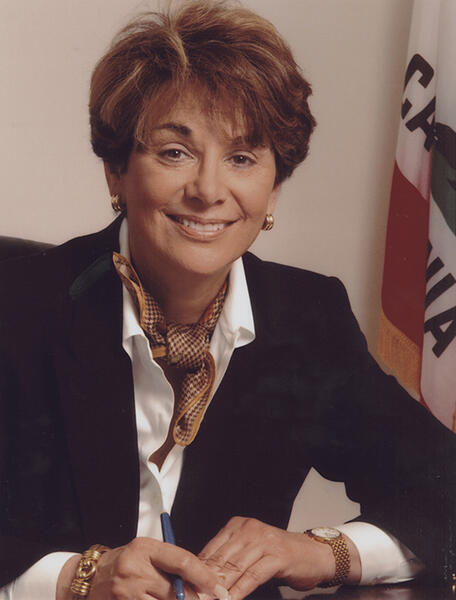
Here you will find contact information for Representative Anna G. Eshoo, including email address, phone number, and mailing address.
| Name | Anna G. Eshoo |
| Position | Representative |
| State | California |
| District | 16 |
| Party | Democratic |
| Status | Former Representative |
| Term Start | January 5, 1993 |
| Term End | January 3, 2025 |
| Terms Served | 16 |
| Born | December 13, 1942 |
| Gender | Female |
| Bioguide ID | E000215 |
About Representative Anna G. Eshoo
Anna A. Eshoo (née Georges; born December 13, 1942) is an American politician who served as a Representative from California in the United States Congress from 1993 to 2025. A member of the Democratic Party, she represented what was for most of her tenure a Silicon Valley–based district, serving as the U.S. representative for California’s 16th congressional district from 1993 to 2025. The district was numbered as the 14th district from 1993 to 2013 and the 18th district from 2013 to 2023 before becoming the 16th district, and included the cities of Redwood City, Sunnyvale, Mountain View, and Palo Alto, as well as a portion of San Jose. During her sixteen terms in office, Eshoo contributed to the legislative process over a significant period in modern American history, participating in the democratic process and representing the interests of her constituents. She was the only Assyrian-American in Congress and the only Armenian American woman in Congress during her tenure. On November 21, 2023, she announced that she would not seek re-election in 2024.
Eshoo was born Anna Georges in New Britain, Connecticut, on December 13, 1942, into a family of Assyrian and Armenian heritage. Her mother had fled from Armenia to Iraq and subsequently emigrated to the United States, while her father, Fred Georges, was a Chaldean Christian who worked as a jeweler and watchmaker. Raised in a household shaped by the experiences of displacement and minority religious and ethnic identity, she grew up with a strong awareness of immigrant and refugee issues that would later inform her public service. She attended local schools in New Britain and graduated from New Britain High School in 1960.
After completing high school, Eshoo moved to California, where she would establish her long-term residence and political base. While raising a family and becoming active in community affairs, she pursued higher education and received an Associate of Arts degree in English from Cañada College in Redwood City in 1975. Her educational background in English, combined with her growing engagement in local civic and party activities, provided a foundation for her later work in communications, policy, and legislative advocacy.
Eshoo’s formal political career began in local and party leadership in San Mateo County. She served as Chair of the San Mateo County Democratic Party from 1978 to 1982, helping to organize local campaigns and strengthen the party’s infrastructure. In the 1980s she was a member of the Democratic National Committee, giving her experience in national party politics and strategy. From 1981 to 1982 she served as chief of staff to Speaker pro tempore Leo McCarthy of the California State Assembly, gaining direct experience with legislative operations and state-level policymaking. In 1982 she was elected to the San Mateo County Board of Supervisors, where she served for a decade until 1992 and held the position of president of the board in 1986.
In the midst of her second term on the San Mateo County Board of Supervisors, Eshoo sought federal office. She ran for Congress in California’s 12th congressional district, entering the Democratic primary and winning it with a plurality of 43 percent. In the 1988 general election she faced Republican Stanford law professor Tom Campbell and lost by a margin of 51 percent to 46 percent. When Campbell later gave up his congressional seat to make an unsuccessful bid for the United States Senate, the district was renumbered as the 14th, and Eshoo again sought election to Congress. She entered a seven-way Democratic primary for the open seat and won with a plurality of 40 percent. In the 1992 general election she defeated the Republican nominee, San Mateo County Supervisor Tom Huening, by a margin of 57 percent to 39 percent, securing her first term in the U.S. House of Representatives.
Eshoo took office in January 1993 and went on to serve sixteen consecutive terms in the House of Representatives, remaining in office until January 2025. Her service in Congress spanned a period marked by major political and technological change, including the rise of the internet economy and the growth of Silicon Valley, which formed the core of her district. She survived the Republican Revolution of 1994, winning reelection that year with 61 percent of the vote, and subsequently consolidated her position as a secure incumbent. In later elections she won reelection against Republican Ronny Santana by a margin of 70 percent to 22 percent, and against Republican Dave Chapman by 69 percent to 28 percent, reflecting strong support within her district. After redistricting, she successfully ran for and won reelection in California’s 18th congressional district, which was based in San Mateo, Santa Clara, and Santa Cruz counties, and later continued her service when the district was renumbered again as the 16th.
Throughout her congressional career, Eshoo was closely associated with issues affecting technology, telecommunications, health care, and consumer protection, reflecting the interests of her Silicon Valley constituency. She served on the House Energy and Commerce Committee, one of the chamber’s key panels with jurisdiction over telecommunications, health policy, and energy matters. After Democrats lost their House majority in 2010, a contested internal race emerged for the position of ranking member on the Energy and Commerce Committee. In a closely watched contest that was widely regarded as a proxy battle between Steny Hoyer and Nancy Pelosi for influence within the caucus, Eshoo sought the ranking member position but lost the party vote to Representative Frank Pallone. Pelosi had argued that Eshoo’s elevation to the top Democratic spot on the committee would be important for the party, allowing her “to tap into lucrative fundraising interests in Silicon Valley and elsewhere that the committee has jurisdiction.” Despite not attaining the ranking member role, Eshoo remained an influential member of the committee and a prominent voice on technology and health policy.
Eshoo continued to win reelection comfortably into the 21st century. In later cycles, she faced intra-party challenges but maintained strong support among Democratic voters. She defeated challenger Rishi Kumar in the Democratic primary and was reelected in the subsequent general election, and later beat Kumar again in a rematch primary before prevailing once more in the general election. Over the course of her sixteen terms, she became one of the longest-serving members from California, and her tenure encompassed debates over the digital economy, health care reform, national security, and infrastructure. On November 21, 2023, after more than three decades in Congress, she announced that she would not seek re-election in 2024, bringing to a close a congressional career that extended from 1993 to 2025 and marked her as a trailblazer for both Assyrian-Americans and Armenian American women in national office.