Representative Anson Herrick
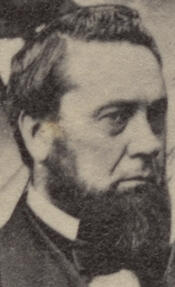
Here you will find contact information for Representative Anson Herrick, including email address, phone number, and mailing address.
| Name | Anson Herrick |
| Position | Representative |
| State | New York |
| District | 9 |
| Party | Democratic |
| Status | Former Representative |
| Term Start | December 7, 1863 |
| Term End | March 3, 1865 |
| Terms Served | 1 |
| Born | January 21, 1812 |
| Gender | Male |
| Bioguide ID | H000537 |
About Representative Anson Herrick
Anson Herrick (January 21, 1812 – February 6, 1868) was a U.S. Representative from New York during the latter half of the American Civil War. A member of the Democratic Party and a newspaperman by trade, he served a single term in Congress from 1863 to 1865, contributing to the legislative process during a significant period in American history and representing the interests of his New York constituents.
Herrick was born in Lewiston, Maine, on January 21, 1812, the son of Ebenezer Herrick. He attended the public schools in Maine, receiving a basic formal education typical of the era. As a young man, he learned the art of printing, a skill that would shape his professional life and provide his principal avenue into public affairs and politics.
In 1833, Herrick established The Citizen at Wiscasset, Maine, marking the beginning of his career in journalism and newspaper publishing. Seeking broader opportunities, he moved to New York City in 1836. There, in 1838, he founded the New York Atlas, a newspaper he continued to publish and manage until his death in 1868. In 1841, he further expanded his journalistic ventures by founding a two-penny daily newspaper, The New York Aurora, in partnership with John F. Ropes. The Aurora later gained additional note when it was edited for a time by the poet and writer Walt Whitman, underscoring Herrick’s role in the vibrant mid-nineteenth-century New York press.
Herrick’s prominence in the city’s journalistic and civic life led to his entry into local politics. He served as a member of the New York City Board of Aldermen from the 19th Ward from 1853 to 1857, participating in municipal governance during a period of rapid urban growth. In 1857, President James Buchanan appointed him naval storekeeper for the port of New York, a federal post he held until 1861. This position placed him at an important commercial and strategic hub on the eve of the Civil War and further solidified his standing within Democratic Party circles.
In national politics, Herrick was elected as a Democrat to the Thirty-eighth Congress, serving as a Representative from New York from March 4, 1863, to March 3, 1865. His term in the U.S. House of Representatives coincided with the latter half of the American Civil War, a critical phase in the nation’s history. During this time, he participated in the democratic process at the federal level and contributed to the legislative deliberations of a country at war. Notably, Herrick was one of the relatively few Democrats to vote for the submission of the Thirteenth Amendment to the states, an amendment that abolished slavery throughout the United States. He had previously published editorials in favor of the amendment in his newspapers, reflecting his public support for the measure. Contemporary accounts suggest that his vote was also influenced by an understanding that President Abraham Lincoln would appoint Herrick’s brother as a federal revenue assessor; following Lincoln’s assassination, however, the appointment was never confirmed. Herrick was an unsuccessful candidate for reelection in 1864 to the Thirty-ninth Congress and thus returned to private life after a single term.
After leaving Congress, Herrick resumed his journalistic pursuits in New York City, continuing his long association with the New York Atlas and remaining active in public affairs through his editorial work. In 1866, he served as a delegate to the Union National Convention at Philadelphia, a gathering that sought to promote national reconciliation and support President Andrew Johnson’s Reconstruction policies. This role reflected his ongoing engagement with the political issues of the postwar period, even after his formal congressional service had ended.
Anson Herrick died in New York City on February 6, 1868. He was interred in Green-Wood Cemetery in Brooklyn, New York. At the time of his death, he was still associated with the New York Atlas, the newspaper he had established three decades earlier, leaving a legacy as both a Civil War–era congressman and a significant figure in nineteenth-century American journalism.