Representative Anson George McCook
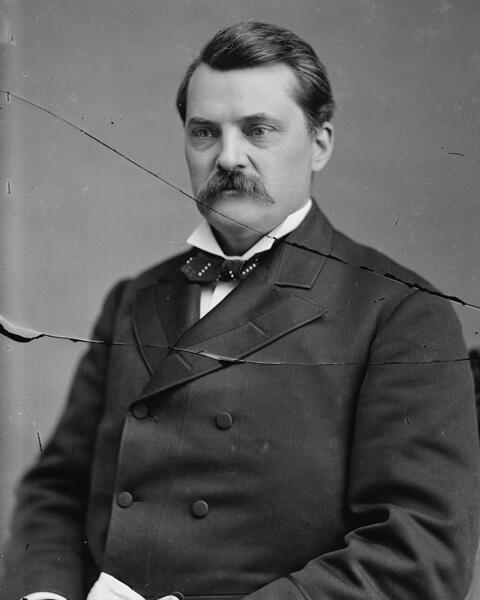
Here you will find contact information for Representative Anson George McCook, including email address, phone number, and mailing address.
| Name | Anson George McCook |
| Position | Representative |
| State | New York |
| District | 8 |
| Party | Republican |
| Status | Former Representative |
| Term Start | October 15, 1877 |
| Term End | March 3, 1883 |
| Terms Served | 3 |
| Born | October 10, 1835 |
| Gender | Male |
| Bioguide ID | M000358 |
About Representative Anson George McCook
Anson George McCook (October 10, 1835 – December 30, 1917) was an American military and political figure who served as a Union Army colonel during the Civil War and later as a three-term Republican Representative from New York in the United States Congress from 1877 to 1883. A member of the “Fighting McCooks,” one of the most prominent military families of the Civil War era, he was also an attorney, newspaper founder and editor, and a senior congressional officer who played a significant role in modernizing the administration of the United States Senate.
McCook was born in Steubenville, Jefferson County, Ohio, on October 10, 1835, to Dr. John McCook and Catherine Julia Sheldon. He was one of five brothers, all of whom served as officers in the Union Army during the Civil War, contributing to the family’s collective reputation as the “Fighting McCooks.” He received his early education in the local public schools of Steubenville. In 1854 he traveled overland to California, spending several years on the Pacific Coast, where he was primarily engaged in mining activities in California and in the region that would later become the state of Nevada. Returning to Ohio in 1859, he studied law in the family firm of Stanton & McCook and was admitted to the bar. Before he could establish a full legal practice, the outbreak of the Civil War in 1861 led him to volunteer for military service in response to President Abraham Lincoln’s call for troops. He later married Hettie Beatty, and they had one daughter, Katherine McCook.
At the beginning of the Civil War, McCook enlisted in the 2nd Ohio Infantry, a three-months regiment, and was commissioned as a captain. He saw early combat at the First Battle of Bull Run in northern Virginia. When the 2nd Ohio was reorganized as a three-years regiment, he re-enlisted and was appointed major, subsequently rising to lieutenant colonel and then colonel of the regiment. Serving with the Army of the Cumberland, he participated in a series of major engagements, including the Battles of Perryville, Stones River, Lookout Mountain, and Missionary Ridge. During the Atlanta Campaign he commanded a brigade of infantry and distinguished himself at the Battle of Peachtree Creek, where his composure under fire and effective tactical leadership were noted favorably in official reports. He was mustered out with his regiment in late 1864.
Following his initial mustering out, McCook was appointed by Ohio Governor John Brough as colonel of the newly raised 194th Ohio Infantry, a one-year regiment that served in the Shenandoah Valley under the command of Union General Philip Sheridan. In this assignment he again exercised brigade command with recognized efficiency. He was discharged from this service on October 11, 1865. In recognition of his wartime contributions, on January 13, 1866, President Andrew Johnson nominated him for appointment to the grade of brevet brigadier general of volunteers, to rank from March 13, 1865; the United States Senate confirmed this brevet promotion on March 12, 1866.
After the war, McCook returned to Steubenville and was formally admitted to the bar in 1866. Even before that admission, he had entered federal service as U.S. assessor of internal revenue taxes, a position he held from November 1865 until May 1873. In that role he was responsible for overseeing the assessment of federal taxes during the Reconstruction era. In 1873 he moved to New York City, where he established a law practice and became active in Republican politics. He founded and edited the Daily Register, a legal newspaper that later became known as the New York Law Journal, and served as president of the New York Law Publishing Company until his death. In New York he developed close friendships with leading Republican figures, including his former Civil War comrades James A. Garfield and Rutherford B. Hayes, as well as Ohio Senator John Sherman.
McCook was elected as a Republican to the United States House of Representatives from a Lower Manhattan district, serving in the Forty-fifth, Forty-sixth, and Forty-seventh Congresses from 1877 to 1883. His three consecutive terms in office placed him at the center of national legislative debates during a significant period in American history marked by the later phases of Reconstruction and the emergence of the Gilded Age. As a member of the House of Representatives, he participated in the democratic process and represented the interests of his New York constituents, contributing to the legislative work of the era. Among his committee assignments, he served on the House committee that oversaw military affairs, where his extensive Civil War experience informed his approach to military and veterans’ issues. A member of the Republican Party, he sought a fourth term in 1882 but was defeated in that election, ending his House service in March 1883.
In December 1883, shortly after leaving the House, McCook was elected by the Republican Caucus as Secretary of the United States Senate, a position he held from 1883 until 1893. His tenure coincided with Republican control of the Senate, and he used the office to introduce administrative reforms. He adopted an employee merit system, resisting strong and persistent pressures from senators for purely patronage-based appointments. He also modernized office procedures and initiated a program for preserving the Senate’s historical archives, thereby contributing to the institutional development and professionalization of the Senate’s administrative apparatus. His service as Secretary concluded when the Democrats regained control of the Senate and replaced him with former Confederate general William Ruffin Cox in 1893.
In addition to his federal service, McCook held important municipal office in New York City. Mayor William L. Strong appointed him city chamberlain, a senior financial post, in which he served from 1895 to 1898 while continuing to direct his publishing company. In his later years he remained a prominent figure in legal, political, and veterans’ circles in New York, maintaining his leadership of the New York Law Publishing Company and his connections to Republican Party affairs. Anson George McCook died in New York City on December 30, 1917. He was buried in Union Cemetery–Beatty Park in his native Steubenville, Ohio, closing a career that spanned distinguished military service, three terms in Congress, and influential administrative roles in both the Senate and the city of New York.