Representative Arlan Stangeland
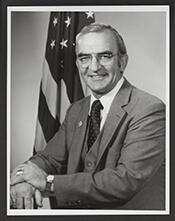
Here you will find contact information for Representative Arlan Stangeland, including email address, phone number, and mailing address.
| Name | Arlan Stangeland |
| Position | Representative |
| State | Minnesota |
| District | 7 |
| Party | Republican |
| Status | Former Representative |
| Term Start | January 4, 1977 |
| Term End | January 3, 1991 |
| Terms Served | 7 |
| Born | February 8, 1930 |
| Gender | Male |
| Bioguide ID | S000795 |
About Representative Arlan Stangeland
Arlan Ingehart Stangeland (also spelled Arlan Inghart Stangeland) was born on February 8, 1930, in Minnesota and became a prominent Republican politician representing a largely rural district in northwestern Minnesota. He attended grades 1 through 8 at Oak Mound School in Kragnes Township, Minnesota, and graduated from Moorhead High School in Moorhead, Minnesota, in 1948. While growing up, he was active in the Oak Mound 4-H Club, the Oak Mound Parent-Teacher Association, and the Oak Mound Community Club, early experiences that reflected his engagement with community and agricultural life in the region.
Following his graduation from high school, Stangeland worked as a farmer, raising Purebred Shorthorns and building a livelihood closely tied to the agricultural economy of his district. He married Virginia (Trowbridge) Stangeland, and together they had seven children, two daughters and five sons. A long-time member of Our Savior’s Lutheran Church, he was rooted in the religious and civic life of his community. His early involvement in local organizations and his work as a farmer helped shape the political identity he would later present to voters as a representative of a predominantly rural and Protestant area.
Stangeland’s formal political career began within the Republican Party of Minnesota. He served as a delegate to the Minnesota State Republican conventions from 1964 to 1968, participating in party deliberations during a period of significant political change nationally and within the state. He entered elective office at the local level as a member of the Barnesville, Minnesota, school board, serving from 1966 to 1975. His school board service provided him with experience in public administration and local governance, particularly in educational policy and budgeting.
Building on his local service, Stangeland was elected to the Minnesota House of Representatives, where he served from 1976 to 1977. His tenure in the state legislature, though brief, gave him legislative experience and visibility within the Republican Party and his region. It also established his record as a lawmaker, which later became a point of discussion during his campaigns for federal office. His background as a farmer-legislator resonated with many constituents in his largely agricultural district.
Stangeland sought election to the United States House of Representatives as a Republican from Minnesota’s 7th congressional district in a special election to fill the vacancy created by the resignation of Representative Robert Bergland, a Democrat who left the House to become U.S. Secretary of Agriculture. In the Republican primary held on February 8, 1977, Stangeland defeated Richard Franson, described as a frequent candidate who lived in Minneapolis, far from the district, winning 97 percent of the vote. In the February 22, 1977, special general election for the 95th Congress, he faced Democratic–Farmer–Labor Party nominee Michael J. Sullivan, a former aide to Senator Walter Mondale. The campaign drew attention when Roman Catholic Bishop Victor Hermann Balke of the Diocese of Crookston urged voters to support Sullivan, whom he described as “very pro-church,” and to oppose Stangeland, whose voting record in the state house he characterized as “very negative.” Stangeland campaigned on the theme that heavily rural northwestern Minnesota needed another farmer, like Bergland, in Congress. He won the election with 71,251 votes to Sullivan’s 43,467, also defeating minor candidates Jim Born of the American Party and independent candidate Jack Bibeau. His victory was widely regarded as a political upset; The New York Times reported that Republicans were elated and attributed his success to his lifelong residence in the district, his roots as a farmer in a mostly rural area, and his identification as a Lutheran in a predominantly Protestant region, while noting that Sullivan was perceived as handicapped by his Roman Catholic faith and reliance on prominent Democrats rather than grassroots organizations.
Arlan Ingehart Stangeland served as a Representative from Minnesota in the United States Congress from February 22, 1977, to January 3, 1991, completing seven terms in office. A member of the Republican Party, he contributed to the legislative process during a significant period in American history, participating in the democratic process and representing the interests of his constituents in the 7th congressional district. During his years in the House of Representatives, he was part of the broader national debates of the late 1970s and 1980s, including agricultural policy, rural economic issues, and federal budget priorities, and he became known in his district as a farmer-legislator who sought to reflect the concerns of rural Minnesota in Congress.
In January 1990, Stangeland became the subject of controversy when it was reported that he had made several hundred long-distance telephone calls between 1986 and 1987 on his Minnesota House credit card to and from the residences of a female lobbyist from Virginia. Stangeland acknowledged that he had made the calls and conceded that some of them might have been personal in nature, but he denied having a romantic relationship with the woman. The episode damaged his public standing, and his popularity declined sharply. In the 1990 House election, he was defeated by Democratic State Senator Collin Peterson, who had previously run against him twice and had come close to unseating him in 1986. After losing his campaign for reelection in 1990, Stangeland left Congress on January 3, 1991, and subsequently retired from politics.
In his later years, Stangeland remained in Minnesota, maintaining his ties to the region where he had lived, farmed, and served in public office. He died peacefully at his home on Lake Lizzie in northwestern Minnesota, outside of Detroit Lakes, on July 2, 2013. His life and career reflected a trajectory from local community involvement and farming to state and national legislative service, and his long tenure in the U.S. House of Representatives marked him as a significant Republican figure in Minnesota politics during the last quarter of the twentieth century.