Representative Arthur Glenn Andrews
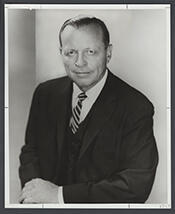
Here you will find contact information for Representative Arthur Glenn Andrews, including email address, phone number, and mailing address.
| Name | Arthur Glenn Andrews |
| Position | Representative |
| State | Alabama |
| District | 4 |
| Party | Republican |
| Status | Former Representative |
| Term Start | January 4, 1965 |
| Term End | January 3, 1967 |
| Terms Served | 1 |
| Born | January 15, 1909 |
| Gender | Male |
| Bioguide ID | A000204 |
About Representative Arthur Glenn Andrews
Arthur Glenn Andrews (January 15, 1909 – September 25, 2008) was an American politician and businessman who served as a Republican United States Representative from Alabama from 1965 to 1967. His single term in the House of Representatives coincided with a pivotal era in the civil rights movement and major federal legislative action, during which he represented Alabama’s 4th congressional district.
Andrews was born in Anniston, Calhoun County, in northern Alabama, the son of Roger Lee Andrews and the former Beryl Elizabeth Jones. He spent his early years in Alabama and attended public schools in Birmingham, where he was a student at John Herbert Phillips High School. He later enrolled at Mercersburg Academy, a boarding school in Mercersburg, Pennsylvania, from which he graduated before pursuing higher education. Andrews went on to Princeton University, where he studied politics and received an A.B. degree in 1931. His senior thesis, completed that year, was an 83-page study titled “Mr. Charles Evans Hughes. A Study of his Early Life, and Some of His Economic Opinions,” reflecting an early interest in public affairs and economic policy. In 1937 he married Ethel Standish Jackson.
Following his graduation from Princeton, Andrews embarked on a career in business and finance. From 1931 to 1933 he was associated with the National City Bank of New York, gaining experience in the banking sector during the final years of the Great Depression. In 1933 he joined International Business Machines (IBM), where he worked until 1936, a period when the company was expanding its role in business machines and data processing. Andrews then became district manager of a subsidiary of Eastman Kodak, serving in that capacity from 1936 to 1946, which spanned the World War II years and the early postwar period. Afterward, he entered the advertising field, working as an advertising executive from 1946 to 1970, apart from the interval of his congressional service.
An active member of the Republican Party in a state long dominated by Democrats, Andrews became a prominent Alabama Republican. He chaired the Alabama Fourth Congressional District Republican Executive Committee for a time, helping to build party organization and support in his home region. His political base was centered on his birthplace of Anniston, which lay within the congressional district he would later represent. As the national Republican Party gained strength in the South during the 1960s, Andrews emerged as one of the party’s leading figures in his district.
Andrews was elected to the United States House of Representatives as a Republican from Alabama’s 4th congressional district and served in the 89th Congress from January 3, 1965, to January 3, 1967. During his one term in office, he contributed to the legislative process and participated in the democratic governance of the nation, representing the interests of his constituents during a significant period in American history. His district, which was largely coterminous with what had previously been the 3rd district, was centered on Anniston and surrounding areas. In Congress, Andrews and other members of the Alabama delegation opposed the Voting Rights Act of 1965, landmark legislation that followed the Selma-to-Montgomery marches and was designed to secure federal protection of African American voting rights. Despite his opposition, the act passed and became one of the central statutes of the civil rights era.
In the 1966 election, Andrews sought a second term but was defeated for reelection by Democratic State Senator Bill Nichols. The race reversed his earlier success in 1964; Nichols received 54,515 votes (58.7 percent) to Andrews’s 38,402 (41.3 percent), ending his service in the House after a single term. Andrews later attempted a political comeback in the 1970 general election, again challenging Nichols for the same seat at a time when Governor George Wallace ran unopposed for a second term. In that contest, Andrews was overwhelmingly defeated, with Nichols winning 77,701 votes (83.7 percent) to Andrews’s 13,217 (14.2 percent). After these defeats, Andrews did not return to elective office but remained associated with public service.
In the 1970s, Andrews resumed his professional career while also taking on a federal appointment. President Richard Nixon appointed him a trustee in bankruptcy court, a position he held from 1973 to 1985. In this role, he was responsible for overseeing bankruptcy proceedings and administering the affairs of insolvent estates under the supervision of the federal courts, drawing on his long experience in business and finance. He continued to reside in Alabama and remained a figure of note in Republican circles and among former members of Congress.
Arthur Glenn Andrews died in White Plains, Calhoun County, Alabama, on September 25, 2008. He was cremated, and his ashes were interred in the columbarium of Grace Episcopal Church in Anniston, Alabama. At the time of his death, he was the last living former U.S. representative born in the 1900s decade and, since November 10, 2007, following the death of former California Representative Augustus Hawkins, had been the oldest living former member of the United States Congress. Upon Andrews’s death, former Kansas governor and congressman William H. Avery became the oldest living former member of Congress.