Representative Arthur Link
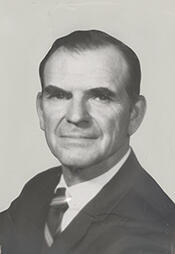
Here you will find contact information for Representative Arthur Link, including email address, phone number, and mailing address.
| Name | Arthur Link |
| Position | Representative |
| State | North Dakota |
| District | 2 |
| Party | Democratic |
| Status | Former Representative |
| Term Start | January 21, 1971 |
| Term End | January 3, 1973 |
| Terms Served | 1 |
| Born | May 24, 1914 |
| Gender | Male |
| Bioguide ID | L000333 |
About Representative Arthur Link
Arthur Albert Link (May 24, 1914 – June 1, 2010) was an American politician and farmer of the North Dakota Democratic Party, and later the North Dakota Democratic–Nonpartisan League Party (Democratic-NPL). He served as a U.S. Representative from North Dakota from 1971 to 1973 and as the 27th governor of North Dakota from 1973 to 1981. A charter member of the National Cowboy Hall of Fame, Link combined a long career in agriculture with decades of public service at the local, state, and federal levels.
Link was born on May 24, 1914, in Alexander, McKenzie County, North Dakota. He attended the McKenzie County public schools and later pursued higher education at North Dakota Agricultural College (now North Dakota State University). Rooted in the rural life of western North Dakota, he began farming soon after his marriage in 1939, establishing himself as a working farmer. During these early years he became active in agrarian politics through local chapters of the National Farmers’ Union and the Nonpartisan League, organizations that shaped his political outlook and aligned him with progressive farm and rural interests.
Link’s public career began at the local level in the 1930s, when he served on county and state Farm Security Administration committees from 1941 to 1946, working on programs designed to assist struggling farm families during and after the Great Depression. He went on to hold a series of local offices that reflected his commitment to community governance. He served on the Randolph Township Board of Supervisors from 1942 to 1971 (also recorded as 1942 to 1972), on the McKenzie County Welfare Board from 1948 to 1968 (also cited as 1948 to 1969), and on the Randolph School Board from 1945 to 1963. Through these roles he gained extensive experience in local administration, social services, and education policy, building a reputation as a steady and pragmatic local leader.
In 1946, Link was elected to the North Dakota House of Representatives as a Democrat, marking the beginning of a long tenure in state legislative politics. Over the course of his service he became one of the most prominent Democratic legislators in a predominantly Republican state. He served for 14 years as the House minority leader, guiding his party’s legislative strategy, and from 1965 to 1967 he was speaker of the North Dakota House of Representatives. During this period he also remained active in party affairs as a delegate to North Dakota state Democratic conventions from 1964 to 1968. His combined legislative and local-government experience made him a central figure in the emerging Democratic-NPL coalition that sought to strengthen the party’s rural base.
In 1970, Link was persuaded to run for the U.S. House of Representatives from North Dakota’s western congressional district to succeed Republican incumbent Thomas S. Kleppe, who left the seat to run unsuccessfully for the U.S. Senate. Although it was widely anticipated that North Dakota would lose a congressional seat after the 1970 census and be reduced to a single at-large district, Link agreed to run despite the uncertain long-term prospects. He was narrowly elected as a Democrat-NPLer to the 92nd United States Congress, serving from January 3, 1971, to January 3, 1973. As a member of the House of Representatives, Arthur Albert Link participated in the democratic process and represented the interests of his constituents during a significant period in American history. In Congress he served on the House Committee on Agriculture, including the Livestock and Grains Subcommittee and the Domestic Marketing and Consumer Relations Subcommittee, as well as on the Committee on the District of Columbia, where he worked on the Judiciary and Business, Commerce and Fiscal Affairs subcommittees. After the state’s districts were consolidated, Link chose not to challenge veteran Republican Representative Mark Andrews for the new at-large seat in 1972 and instead turned his attention to the governorship.
In 1972, Link sought and won the Democratic-NPL nomination for governor, defeating Edward P. Burns in the primary. In the general election he faced Republican Lieutenant Governor Richard F. Larsen. Running on his record as a farmer-legislator and congressman, and emphasizing responsible development of the state’s resources, Link won the election by 5,867 votes and took office as the 27th governor of North Dakota in 1973. He ran for a second term in 1976 and was unopposed in the Democratic primary. In the general election he faced Republican nominee Richard Elkin, and on November 2, 1976, touting his administration’s accomplishments, particularly in the management of coal mining and energy development, he was re-elected by a margin of 14,988 votes. In 1980, Link sought a third term as governor. Again unopposed for the Democratic nomination, he faced Republican Attorney General Allen Olson in the general election and was defeated by 21,839 votes, leaving office in 1981.
As governor, Link became known for his insistence that North Dakota’s energy resources—especially coal and oil—be developed in harmony with values he regarded as deeper than mere extraction: stewardship of the land, the agrarian ideal, and the integrity of rural communities. His tenure coincided with the energy crises of the 1970s, when pressure mounted to accelerate coal and oil development in the state. Link favored careful management of North Dakota’s natural resources and advocated conservative, measured policies for coal and oil development, often placing environmental protection and long-term community interests above rapid exploitation. Under his leadership, North Dakota’s agricultural community prospered, and the legislature enacted reforms to income and property tax laws. He supported efforts to expand both foreign and domestic trade and led a trade mission to the Middle East in the 1970s, as well as accompanying other trade and cultural missions abroad. He also vetoed a legislative reapportionment bill that he judged inconsistent with fair representation. During his administration, he supported historical preservation, helped in the establishment of the former governor’s mansion as a museum, and oversaw the construction of the state’s Heritage Center in Bismarck.
After leaving office in 1981, Link remained active in public affairs and civic life. In 1984 he led a successful statewide campaign against the establishment of a state lottery, reflecting his continuing influence in North Dakota politics and his preference for cautious fiscal and social policy. He devoted considerable energy to historical preservation and the writing and promotion of local and regional histories, and he remained a strong supporter of the North Dakota Heritage Center, which he had championed as governor. In 1985, Governor George Sinner appointed Link chairman of the North Dakota Centennial Commission, placing him at the forefront of planning and commemorating the state’s 100th anniversary. A film about the lives and legacy of Arthur and Grace Link, titled “When the Landscape is Quiet Again: The Legacy of Art Link,” was released in 2008, highlighting his contributions to the state’s political and cultural life.
Arthur Albert Link and his wife Grace made their home in Bismarck, North Dakota, in their later years. He continued to be recognized for his lifelong connection to ranching and rural life as a charter member of the National Cowboy Hall of Fame. Link died at St. Alexius Hospital in Bismarck on June 1, 2010, at the age of 96. He was buried in Alexander Cemetery in his hometown of Alexander, North Dakota, closing a life that had spanned from the homestead era through decades of service in local government, the state legislature, the U.S. Congress, and the governor’s office.