Senator Asbury Churchwell Latimer
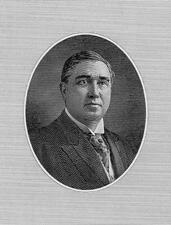
Here you will find contact information for Senator Asbury Churchwell Latimer, including email address, phone number, and mailing address.
| Name | Asbury Churchwell Latimer |
| Position | Senator |
| State | South Carolina |
| Party | Democratic |
| Status | Former Representative |
| Term Start | August 7, 1893 |
| Term End | March 3, 1909 |
| Terms Served | 6 |
| Born | July 31, 1851 |
| Gender | Male |
| Bioguide ID | L000114 |
About Senator Asbury Churchwell Latimer
Asbury Churchwell Latimer (July 31, 1851 – February 20, 1908) was a United States representative and senator from South Carolina. He was born near Lowndesville, Abbeville County, South Carolina, where he attended the common schools of the area and worked on local farms. From an early age he was engaged in agricultural pursuits, an occupation that would shape both his livelihood and his political identity in a predominantly rural state during the post–Civil War and Reconstruction eras.
In 1880 Latimer moved to Belton, in Anderson County, South Carolina, where he devoted his time more fully to farming. His experience as a farmer in Belton strengthened his ties to the agrarian interests that were central to South Carolina’s economy in the late nineteenth century. This background helped position him within the Democratic Party at a time when questions of agriculture, tariffs, and economic policy were at the forefront of regional and national politics in the South.
Latimer entered national public life as a Democrat when he was elected to the Fifty-third Congress and to the four succeeding Congresses, serving as a United States representative from South Carolina from March 4, 1893, to March 3, 1903. His decade in the House of Representatives coincided with a significant period in American history marked by the aftermath of Reconstruction, the rise of the Populist movement, and debates over currency, industrialization, and the role of the federal government. During these six terms in office, he contributed to the legislative process and participated in the democratic governance of the nation, representing the interests of his South Carolina constituents in the lower chamber of Congress.
In 1902 Latimer chose not to seek renomination to the House of Representatives, instead becoming a candidate for the United States Senate. He was elected as a senator from South Carolina and began his Senate service on March 4, 1903. As a member of the Senate, he served during a transformative era that included the early years of the Progressive movement and growing national attention to issues such as immigration, labor, and economic regulation. Latimer’s Senate tenure extended until his death in 1908, and during this period he continued to represent the Democratic Party and the agrarian and regional concerns of his state at the federal level.
While serving in the Senate, Latimer was appointed in 1907 as a member of the United States Immigration Commission, a body created to study and report on the social, economic, and legislative aspects of immigration to the United States. His appointment reflected the increasing importance of immigration policy in national debates during the early twentieth century, as Congress sought to understand and respond to changing patterns of migration and their impact on American society and labor markets. Through this work, he participated in shaping the federal government’s approach to immigration at a time of rapid demographic change.
Latimer’s service in Congress, first in the House of Representatives and then in the Senate, occurred during a significant period in American history, spanning the Gilded Age and the dawn of the Progressive Era. Over the course of his six terms in the House and his subsequent Senate service, he took part in the legislative deliberations of a nation grappling with industrial expansion, regional realignments, and evolving federal responsibilities. His career reflected the perspective of a Southern Democrat rooted in agricultural life, representing South Carolina’s interests in both chambers of Congress.
Asbury Churchwell Latimer died of peritonitis in Washington, D.C., on February 20, 1908, while still serving in the United States Senate, placing him among the members of Congress who died in office in the early twentieth century. He was interred in Belton Cemetery in Belton, South Carolina, returning in death to the community where he had lived and farmed before his entry into national politics. His life and public service were later commemorated in memorial addresses delivered in the House of Representatives and the Senate, published in 1909, and his likeness has been preserved in a portrait at the South Carolina State House as well as in other archival and photographic collections.