Senator Atlee Pomerene
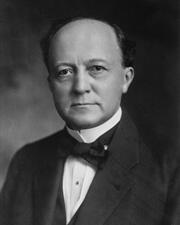
Here you will find contact information for Senator Atlee Pomerene, including email address, phone number, and mailing address.
| Name | Atlee Pomerene |
| Position | Senator |
| State | Ohio |
| Party | Democratic |
| Status | Former Representative |
| Term Start | April 4, 1911 |
| Term End | March 3, 1923 |
| Terms Served | 2 |
| Born | December 6, 1863 |
| Gender | Male |
| Bioguide ID | P000420 |
About Senator Atlee Pomerene
Atlee Pomerene (December 6, 1863 – November 12, 1937) was an American Democratic Party politician and lawyer from Ohio who served as a United States Senator from 1911 to 1923. He also briefly held the office of Lieutenant Governor of Ohio in 1911. Over the course of two terms in the Senate, he contributed to the legislative process during a significant period in American history, representing the interests of his Ohio constituents and participating in major national policy debates, including the creation of the Federal Reserve System.
Pomerene was born on December 6, 1863, in Berlin, Holmes County, Ohio, to Elizabeth and Peter P. Pomerene. Raised in rural Ohio, he pursued higher education with distinction, graduating with high honors from Princeton University in 1884. He then studied law at the University of Cincinnati College of Law, from which he graduated in 1886. That same year he was admitted to the bar in Ohio, beginning a legal career that would underpin his later prominence in state and national politics.
In 1886, Pomerene began practicing law in Canton, Ohio, initially in partnership with Charles R. Miller. He later entered into a partnership with Judge Robert S. Shields in the firm of Shields and Pomerene, and subsequently helped organize the firm Pomerene, Ambler and Pomerene with Ralph Ambler and his brother Celsus Pomerene. Alongside his private practice, he quickly became active in public legal service. From 1887 to 1901, he served as city solicitor of Canton, and from 1897 to 1900 he was prosecutor of Stark County, Ohio. In that capacity he gained public attention for prosecuting the homicide case against Anna George for the murder of George Saxton, the brother of Ida Saxton McKinley, wife of President William McKinley. His expertise in public finance and taxation led to his appointment in 1906 by Governor Andrew L. Harris as a member of the honorary tax commission of Ohio. By 1910, he had become a leading figure in his party in the state and served as chairman of the Ohio Democratic convention.
After holding a variety of city, county, and state positions as solicitor and prosecutor, Pomerene was elected the 31st Lieutenant Governor of Ohio in 1910 as a Democrat. He took office in early 1911 but served only a few months in that role. On January 19, 1911, he was elected by the Ohio General Assembly to the United States Senate, succeeding Charles W. F. Dick. His elevation to the Senate marked the beginning of a twelve-year tenure in Congress, during which he served two full terms from 1911 until 1923. His service in Congress coincided with a transformative era in American history, encompassing the Progressive Era, World War I, and the early postwar period.
As a member of the United States Senate, Pomerene played a notable role in financial and banking legislation. In 1913, he served on the Senate Banking and Currency Commission and assisted in developing the legislation that created the Federal Reserve System, a cornerstone of modern American monetary policy. A loyal Democrat, he supported much of the reform agenda of the Woodrow Wilson administration. Pomerene was re-elected to the Senate in 1916, defeating Republican candidate Myron T. Herrick. He continued to participate actively in the democratic process and legislative deliberations throughout his second term, representing Ohio’s interests in matters ranging from economic regulation to wartime policy. In 1922, he narrowly lost his bid for a third term to Republican Simeon D. Fess. He sought to return to the Senate in the following election cycle but was defeated by Frank B. Willis.
After leaving the Senate in 1923, Pomerene resumed the practice of law, joining the prominent Cleveland firm of Squire, Sanders and Dempsey. That same year, in March 1923, President Warren G. Harding named him a delegate to the Fifth Pan-American Conference held in Santiago, Chile, reflecting his continued stature in national affairs despite his electoral defeat. Although a Democrat, he was frequently called upon by presidents of both parties for important assignments. President Calvin Coolidge appointed him, alongside Owen Roberts, as a special prosecutor to investigate and prosecute the Teapot Dome scandal, one of the most significant corruption cases in early twentieth-century American politics. Pomerene also remained politically ambitious, running unsuccessfully for Ohio’s other U.S. Senate seat in 1926 and seeking the Democratic nomination for the presidency in 1928.
Pomerene’s public service continued during the Great Depression. On August 1, 1932, President Herbert Hoover appointed him to succeed Charles G. Dawes as head of the Reconstruction Finance Corporation (RFC), following Dawes’s sudden resignation on June 7. As head of the RFC, he oversaw federal efforts to stabilize banks, railroads, and other key institutions during a period of acute economic crisis. He served in that capacity until March 4, 1933, when he retired from the post coincident with the end of the Hoover administration. After leaving the RFC, Pomerene returned to Cleveland and continued practicing law.
In his personal life, Pomerene married Mary H. Bockius, daughter of L. V. Bockius of Canton, on June 29, 1892. Over the course of his career he was recognized by several academic institutions for his contributions to law and public service. He received honorary Doctor of Laws degrees from Miami University, the College of Wooster, and Mount Union College, and also received an honorary degree from Kenyon College. Atlee Pomerene died in Cleveland on November 12, 1937, following pneumonia and a stroke. He was buried in Westlawn Cemetery in Canton, Ohio, closing a career that spanned local, state, and national service during some of the most consequential decades in modern American history.