Representative Augustus Brandegee
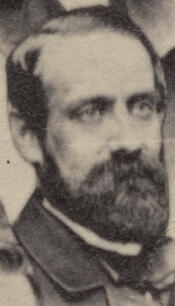
Here you will find contact information for Representative Augustus Brandegee, including email address, phone number, and mailing address.
| Name | Augustus Brandegee |
| Position | Representative |
| State | Connecticut |
| District | 3 |
| Party | Republican |
| Status | Former Representative |
| Term Start | December 7, 1863 |
| Term End | March 3, 1867 |
| Terms Served | 2 |
| Born | July 15, 1828 |
| Gender | Male |
| Bioguide ID | B000768 |
About Representative Augustus Brandegee
Augustus Brandegee (July 12, 1828 – November 10, 1904) was an American lawyer and Republican politician who served as a Representative from Connecticut in the United States Congress from 1863 to 1867. He was born in New London, Connecticut, the son of John Brandegee and Mary Ann Deshon Brandegee. His father, from a longstanding Connecticut family, had relocated to New Orleans as a cotton broker before returning to New London, where he became active in the whaling industry and other business ventures. Growing up in this commercially active seaport community, Augustus Brandegee was educated at Union Academy in New London and later at Hopkins Grammar School in New Haven, institutions that prepared him for advanced study and public life.
In 1845 Brandegee entered Yale University, where he distinguished himself as a student and joined the Delta Kappa Epsilon fraternity as well as the secret society Skull and Bones. He graduated from Yale in 1849 and proceeded to Yale Law School to begin formal legal training. In 1850 he completed his legal studies in the New London office of attorney Andrew C. Lippitt, under whose guidance he read law. Brandegee was admitted to the bar in 1851 and immediately entered into practice in partnership with Lippitt, quickly establishing himself as a capable and learned young lawyer.
Brandegee’s political career began early. In 1854 he was elected to the Connecticut House of Representatives. Though a young member, he was placed on the important judiciary committee and soon emerged as an active figure in the state’s most contentious debates. He chaired the select committee that managed the “bill for the defense of liberty,” legislation aimed at preventing enforcement of the federal Fugitive Slave Law in Connecticut, reflecting his strong antislavery convictions. He later chaired the committee that oversaw passage of Connecticut’s version of the Maine liquor law, which prohibited the sale of alcoholic beverages. From 1857 to 1859 he served as judge of New London’s city court, further enhancing his legal reputation. During these years he became a popular public speaker in favor of abolishing slavery, delivering addresses throughout Connecticut that aligned him with the emerging Republican Party and the broader antislavery movement.
Brandegee returned to the Connecticut House as a Republican in 1858 and was reelected in 1859, though he declined to serve the latter term following the death of his father. In 1860 he was chosen as one of Connecticut’s presidential electors on the Republican ticket headed in the state by former Governor Roger Sherman Baldwin. When Abraham Lincoln carried Connecticut, Brandegee and his fellow electors cast their ballots for Lincoln for president and Hannibal Hamlin for vice president. In 1861 he was again elected to the Connecticut House of Representatives and chosen as speaker during the first “war” session of the legislature after the outbreak of the Civil War. In that role he managed to maintain the confidence of both Democrats and Republicans, and at the close of the session Henry C. Deming, a fellow member of Skull and Bones and leader of the House Democrats, presented him with a silver service in recognition of his fairness and impartiality. At the start of the Civil War, Brandegee was active in supporting the Union cause, traveling across Connecticut to address public meetings, raise troops, and arouse sentiment in favor of the war effort.
In 1862 Brandegee was elected as a Republican to the United States House of Representatives from Connecticut’s 3rd congressional district, beginning his service in the Thirty‑eighth Congress in March 1863. He served two terms, from 1863 to 1867, thus sitting in the Thirty‑eighth and Thirty‑ninth Congresses during the Civil War and the early Reconstruction period. Although he was the youngest member of the House when first elected, he was appointed to the Committee on Naval Affairs and later to the Committee on Military Affairs, and he also served on the Committee on Naval Accounts. He was chairman of a special committee charged with overseeing the construction of a post office and military route from New York City to Washington, D.C., a project of strategic importance during wartime. A respected abolitionist and a friend of President Lincoln, Brandegee, along with Democratic Representative James E. English of New Haven, voted in favor of the Thirteenth Amendment to the Constitution in 1864, which abolished slavery throughout the United States. His affirmative vote stands in contrast to the erroneous depiction in Steven Spielberg’s 2012 film “Lincoln,” which portrays two fictional Connecticut Democrats voting against the amendment. Also in 1864, Brandegee was a member of the Connecticut delegation to the National Republican Convention in Baltimore, which renominated Lincoln for president and selected Andrew Johnson for vice president. He continued in Congress through the critical early Reconstruction debates and in 1866 attended the National Union Convention at Philadelphia. Choosing not to seek reelection in 1866, he allowed his congressional service to conclude with the expiration of his second term in March 1867.
After leaving Congress, Brandegee resumed his legal practice in New London and remained an influential figure in Connecticut politics and civic life. In 1871 he was nominated for the office of mayor of New London and was elected, serving a single two‑year term. His tenure as mayor added municipal executive experience to his already extensive legislative and judicial background. Within the Republican Party he continued to hold positions of trust; he served as chairman of the Connecticut delegation to the Republican National Conventions of 1880 and 1884, participating in the selection of national candidates and the shaping of party platforms. In 1892 he became a founding partner of the law firm Noyes & Brandegee, which grew into one of the leading firms in New London. Although his fellow Republicans repeatedly attempted to persuade him to run for higher office, including governor or United States senator, he declined to seek further elective posts. He did, however, accept appointment as corporation counsel of New London, serving in that capacity in 1897 and 1898 and continuing to advise on important legal matters affecting the city.
In his personal life, Brandegee married Nancy Christine Bosworth (1840–1881). The couple had four children: Augustus (1857–1881), Helen (1858–1915), Frank (1864–1924), and Marian (1866–1884). His son Frank Brandegee followed him into national politics, serving as a member of the United States House of Representatives and later as a longtime member of the United States Senate from Connecticut, thereby extending the family’s influence in state and national affairs. Augustus Brandegee’s family life was marked by both public prominence and private loss, as three of his four children predeceased him.
Augustus Brandegee died in New London on November 10, 1904, and was buried in Cedar Grove Cemetery in that city. His death prompted formal tributes from the Connecticut bar and judiciary. At a special meeting of the superior court on December 31, 1904, Judge George D. Stanton memorialized him as a leader of the New London County bar for half a century, praising his classical learning, his mastery of the law, his eloquence as an orator in conventions, legislatures, Congress, and the courts, and his steadfast devotion to high ideals. Stanton emphasized Brandegee’s early and zealous work for the abolition of slavery, his trusted friendship with President Lincoln during the Civil War, and his decision thereafter to “put aside official station for the simple life.” He was remembered as a “knightly man” who opposed hypocrisy and deceit and whose long public and professional career, culminating in his service in Congress from 1863 to 1867, reflected honor upon his state and his profession.