Representative Austin Blair
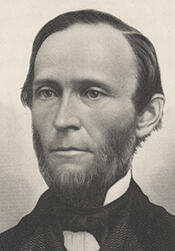
Here you will find contact information for Representative Austin Blair, including email address, phone number, and mailing address.
| Name | Austin Blair |
| Position | Representative |
| State | Michigan |
| District | 3 |
| Party | Republican |
| Status | Former Representative |
| Term Start | March 4, 1867 |
| Term End | March 3, 1873 |
| Terms Served | 3 |
| Born | February 8, 1818 |
| Gender | Male |
| Bioguide ID | B000521 |
About Representative Austin Blair
Austin Blair (February 8, 1818 – August 6, 1894) was an American politician and lawyer who served as the 13th governor of Michigan during the American Civil War and later as a Representative from Michigan in the United States Congress from 1867 to 1873. A prominent member of the Republican Party and earlier of the Whig and Free Soil parties, he was known as a strong opponent of slavery and secession and as an advocate for expanded civil and political rights, including efforts to provide women and Black citizens the right to vote and to ban capital punishment. Over the course of his career, he served in the Michigan House of Representatives and Senate, on the University of Michigan Board of Regents, and in the U.S. House of Representatives.
Blair was born in Caroline, Tompkins County, New York, in a log cabin built by his father, George Blair, who was of Scottish ancestry. The cabin was reportedly the first built in Tompkins County, and Blair lived there until the age of seventeen, working on the family farm and attending local common schools. He pursued further education at Cazenovia Seminary and Hamilton College before transferring in the middle of his junior year to Union College in Schenectady, New York, from which he graduated in 1839. After college he studied law in Owego, New York, and was admitted to the bar in Tioga County, New York, in 1841. That same year he moved west to Michigan, first settling in Jackson and later moving to Eaton Rapids as he began his legal and political career.
Blair’s public life commenced in Eaton County, where he was elected county clerk in 1842. In 1844 he returned to Jackson, which would remain his principal home for the rest of his life. A member of the Whig Party at that time, he was elected to the Michigan House of Representatives from Jackson County in 1846. Serving on the House Judiciary Committee, he emerged as the leading proponent of the successful 1846 effort to abolish capital punishment in Michigan, making the state one of the earliest jurisdictions in the world to do so. During this period he also introduced legislation to allow Black citizens the right to vote, reflecting his early and consistent opposition to racial discrimination. Disillusioned by the Whig Party’s failure to adopt a strong anti-slavery position, Blair left the party and became active in the Free Soil movement. He was a delegate to the Free Soil Party National Convention in Buffalo, New York, in 1848, which nominated former President Martin Van Buren for the presidency. In February 1849 Blair married Sarah L. Ford of Seneca County, New York; the couple had four sons—George, who became a postal clerk in the railway mail service; Charles, who became his father’s law partner; and Fred and Austin.
Blair continued to build his legal and political reputation in Jackson County. He was elected county prosecutor in 1852 and played a key role in the organization of the Republican Party in Michigan in 1854. He served as chairman of the committee that drafted the Republican platform adopted at the famous “under the oaks” convention in Jackson on July 6, 1854, a foundational event in the history of the Republican Party. From 1855 to 1856 he served in the Michigan Senate, representing the 12th district, where he further solidified his standing as an anti-slavery leader. In 1860 he was a delegate from Michigan to the Republican National Convention in Chicago, which nominated Abraham Lincoln for president. That same year Blair was elected governor of Michigan and was reelected in 1862, serving as the state’s 13th governor from 1861 to 1865.
As governor during the American Civil War, Blair took an aggressive and highly visible role in supporting the Union cause. In his first inaugural address in January 1861, he recommended that Michigan offer its entire military resources to President Lincoln for maintaining the supremacy of the U.S. Constitution. Within days of the outbreak of war in April 1861, he called for ten companies of volunteers. The Michigan legislature later retroactively approved his swift actions, authorized a war loan of $1,000,000, and enacted the Soldiers’ Relief Law, requiring counties to provide support to the families of soldiers. Under Blair’s leadership, Michigan rapidly organized and dispatched troops: the First Michigan Infantry, under Colonel O. B. Willcox, became the first western regiment to reach the seat of combat, and the Second Michigan Infantry, under Colonel Israel B. Richardson, soon followed. When the U.S. Secretary of War attempted to limit Michigan’s contribution to four regiments, Blair disregarded the restriction and proceeded to raise the Fifth, Sixth, and Seventh regiments, all deployed by mid-September 1861. Over the course of the war, Michigan, with a population of about 800,000 and an estimated 110,000 able-bodied men, sent more than 90,000 volunteers into Union service. Blair personally helped raise approximately $100,000 to organize and equip the initial muster of troops and expended much of his own fortune in support of the war, leaving office in 1864 nearly destitute. He administered much of the state’s wartime government from his hometown of Jackson, making it a central hub of Michigan’s war effort. Among the units raised under his administration was the 102nd United States Colored Troops, a Black regiment that included two sons of abolitionist Sojourner Truth and Josiah Henson, whose life partly inspired Harriet Beecher Stowe’s “Uncle Tom’s Cabin.” In 1862 Blair attended the Loyal War Governors’ Conference in Altoona, Pennsylvania, which endorsed Lincoln’s Emancipation Proclamation and the broader Union war effort. After his gubernatorial term, he unsuccessfully challenged fellow Republican Zachariah Chandler for a seat in the U.S. Senate, criticizing Chandler as a representative of wealthy Detroit interests rather than the broader state.
Two years after leaving the governor’s office, Blair was elected as a Republican to the United States House of Representatives from Michigan’s 3rd congressional district. He served three consecutive terms in the 40th, 41st, and 42nd Congresses, from March 4, 1867, to March 3, 1873. His tenure in Congress coincided with Reconstruction, a significant and contentious period in American history. As a member of the House of Representatives, he participated in the legislative process during these critical years, representing the interests of his Michigan constituents while continuing to advocate principles consistent with his long-standing opposition to slavery and secession. He contributed to debates over Reconstruction policy, civil rights, and the postwar settlement, aligning with the Republican majority that sought to secure the results of Union victory. He was not a candidate for renomination in 1872. Instead, that year he ran unsuccessfully for governor of Michigan as the candidate of the Liberal Republican Party, a short-lived faction that broke with the regular Republicans over issues including civil service reform and the federal government’s approach to Reconstruction.
After leaving Congress, Blair returned to Jackson and resumed his private law practice, in which his son Charles later became his partner. He remained active in public affairs and higher education. From 1881 to 1889 he served as a member of the Board of Regents of the University of Michigan, helping oversee the governance and development of the state’s leading public university. In 1883 he received the Republican nomination for justice of the Michigan Supreme Court, but was defeated in the general election. Despite these later electoral setbacks, he retained a reputation as one of Michigan’s foremost wartime leaders and a consistent advocate of reform causes, including the abolition of capital punishment and the expansion of voting rights to women and Black citizens.
Austin Blair died in Jackson, Michigan, on August 6, 1894, and was interred at Mount Evergreen Cemetery in that city. His memory and public service were soon commemorated by the state he had helped lead through civil war. In 1895 the Michigan legislature appropriated $10,000 (equivalent to roughly $326,771 in 2024) for a statue in his honor, to be placed on Capitol Square in Lansing—the only time an actual person has been so honored on the grounds of the Michigan State Capitol. The monument, made of bronze and Milford granite and standing just under twenty-five feet tall, was cast by the Bureau Brothers Foundry of Philadelphia, with the granite pedestal executed by C. W. Hills of Jackson. Sculptor Edward Clark Potter designed the statue, while the architectural firm Donaldson and Meier designed the pedestal. Officially dedicated on October 12, 1898, the monument is notable for bearing a quotation by Blair that explicitly identifies slavery as the cause of the Civil War, making it one of only two major American monuments to do so, the other being the Lincoln Memorial in Washington, D.C. Blair’s legacy is also reflected in Michigan’s geography: Blair Township in Grand Traverse County is named in his honor, underscoring his enduring place in the state’s political and historical memory.