Representative Austin J. Murphy
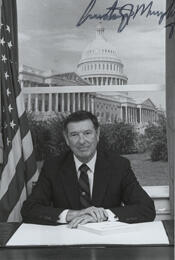
Here you will find contact information for Representative Austin J. Murphy, including email address, phone number, and mailing address.
| Name | Austin J. Murphy |
| Position | Representative |
| State | Pennsylvania |
| District | 20 |
| Party | Democratic |
| Status | Former Representative |
| Term Start | January 4, 1977 |
| Term End | January 3, 1995 |
| Terms Served | 9 |
| Born | June 17, 1927 |
| Gender | Male |
| Bioguide ID | M001088 |
About Representative Austin J. Murphy
Austin John Murphy Jr. (June 17, 1927 – April 13, 2024) was an American lawyer and Democratic politician from Pennsylvania who served in the United States House of Representatives from 1977 to 1995. Over the course of nine consecutive terms in Congress, he represented his southwestern Pennsylvania constituents during a period of significant political and economic change, following nearly two decades of service in the Pennsylvania General Assembly.
Murphy was born in North Charleroi, Pennsylvania, to Austin John Murphy Sr. and Evelyn F. Spence. During his childhood, his family lived for a time in New London, Connecticut, where he grew up before returning to Charleroi, Pennsylvania. In the final years of World War II, he entered the United States Marine Corps, serving from 1944 to 1946. After his military service, he pursued higher education under the G.I. Bill era, laying the foundation for a career in law and public service.
Murphy earned a Bachelor of Arts degree from Duquesne University in 1949. He then studied law at the University of Pittsburgh, receiving a Bachelor of Laws (LL.B.) in 1952. Admitted to the Pennsylvania bar in 1953, he established a law practice in Washington, Pennsylvania. In addition to his private practice, he served as an assistant district attorney for Washington County, gaining prosecutorial and courtroom experience that would inform his later legislative work at both the state and federal levels.
Murphy’s political career began in the Pennsylvania House of Representatives. He was first elected in 1958 and took office in 1959, representing Washington County. He served in the Pennsylvania House from 1959 to 1968 as a county-based representative and then continued in the restructured Pennsylvania House of Representatives, District 48, from 1969 to 1970. In 1970 he was elected to the Pennsylvania Senate from the 46th District, where he served from 1971 to 1977. During these years in the General Assembly, he built a reputation as a Democratic legislator from the industrial and coal-mining region of southwestern Pennsylvania, focusing on local economic and labor concerns.
In 1976, Murphy was elected to the United States House of Representatives, succeeding longtime Democratic incumbent Thomas E. Morgan. He took his seat in January 1977 and served nine terms, remaining in office until January 3, 1995. As a member of the House of Representatives, Murphy participated actively in the legislative process and represented the interests of his Pennsylvania constituents through the late 1970s, the Reagan era, and the early 1990s. He was a delegate to the Democratic National Conventions in 1984 and 1988, reflecting his standing within the party. His congressional tenure coincided with major national debates over economic restructuring, social welfare, and foreign policy, and he was part of the Democratic caucus that navigated these issues in a period of divided government.
Murphy’s congressional career was marred by ethical controversy. In December 1987, during the 100th United States Congress, he was formally reprimanded by the House of Representatives for ghost voting and misuse of House funds. The reprimand cited his diversion of government resources to his former law firm, the presence of a ghost employee on his House payroll, and instances in which another person cast votes for him on the House floor. The scandal damaged his political standing and contributed to his decision not to seek reelection in 1994, bringing his eighteen-year congressional career to a close at the end of his ninth term.
After leaving Congress, Murphy continued to reside in southwestern Pennsylvania but again faced legal difficulties. In May 1999, a Fayette County, Pennsylvania, grand jury indicted him on charges related to voter fraud, including forgery, criminal conspiracy, and tampering with public records. The case centered on absentee ballots for residents of a nursing home, with the grand jury alleging that Murphy and two associates forged ballots and added his wife, Eileen Murphy, as a write-in candidate for a local township election official position. Murphy maintained that he had merely been assisting elderly residents in completing the paperwork accompanying absentee ballots. In June 1999, following closed-door negotiations, all but one of the charges were dropped. He ultimately received a sentence of six months’ probation and fifty hours of community service and left the courthouse by a back entrance to avoid an angry crowd gathered outside.
Murphy married Eileen Ramona “Mona” McNamara on March 1, 1953. The couple had seven children and, in time, 19 grandchildren. Eileen Murphy died on March 1, 2016, while visiting one of their daughters in Spring Valley, Nevada, a census-designated place near Las Vegas. Austin John Murphy Jr. died on April 13, 2024, in Carroll Township, Washington County, Pennsylvania, at the age of 96. He was interred at Howe Cemetery in Long Branch, Pennsylvania, closing a long life marked by military service, a substantial record of state and federal legislative work, and episodes of public controversy.