Senator Bainbridge Wadleigh
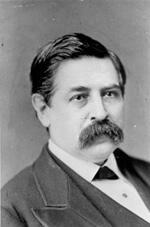
Here you will find contact information for Senator Bainbridge Wadleigh, including email address, phone number, and mailing address.
| Name | Bainbridge Wadleigh |
| Position | Senator |
| State | New Hampshire |
| Party | Republican |
| Status | Former Representative |
| Term Start | December 1, 1873 |
| Term End | March 3, 1879 |
| Terms Served | 1 |
| Born | January 4, 1831 |
| Gender | Male |
| Bioguide ID | W000009 |
About Senator Bainbridge Wadleigh
Bainbridge Wadleigh (January 4, 1831 – January 24, 1891) was a United States senator from New Hampshire and a Republican Party politician who represented his state in the U.S. Senate from 1873 to 1879. His congressional service occurred during a significant period in American history, in the years following the Civil War and during Reconstruction, when he participated in the legislative process and represented the interests of his New Hampshire constituents.
Wadleigh was born in Bradford, Merrimack County, New Hampshire, on January 4, 1831. He attended the common schools of his native state and pursued further studies at Kimball Union Academy in Meriden, New Hampshire, a prominent preparatory institution that trained many future public officials and professionals. After completing his academic preparation, he turned to the study of law, reflecting both his intellectual interests and the common pathway into public life in mid-nineteenth-century New England.
In 1850 Wadleigh was admitted to the bar and commenced the practice of law in Milford, New Hampshire, which became his long-term home and professional base. He quickly became active in local affairs, serving six terms as town moderator, a position that placed him at the center of town meetings and local governance. His growing prominence in the community led to election to the New Hampshire House of Representatives, where he served multiple nonconsecutive terms in 1855–1856, 1859–1860, and again from 1869 to 1872. Through these legislative terms he gained experience in state politics and legislative procedure, establishing himself as a reliable Republican voice in New Hampshire’s political life.
Wadleigh’s elevation to the United States Senate came through the Republican Party caucus of the New Hampshire legislature on the evening of June 13, 1872. The nomination emerged only after an extended balloting process in which he was not initially considered a leading contender and had not actively sought the office. On the first caucus ballot he received only 3 votes, while the incumbent senator, James W. Patterson, led the field. On the second, third, and fourth ballots, Wadleigh’s support grew to 8, 18, and 39 votes respectively, reflecting a gradual consolidation of Republican legislators behind his candidacy. On the fifth ballot he secured the nomination with 152 votes, while all other candidates together received 58. Among those also considered on the final ballot were Edward H. Rollins, a former congressman and future U.S. senator; Onslow Stearns, the recent governor of New Hampshire; Mason W. Tappan, a former congressman and later New Hampshire attorney general; and Gilman Marston, another former congressman. Following this caucus decision, the New Hampshire legislature elected Wadleigh to the U.S. Senate.
Wadleigh served one full term in the United States Senate, from March 4, 1873, to March 3, 1879. As a Republican senator during the Forty-third through Forty-fifth Congresses, he contributed to the legislative process at a time when the federal government was grappling with the final stages of Reconstruction, economic issues following the Panic of 1873, and questions of civil service and institutional reform. During his Senate tenure he held important committee assignments, serving as chairman of the Committee on Patents in the Forty-fourth and Forty-fifth Congresses, where he oversaw matters related to intellectual property and technological innovation, and as a member of the Committee on Privileges and Elections in the Forty-fifth Congress, which dealt with contested elections and questions concerning the qualifications and conduct of members of Congress.
As his first term drew to a close, Wadleigh sought to continue his service in the Senate. Charles H. Bell was appointed as his immediate successor for a brief period, filling the seat until the newly elected New Hampshire legislature could convene and choose a senator for the next full term. Wadleigh attempted to obtain the Republican nomination from the legislative caucus for re-election in 1879, but after several ballots the caucus selected Henry W. Blair, who was subsequently elected by the legislature to the Senate. With this outcome, Wadleigh’s federal legislative career concluded after a single term.
Following his departure from the Senate, Wadleigh resumed the practice of law, relocating his professional activities to Boston, Massachusetts. He continued to work as an attorney there until his death, maintaining the legal career that had underpinned his rise in public life. Bainbridge Wadleigh died in Boston on January 24, 1891. He was interred in West Street Cemetery in Milford, New Hampshire, reflecting his long association with that community and his enduring ties to the state he had represented in both its legislature and the United States Senate.