Representative Barbara Comstock
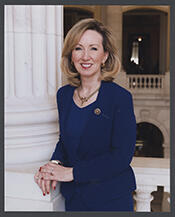
Here you will find contact information for Representative Barbara Comstock, including email address, phone number, and mailing address.
| Name | Barbara Comstock |
| Position | Representative |
| State | Virginia |
| District | 10 |
| Party | Republican |
| Status | Former Representative |
| Term Start | January 6, 2015 |
| Term End | January 3, 2019 |
| Terms Served | 2 |
| Born | June 30, 1959 |
| Gender | Female |
| Bioguide ID | C001105 |
About Representative Barbara Comstock
Barbara Jean Comstock (née Burns; born June 30, 1959) is an American politician, attorney, and former lobbyist who represented Virginia’s 10th congressional district in the U.S. House of Representatives from January 3, 2015, to January 3, 2019. A member of the Republican Party, she previously served in the Virginia House of Delegates from 2010 to 2014 and has held numerous positions in federal government, including chief counsel of the House Government Reform and Oversight Committee and director of public affairs at the U.S. Department of Justice.
Comstock was born Barbara Jean Burns in Springfield, Massachusetts, on June 30, 1959, the daughter of Sally Ann Burns, a teacher, and John Ferguson Burns, national manager of polymer sales for Shell Chemicals. Her family later moved to Texas, and she graduated from Westchester High School in Houston in 1977. Raised as a Democrat, she attended Middlebury College in Vermont, where she graduated cum laude in 1981. While at Middlebury, she was known for her vigorous opposition to abortion and often stood out in her political science classes for articulating pro-life positions. During college she spent a semester in Washington, D.C., interning for Senator Ted Kennedy. Over the course of that internship she came to identify more closely with Republican positions, later recalling that she considered herself a “Reagan Democrat” and found herself agreeing more with Senator Orrin Hatch than with Kennedy. She subsequently enrolled at Georgetown University Law Center, earning her Juris Doctor degree in 1986.
After law school, Comstock worked in private legal practice before moving into government service. From 1991 to 1995, she served as a senior aide to Congressman Frank Wolf of Virginia, beginning a long association with the 10th District and its representation in Congress. In 1995 she joined the U.S. House Committee on Government Reform (later Government Reform and Oversight), serving as chief investigative counsel and senior counsel until 1999. In that role she became one of Washington’s most prominent Republican opposition researchers during the Clinton administration, helping to lead high-profile investigations and shaping GOP oversight strategy. She also became active in national Republican politics, working on behalf of George W. Bush’s 2000 presidential campaign. Her research team compiled extensive documentary material on Vice President Al Gore—known in Republican circles as “The Gore File”—which became a key resource for GOP publicists and advertising strategists. She was credited with helping craft the Republican “playbook” for defending Bush administration nominees, including Attorney General nominee John Ashcroft.
Comstock continued her federal executive branch service when she was appointed director of public affairs at the U.S. Department of Justice, a post she held from 2002 to 2003. In Washington political and legal circles she was closely associated with conservative commentator and attorney Barbara Olson, wife of Solicitor General Theodore Olson; the two were informally known as the “Two Barbaras” until Barbara Olson’s death in the September 11, 2001 terrorist attacks. Comstock later became a founding partner and co-principal of the public relations firm Corallo Comstock, and in 2004 she joined the law firm Blank Rome. In private practice and consulting, she assisted the defense teams of I. Lewis “Scooter” Libby, former chief of staff to Vice President Dick Cheney, and former House Majority Leader Tom DeLay. In 2005 she was hired by Dan Glickman to lobby on behalf of the Motion Picture Association of America, and she subsequently worked as a consultant on Mitt Romney’s 2008 presidential campaign. She also served as a co-chair of the executive committee of the Susan B. Anthony List, a prominent anti-abortion advocacy organization. Prior to seeking elected office herself, she was registered as a lobbyist and her public relations firm consulted for the Workforce Fairness Institute, a conservative group focused on federal labor policy, from 2008 through 2012.
Comstock entered elective politics in 2009, when she ran for a seat in the Virginia House of Delegates. In the November 2009 election she defeated incumbent Democrat Margaret Vanderhye by 316 votes, winning a district in Northern Virginia that had been trending Democratic. She took office in January 2010 and was re-elected in 2011 and 2013. During her tenure in the House of Delegates, she supported a generally conservative agenda, including legislation to increase penalties for teen sex trafficking. She also sponsored measures that aligned with the policy objectives of the Workforce Fairness Institute, including bills calling for union representation elections to be conducted by secret ballot, restricting employers from providing employees’ personal information to unions, and prohibiting state-funded construction contracts from being awarded exclusively to unionized firms. When a 2014 Politico report highlighted the overlap between her legislative efforts and her firm’s consulting work for WFI, her campaign responded that she had disclosed her federal clients as required under Virginia law. On social issues, she supported a ban on abortion except in cases of rape, incest, or when the mother’s life is in danger. In 2011 she voted in favor of Virginia HB 462, which initially required women to undergo a transvaginal ultrasound before receiving an abortion; after criticism that early-term pregnancies would necessitate an internal procedure, she also voted for an amendment limiting the requirement to external ultrasounds. She supported making birth control available to women over the counter.
On January 7, 2014, following Congressman Frank Wolf’s announcement that he would retire at the end of the 113th Congress, Comstock declared her candidacy for the U.S. House of Representatives from Virginia’s 10th District. She won the Republican nomination on April 26, 2014, capturing approximately 54 percent of the vote in a six-candidate primary. Her general election campaign drew significant national attention in a competitive, fast-changing suburban district. She received endorsements from the U.S. Chamber of Commerce, the National Federation of Independent Business, the Virginia Association of Realtors, the National Association of Realtors, and the Virginia Police Benevolent Association, which had endorsed the Democratic challenger to Wolf in 2012. During the campaign, her Democratic opponent, Fairfax County Supervisor John Foust, remarked that she had never had a “real job,” a comment he later said referred to her work in partisan politics; Comstock and her supporters criticized the remark as sexist, and she called it “offensive and demeaning.” On November 4, 2014, she was elected to Congress with 56 percent of the vote, succeeding Wolf and becoming the representative for Virginia’s 10th congressional district.
Comstock served two terms in the U.S. House of Representatives, from January 3, 2015, to January 3, 2019, during a period of intense national political polarization and significant partisan realignment in suburban districts. As a member of the House of Representatives, she participated in the legislative process and represented the interests of her Northern Virginia constituents, which included parts of the Washington metropolitan area. In the 114th and 115th Congresses she served on the Committee on House Administration; the Committee on Science, Space, and Technology, where she chaired the Subcommittee on Research and Technology and also sat on the Subcommittee on Energy; and the Committee on Transportation and Infrastructure, where her assignments included the Subcommittee on Aviation, the Subcommittee on Economic Development, Public Buildings, and Emergency Management, and the Subcommittee on Highways and Transit. She was a member of the Congressional Arts Caucus and the bipartisan Climate Solutions Caucus, and she belonged to the Republican Main Street Partnership, a group of generally pragmatic, business-oriented Republicans.
In her first re-election campaign in 2016, Comstock faced Democrat LuAnn Bennett, a real estate executive and former wife of Congressman Jim Moran. The race was closely watched given Virginia’s status as a presidential swing state and the 10th District’s reputation as “the swingiest district in the swingiest state.” During the campaign, Comstock sought to maintain some distance from Republican presidential nominee Donald Trump. In October 2016, after the release of the Access Hollywood tape, she publicly called on Trump to withdraw from the race, stating that his comments were “disgusting, vile, and disqualifying” and that no woman should be subjected to such behavior. She urged that he step aside in favor of Mike Pence or another Republican nominee and said she could not in good conscience vote for Trump. Nonetheless, she retained substantial Republican support and won re-election by a margin of 53 to 47 percent. Some constituents during her tenure pressed her to hold in-person town hall meetings rather than “tele-town halls” conducted by phone, reflecting broader national debates over congressional accessibility.
By the 2018 midterm election cycle, Virginia’s 10th District had shifted decisively toward the Democratic Party; Hillary Clinton had carried the district in 2016 with 52 percent of the vote to Trump’s 42 percent, and Democrats made further gains in Northern Virginia in the 2017 statewide elections. In early 2017 the Democratic Congressional Campaign Committee named Comstock and her seat as one of its top targets. Multiple Democrats entered the race for their party’s nomination, and Republican Shak Hill announced a primary challenge, which Comstock easily defeated on June 12, 2018. She was mentioned as a potential Republican candidate for the U.S. Senate against incumbent Democrat Tim Kaine in 2018 but chose not to run. In the general election she faced Democratic State Senator Jennifer Wexton in what was widely regarded as one of the nation’s most competitive House contests. Despite her earlier public break with Trump over the Access Hollywood tape, Comstock’s voting record in Congress aligned closely with the Trump administration’s positions; as of October 2018 she had voted with Trump 97.8 percent of the time, making her the second-most partisan Trump supporter relative to her district’s presidential voting patterns, and she voted with the Republican Party 94.7 percent of the time in the 115th Congress. At the same time, she had been ranked the 82nd most bipartisan House member in the 114th Congress by the Lugar Center’s Bipartisan Index. In the November 2018 election, Wexton defeated Comstock with 56 percent of the vote to Comstock’s 44 percent. Her loss ended Republican representation of the 10th District and made her the last Republican to represent a significant portion of the Washington metropolitan area in Congress.
Throughout her political career, Comstock maintained generally conservative policy positions. According to a 2016 analysis by Vote Smart, she generally supported pro-life legislation, opposed increases in income taxes, supported federal spending and lower taxes as tools for promoting economic growth, backed construction of the Keystone XL Pipeline, and favored government funding for the development of renewable energy while opposing federal regulation of greenhouse gas emissions. She opposed most gun-control legislation, supported repealing the Affordable Care Act, favored requiring the deportation of immigrants unlawfully present in the United States, opposed same-sex marriage, and supported expanded American military intervention in Iraq and Syria beyond air support. After leaving Congress in January 2019, she joined the law and lobbying firm Baker Donelson as a senior advisor, continuing her involvement in public policy and government affairs.