Representative Barbara Jordan
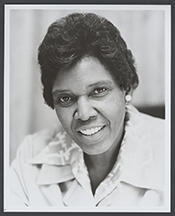
Here you will find contact information for Representative Barbara Jordan, including email address, phone number, and mailing address.
| Name | Barbara Jordan |
| Position | Representative |
| State | Texas |
| District | 18 |
| Party | Democratic |
| Status | Former Representative |
| Term Start | January 3, 1973 |
| Term End | January 3, 1979 |
| Terms Served | 3 |
| Born | February 21, 1936 |
| Gender | Female |
| Bioguide ID | J000266 |
About Representative Barbara Jordan
Barbara Charline Jordan (February 21, 1936 – January 17, 1996) was an American lawyer, educator, and politician who served as a Representative from Texas in the United States Congress from 1973 to 1979. A member of the Democratic Party, she was the first African American elected to the Texas Senate since Reconstruction, the first southern African-American woman elected to the U.S. House of Representatives, and one of the first two African Americans elected to the U.S. House from the former Confederacy since 1901, alongside Andrew Young of Georgia. Her service in Congress occurred during a significant period in American history, and she became nationally prominent for her eloquent defense of constitutional principles and civil rights.
Jordan was born in Houston, Texas, on February 21, 1936, and grew up in the city’s Fifth Ward, a historically African-American neighborhood. She was raised in a working-class family; her father was a Baptist minister and warehouse clerk, and her mother was a domestic worker and church teacher. The family emphasized education, faith, and public service, influences that shaped Jordan’s later career. As a youth she excelled in debate and oratory, winning awards in high school competitions and developing the commanding speaking style that would later define her public life.
After graduating from Phyllis Wheatley High School in Houston, Jordan attended Texas Southern University, a historically Black institution in Houston, where she majored in political science and history. At Texas Southern she joined the debate team and gained national recognition by competing successfully against teams from prominent universities, including Harvard and Yale. She graduated magna cum laude in 1956. Jordan then enrolled at Boston University School of Law, where she earned her law degree in 1959. Following her admission to the bar, she returned to Houston to begin practicing law, establishing a private practice and becoming involved in local Democratic politics and voter registration efforts during the early years of the civil rights movement.
Jordan’s formal political career began in the 1960s. After two unsuccessful campaigns for the Texas House of Representatives, she was elected to the Texas Senate in 1966, becoming the first African American to serve in that body since Reconstruction. She took office in 1967 and quickly emerged as an influential legislator, noted for her mastery of parliamentary procedure and her ability to build coalitions across party and racial lines. In 1972 she was elected president pro tempore of the Texas Senate, and on June 10, 1972, she served as Governor of Texas for a day under the state’s tradition that allows the Senate’s president pro tempore to assume the governorship when the governor and lieutenant governor are out of the state. Her tenure in the Texas Senate also included advocacy for allowing African Americans to be buried in the Texas State Cemetery, an issue that would later bear directly on her own legacy.
In 1972 Jordan was elected to the U.S. House of Representatives from a newly redrawn, majority-minority district based in Houston, taking office on January 3, 1973. She served three terms in Congress, from 1973 to 1979, and as a member of the House of Representatives she participated in the democratic process and represented the interests of her constituents during a period marked by the Watergate scandal, the end of the Vietnam War, and major debates over civil rights and social policy. Jordan served on several key committees, most notably the House Judiciary Committee, where she played a central role in the impeachment inquiry against President Richard Nixon. On July 25, 1974, she delivered a 15-minute televised opening statement during the Judiciary Committee hearings that became one of the defining speeches of the era. Throughout this speech, Jordan strongly defended the Constitution of the United States and the system of checks and balances designed to prevent abuses of power. Without explicitly calling for Nixon’s impeachment, she carefully marshaled facts suggesting his involvement in illegal activities and quoted the framers of the Constitution to argue that such conduct fell within their understanding of impeachable offenses. The address earned her national acclaim across the political spectrum for her rhetoric, moral clarity, and constitutional reasoning, and it solidified her reputation as one of the leading voices in Congress on issues of law and governance.
During her congressional service, Jordan was an active and productive legislator. She supported the Community Reinvestment Act of 1977, which required banks to lend and provide services in underserved poor and minority communities, seeking to combat redlining and expand access to credit. She was a strong proponent of civil rights and voting rights, backing the renewal of the Voting Rights Act of 1965 and supporting its expansion to cover language minorities, a change that extended protections to Hispanics in Texas and brought the state under the Act’s Section 5 preclearance requirements, including provisions for bilingual ballots in jurisdictions where more than five percent of the population spoke a language other than English. Jordan also authored legislation ending federal authorization of price fixing by manufacturers, advocated for the Equal Rights Amendment, and publicly supported extending the ERA ratification deadline in 1979. Over the course of her tenure in the House, she sponsored or cosponsored more than 300 bills and resolutions, many of which remained in effect as law, reflecting her broad engagement with economic justice, consumer protection, and equal rights.
Jordan’s national profile grew further in 1976 when she became the first African American, and the first woman, to deliver a keynote address at a Democratic National Convention, speaking at the party’s convention in New York City. Her keynote address, emphasizing unity, equality, and the promise of the American democratic experiment, was widely praised and is remembered as one of the most powerful convention speeches of the twentieth century. She continued to be a prominent figure within the Democratic Party and a respected voice on constitutional and civil rights issues, even as she chose not to seek reelection to Congress in 1978. She left the House at the conclusion of her third term in January 1979.
After retiring from elective office, Jordan turned to education and public policy. She joined the faculty of the Lyndon B. Johnson School of Public Affairs at the University of Texas at Austin, where she served as a professor and later as the Lyndon B. Johnson Centennial Chair in National Policy. In the 1990s she became chair of the U.S. Commission on Immigration Reform, a bipartisan body charged with examining and recommending changes to federal immigration policy. In that role she became known for advocating a balance between generous legal immigration and effective enforcement of immigration laws, emphasizing both national interest and fairness. Over the course of her post-congressional career she received numerous honors, including the Presidential Medal of Freedom, the nation’s highest civilian award, in recognition of her contributions to public life, civil rights, and constitutional governance.
Jordan battled multiple sclerosis for several years, and in her later life her mobility was increasingly limited, though she continued to write, lecture, and advise on public policy. She died at the Austin Diagnostic Medical Center in Austin, Texas, on January 17, 1996, at the age of 59, from complications of pneumonia and leukemia. She was interred in the Texas State Cemetery, becoming the first African American—and the first African-American woman—to receive this honor. Her grave lies near that of Stephen F. Austin, the “Father of Texas,” underscoring the symbolic significance of her place in the state’s history. In the years following her death, additional African Americans, including musical artists James Henry Cotton and Barbara Smith Conrad and Texas congresswoman Eddie Bernice Johnson, were also buried in the Texas State Cemetery, reflecting the broader recognition Jordan had helped to advance during her lifetime.